Saturday, January 26, 2008

Scene-Level Editing


My previous posting discussed the three levels or types of editing. In this
posting I'll share an example regarding scene-level editing using my current
editing project, the novel JACK & JILL: THE UNTOLD STORY.

Scenes work best when there is a TIGHT FOCUS on a SPECIFIC GOAL and a clear sense of the RESULT of the POV character's effort to achieve that goal in the here-and-now. The actual result may itself be clear or unclear to the POV character, but whatever the case, the result should be clear to the READER, including the fact that things may be unclear to the POV character. In other words, it's okay to keep the POV character guessing, but don't leave the Reader guessing -- let the Reader know clearly who the POV character is, what his/her goal is, what stands in the way, and how things turn out.

Here is a closer look. The following elements are essential to a tightly-
focused scene:

1. At the outset, the Reader wants to know where we are, what the basic situation is, who the POV character is, what time it is, what's happening around the character at this moment, etc. (i.e., "clue me in, please!"). The Reader also wants to know what the POV character is attempting to do, or what danger or risk he/she is facing. This poses a story question for the current scene, one that is IMPORTANT and provides a REASON TO READ the scene. Even if this scene is part of a subplot and not part of the main dramatic throughline, what is going on in this subplot needs to tie in eventually to the main plot, the way smaller streams feed into a larger river.

2. Once the basic idea of the scene is established, the Reader wants to follow along and even anticipate what the POV character is doing or will do in order to accomplish the goal, or escape from or face the danger (responding to danger provides its own obvious and immediate goals -- other goals need to be made clear since they won't be so obvious or immediate). In other words, the Reader wants to see COMPLICATIONS and how things move along. The Reader also wants to understand the RATIONALE for these efforts and these circumstances. The goal must pan out, must make sense once we see it in action. The complications need to make sense also, not seem contrived or too convenient for the story. Real characters face real obstacles with real stakes!

3. Eventually, the Reader wants to see how things turn out. They want to see the RESULTS of the POV character's efforts when confronted with the complications. They want to know if the POV character achieved the goal or not, why or why not, and where this leaves things: what's next? If the POV character did achieve his/her goal, then there must be some twist to that -- having "won", he/she finds that "winning" is not all it's cracked up to be. Having obtained something, the "something" poses a new set of problems. Having gotten the key to the vault, there is now the issue of a monster that stands in the way of using the key to get into the vault, or the key comes with a new group of thugs that want it back, etc., etc. The result answers the current story question and immediately poses a new story question: where next? I'll repeat that: WHERE NEXT? This adds something called suspense, AKA a REASON TO READ.


Now, to illustrate how I took a simple scene from JACK & JILL, my current WUM (work under the microscope), and edited it to make it more focused! This scene is short, basic and simple. I don't want to share anything that is more involved or important to the story since I don't want to give away anything more than that about the story.

You will recall that JACK & JILL is a fantasy novel which is supposed to reveal the true story behind the Jack & Jill nursery rhyme. In this "original version", the characters are Jacques and Giel, two seventeen-year-old boys who live in a small village somewhere in a fictional version of the Low Countries ("Benelux": Belgium, Netherlands, Luxembourg). You can read the Prologue and first three chapters on my fiction excerpts blog, ADRIAN'S FIX.

Now, to the SIQ (scene in question). In the ORIGINAL (first-draft) version, Jacques and Giel walk along a road, escaping from a great danger behind them. They're far enough from it at the moment that they can walk instead of run. They haven't slept in a while and decide to take a break in a quiet ravine where they will not be seen. Later, some local farmers find them there, fast asleep. The farmers realize Jacques and Giel are fleeing, and take them prisoner in order to hold them for the very "whatever" they were fleeing from. One of the farmers who finds them is named "Jori".

Challenge to the Reader: Before continuing, can you tell what's wrong with the original scene? Name at least two things.

In the REVISED (second-draft) version, Jacques and Giel are walking along the road when the farmer Jori happens by on a wagon pulled by a horse. Jori is alone, going about his own business. He figures out that Jacques and Giel are fleeing and sought after by the dangerous "whatever" of the story. Jori is supportive of them and their cause, and tells them how he will help them. He tells them to wait in the ravine until nightfall, when he will return to give them a ride to safety. Now, the boys have to decide whether or not to believe Jori. Jacques wants to trust him, Giel does not (of course). Jacques prevails, the boys go to the ravine, but they do not acknowledge knowing anything about whatever intrigue Jori is talking about. They say they just want to rest, and if Jori happens back later and can offer them a ride then, they will be happy to take it. Jacques decides to take the risk since he wants to trust the kind farmer, but also he realizes potential danger, so he is playing it safe by denying everything, including any knowledge of "whatever". Later, the farmers arrive and find the boys sleeping in the ravine. The farmers take them prisoner.

The revised version is better than the original version in the following ways:

1. The new immediate danger (the local farmers) is introduced earlier -- we know there are local farmers and at least one of them might pose a threat, before we are faced with a group of farmers arriving as a threat.

2. There is suspense over whether or not to trust Jori. The kindly old farmer makes a convincing case that he really is on the boys' side, and the Reader would have also have every reason to think he may actually be genuine, yet know he might also not be.

3. We suffer greater disappointment when the local farmers show up at the end of this sequence. Not only are we already familiar with the "whatever" that the boys are fleeing from (based on earlier scenes), but we have had time to reflect on the danger the farmers pose, and what it would mean if they were to get into the middle of things and ruin the escape. We feel disappointment that the kindly old farmer is really a nasty guy after all, betraying the boys and taking them captive to return them to the "whatever" from which they were escaping.

4. The new version involves a more significant CHOICE by the POV character (Jacques) -- Jacques decides to trust Jori, and stay in the ravine. Bad choice, of course. By making a choice, Jacques is taking an active role in shaping his own fate. This is stronger than having Jacques decide to stay and rest in a ravine that he just happens to find along the way. Compare: "We're so tired and we just happened upon this ravine and there is no one around -- should we rest here?" vs. "This dude named Jori seems to know our secret but I'm not sure, and he wants us to stay here at this ravine and rest and wait for him to come back to help us, but maybe he's going to betray us, I'm just not sure -- should we rest here?"

5. Something you couldn't have guessed because I didn't tell you enough details up front: The choice Jacques must make also creates FORESHADOWING. Soon after this, there will be another major choice when Jacques has to decide whether or not to trust someone else. Giel will be very much against it -- downright adamant -- but Jacques will have a lot of reasons why he must take the risk, reasons that have been worked in since the very beginning of the story. Jacques is indeed compelled to do something that will turn out to go very, very, very badly for him.


In summary, when writing a first draft we are seeking our story and might describe things as just "happening" to the POV character while feeling our way along. We should strive wherever possible to keep things goal-driven instead. When we edit, we must correct any events that "just happen" and turn them into events that involve a CHOICE by the POV character. At the outset, clue the reader in to the POV character, time, setting, etc., firmly establish the POV character's goal and give a clear rationale for the goal. Along the way, provide justification for the particular complications and reinforce the rationale for having this goal in the first place, in spite of the obstacles. At the end, make it clear how things turn out, even if the way things turn out is that the outcome is not clear -- let the reader know the POV character is unsure, but don't leave the reader unsure about whether or not the POV character is unsure. If the goal is reached, it turns out not to be as helpful as originally thought. There is a twist and a new set of complications that come from having reached the goal. If the goal is not reached, then it should have been and it's not having been reached creates additional problems. However things turn out, there must be a new question, stated or implied, a new direction, a next step. If scenes are goal-driven, you raise story questions, and provide twists and turns, the reader will find it much easier to maintain and build interest.

GOAL-DRIVEN WRITING GIVES READERS A REASON TO READ.

Best wishes for your own editing adventures,

Adrian

Saturday, January 19, 2008

Editing the Novel


I posted a hypothetical "how to edit" piece on my TIPS & TRICKS blog some time ago, before actually attempting to edit a full-length manuscript. I included a disclaimer that warned readers I had never attempted to follow my own advice. The purpose of writing the piece was not to tell people how to do something that I didn't know how to do, but to put myself through the paces of trying to anticipate how I might actually go about it, since I was about to embark on a major editing effort at that time. Since then, I've had the fine pleasure of writing additional complete drafts and also reworking full-length novels and editing them. I've learned a little bit more than I knew before, and want to share a glimpse into the EDITING PROCESS as I experience it. Here goes....

There are three types of editing: story-level, scene-level and text-level. I'll tackle them one at a time.

1. STORY-LEVEL EDITING.

This is the highest-level editing, the one with the view to the entire story. It involves reviewing your overall plan for the story and figuring out whether what you wrote accomplishes that. This is where you figure out whether the ending works, whether a given scene is necessary, whether you adequately set up something or just dropped it on the reader. This is where you look for opportunities to work in more foreshadowing, where you raise questions and leave them to be answered later, creating suspense. You decide whether a given sequence is a relevant sub-plot or whether it ventures too far afield of your main plot, failing to contribute to the development of the themes or major threads. You realize you now possess a deeper level of understanding about your characters, the situation they're in, and their motivations. You gained this understanding while writing a complete draft. You use this understanding to draw out a stronger sense of the characters' motivations and the cause-and-effect aspect of the chain of events for the Reader, who will also appreciate seeing these connections. You also determine whether any new developments that came up in the writing are worth keeping, even if it means changes to your original plan. You have to negotiate with yourself on this, and it can be tough.

I think of this type of editing as reworking the story, more akin to planning and writing the story than editing the story. In fact, I don't really think of it as editing at all, even though it is a form of editing. This is what I do after completing a draft. If what I wrote works overall and needs only a few relatively minor changes, then I use this type of editing (or rethinking) to help me change individual scenes or chapters. If the changes needed are substantial, then I just do a complete rewrite, which is much easier than trying to fix something that is seriously broken. I enjoy this type of editing to a point, since I enjoy plotting. However, sometimes this gets frustrating, usually because I realize I have to make a decision that I don't want to make (should the story go this way or that way...). Overall, this sort of stuff is fun. At least, it can be. I work actively to keep it that way.

2. SCENE-LEVEL EDITING. This type of editing involves making changes to scenes to help them accomplish their business. When I realize from the story level that I need to add a certain piece of story information to a given scene, this is the point where I do that. If I need an outcome of a scene to be different in order for things to work better for the overall plot, then this is where I do that. My focus here is not so much on the actual words in the scene (that's the next level of editing), but on making the scene itself work properly. I take whatever insights I have and work them into the reality of the scene, its particulars, its specifics. I make sure I can see clearly where the beginning of the scene is, its middle and its ending, and what the point of it is.

The main thing I do in scene-level editing is tighten the focus. I make sure the POV character has a clear goal at the outset and makes a decision or two so that he/she takes an active role in doing things. I make sure the scene ends with a clear sense of how things turned out and that the ending of the scene implies or states directly a new question or direction to go in -- scenes must lead from one to the next, and where possible should increase suspense. Not all scenes have to have a major cliffhanger for an ending, but they should all have an emotional impact and/or new question that Readers will notice.

3. TEXT-LEVEL EDITING.

I tend to do text-level editing at all times. Every time I reread I change a word here or there. Every time I go through the story, I find myself fixing little things. Many little fixes over time add up to an awful lot of fixes. The enhancements make a difference, make the story more readable, makes it flow smoothly. I do this so much that I have to make it a point to shut off the text-level editor within me so I can focus on scene or story issues when I need to, or when I just want to read to catch the flow of the story over a longer sequence.

Text-level editing is where I find a more suitable word or phrase, where I break a long sentence down into several short sentences, where I take two short sentences and join them together, where I get rid of "and" and other words I find myself overusing from time to time, where I change -ing forms into -ed forms, where I get rid of "had" to simplify past tenses, where I get rid of "he said" or "she said" as much as possible, etc., etc.

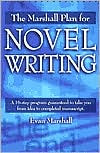
I love this type of editing and now that I've done so much of it I've gotten really good at. I see new ways to consolidate and clarify text that I never dreamed possible before, a higher-level of editing skill -- and I was always a good editor to begin with, a "natural" at it. To learn more about this, I strongly recommend Evan Marshall's book, THE MARSHALL PLAN. The book features concrete examples. Before reading it, I had already learned a lot from reading best-selling authors. I noticed how they had a common style in structural terms that kept their prose readable. THE MARSHALL PLAN helped me bring those impressions together and create a conscious awareness and clear perspective on editing for clarity as it relates to novel writing.

In the near future, I'll post two more entries on my blog about editing. They will focus on scene-level editing and text-level editing, providing examples.

Since story-level editing involves whole stories, and I don't want to give away too much about my plots, I won't post examples of story-level editing. However, basic story planning is what's behind this type of editing -- having a sense of how to outline a story. For more ideas on that, see THE GAY MAN'S GUIDE TO WRITING FANTASY FICTION.

Adrian

Friday, January 11, 2008

If You Can't Write, Edit!


I've been trying to get back into the JASPER novel to continue writing the first draft and finish it. Turns out that's not so easy. Not because I couldn't pick up any other novel right now, but that particular novel is tricky. I had a very particular mindset while writing it, drawing from a very particular sense of humor. Since I set it aside, I haven't been able to recapture that mindset yet to my satisfaction. I don't want to write on it until I know I'm back in the particular grove that this one story requires.

So, I've finally decided to push on and edit the JACK & JILL novel. I've worked my way through the first five chapters already, and was very happy to see that what I wrote, after it had sat for a while, seemed very readable, very tight overall, and actually pretty darned good, in my humble opinion. I was quite pleased with it. That's good, in that I should be happy with my work at this point, in general. If you can write and you've developed some skill at it, then what you write ought well to be readable and engaging, at least in general. It would be unusual if it weren't any good -- a sign that there are problems that need to be addressed! I think I'd address them to someone who cares, and put extra postage on them just to be sure they make it there. (haha)

Only one scene needed any rewriting, since I needed to change the tone of the interaction. Otherwise, the changes were mostly a word or two here or there, or tightening up a sentence, or joining two sentences together or breaking one sentence in two. The minor stuff that makes the text more readable, easier and faster to read.

I was impressed by the clarity of the text. The images and sense of what was happening in each scene was all very clear. There was a tight focus: each scene was about something specific, and ended with a clear sense of how it went, and where it needed to go. The chapter endings in particular were able to raise suspense, or create some impact that generated a sense of "I wonder what happens next". The shorter chapter lengths and goal-driven style really do pay off. There is a goal in each scene, a motivation, an obstacle (or two), and an outcome. Questions are raised, some answered right away, others left dangling there, raising the intrigue and suspense.

Okay, I love to gloat when I feel something I wrote worked well. It's a bad habit, potentially impolite, and certainly something that can define one as a "bore". But, there is a point here -- to become a writer, we must change our self-concept from "wannabe" to "I am a capable writer". Seeing that something you wrote works is part of that process, as much as seeing what doesn't work. I think we need to allow ourselves to see the growth, the progress, and feel good about it. It's not bragging, it's reaffirming for ourselves that what we are trying to do ... is something that we can do, and something we are in fact doing.

As for the editing, I anticipate the first half of the story will go along fairly smoothly, then the second half will turn into a real nightmare, since the later part of the story was less certain for me as I wrote it. I'll probably have to completely rewrite several chapters, maybe even the entire second half. However, that's only 35k words or so, and manageable. I was quite pleased to see that the basic outline held tight, and it's very easy for me to plug new ideas in for minor tweaking as needed, to enhance, draw out the significance of plot details, etc. I also figured out how to rewrite the ending. At this point I have no real questions left regarding this story, which is excellent. I should know it by now. I hate not knowing. Knowing is good.

Back to the bliss of editing,

Adrian

Sunday, January 06, 2008

2008: A Year of Writing Furiously


The glitter begins to settle, the throbbing in my ears dies down to a faint, rhythmic hum ... the frantic commotion of the past few weeks gives way to gentle calm. Reassuring signs that a return to normalcy might indeed be possible.

I have decided to call 2008 my Year of Writing Furiously, a year in which I'll strive to write as many stories as I can. There is a value in writing my way through complete stories. Each time I learn more about the various parts of the three-act plot template, I understand better how things are set up and then realized later, how things tie together, how one part of the story supports another. Each time through I get better at conceptualizing stories, keeping myself on track, moving with more confidence and a more finely-tuned story sense. Even if I end up with a number of first drafts and a backlog of editing to do, still I will have advanced my skills at storytelling, the foundation aspects, which I need to hone and strengthen. I also want to complete at least two stories, three if I can, so that I'll have something to start sending out this year.

I've begun to hear my many Muses again, calling out to me, their sweet melodies drifting across the primordial sea, the Urstoff out of which our universe and our reality were fashioned. Powerful voices, muted still by the techno beats I can't quite free myself from. When I achieve silence in my own mind, I'll be able to hear those voices clearly again.

For now, I seek oblivion. Being and not being. Thinking and not thinking. Feeling and not feeling. In that twilight, I can look up and see not the world as it is, but as it could be, as it once was, as I am sure it is elsewhere. I can see across the planes of existence and know there is more, and find a way to bring it into being within our own world. A way to draw the energy of pure creativity into physical form, a series of symbols on the page that spell out stories which I know must somewhere be true.

Best wishes to all aspiring writers in 2008,

Adrian

P.S. Hope you enjoy the new look for this blog. I have also done away with the ellipsis after the title ("Chronicling the Novel..." is now "Chronicling the Novel").

Monday, December 24, 2007

Happy Holidays!


Wishing all aspiring (and published!) writers a safe and happy holiday season!

Adrian

Wednesday, December 19, 2007

"Nuthin'", huh?


Go figure! Just when I ended my last post with the very optimistic comment that nothing would stop me now, what else happens but something that could stop me! Ugh. I should have known better than to jinx my writing progress!

I won't go into details because I'm such a private person, but something rather significant came up that most definitely did take all my time, energy and focus away from writing. I didn't write at all last week, and am now struggling to get back into it. C'est la vie! The distraction was certainly something important enough to cause such an upset to my routine. I'm not upset with myself for not writing -- it was entirely appropriate to set it aside under the circumstances -- but now it's time to get back to work. I can still finish JASPER within December if I get a move on.

Current status on JASPER, after cutting and editing again, and adding a little: around 28k, in Chapter 10. Goal: 60k to 65k.

Where's that RESET button?

Adrian

Wednesday, December 05, 2007

JACK & JILL: DONE @ 70k


I did finish the JACK & JILL story last night, coming in at just over 70k. I'm not sure on the ending. It was a surprise to me. There was another ending I had envisioned, and which I might want to write after all when I do the editing. This ending is intriguing, but I'm not sure about it. Can't say more, unfortunately.

Now, I'll go back to JASPER and start on that tonight, to finish it. Before I dive back into the writing, I want to rethink the story in basic outline terms, just to make sure I feel solid about going into the second half of ACT II, which is always the most difficult part to write. I know I had intended JASPER to be one I write off-the-cuff, in order to reconnect with unfettered creativity, but to put it bluntly I've found I do have access to my creativity even when working from an outline, and I feel a lot better having a sense of what I'm doing. It saves a lot of time and produces better results. I'll do what I did recently with basic outlining of the JACK & JILL story -- I actually used my own walk-thru from the GAY MAN'S GUIDE TO WRITING FANTASY FICTION and wrote my notes in a simple text editor. A couple of hours to work through it, think it through again, edit, change, improve, was well worth the time. I'll also take time to reread, since it's been a few weeks now when I took off from JASPER to do JACK & JILL for Nano.

I hope to finish JASPER in about two weeks, three at the most, definitely within December. Then I'll edit both JASPER and JACK & JILL. I'll make complete copies available to Beta Readers once I have edited them, for feedback to use in final editing and polishing. The Beta Reader versions would be available in January, 2008, both as encrypted eBooks and on my new password-protected blog.

Oh, and it's December. That's okay. I'm on a roll. Ain't nuthin' stoppin' me now!

Muahahaha.

Adrian

Tuesday, December 04, 2007

Making Progress on JACK & JILL


I took a couple of days off as Nano concluded but now I'm back at work. Each of the past two days I wrote about 6k words on the story, which is now surpassing 60k, the original word count goal. I'm in Act III, have gotten past the Darkest Hour and am about to write the part where the MC makes the decision to act and prepares himself for the next big confrontation, the final one of the story. I'm estimating another 10k to 15k words to finish this out. It should fly by as I get into it.

Sure enough, the story has picked up again. I felt like I lost the way for a while, in the second half of Act II. That's normal, the part where a writer thinks "this is utter *@%@! and nobody would ever want to read it!". Thank goodness I revisited my notes, sorted out the few things that were weakening the story, and got it back on track. I have learned more again doing this story -- every new story teaches me something new and helps me get better at applying the strategies I am using to write and manage the work. I see constant progress, probably because I constantly work at it.

One nice thing I saw happening as I solved these recent plot issues was that I was able to turn things around from stuff that "happens" to decisions the MC makes. Sometimes, juggling so much new material during a first draft, the MC ends up going along for the ride. I guess it's hard to depict the MC as decisive if I'm not sure of the decision to be made or what's going to happen next -- I have the general idea, but I didn't plot out the details for this novel. I'm using "intuition", which is fine, but it just means I have to go back and fix some things to draw a more direct line between them, and recast things as decisions. Just a little focusing work in the editing, nothing too much.

I like the story again, and that's the main thing. For a while I was wondering, but I've gotten past that stage, fairly quickly and fairly painlessly. It IS a cool story. I'm finding between the JASPER story and this one that it is much easier to work with the material if I just KEEP IT SIMPLE. I tend to make everything so complicated, with so much symbolism and other levels of interpretation, etc. It's just the way my mind works. I see that complexity, and I tend to want to put it into the story. If I just keep it simple, concrete, and work with that focus, then all these other things will work their way in anyway -- I can't not write that stuff -- but it will be anchored to something that is more tangible and satisfying to the Reader. Stories are much easier to write if you keep an emphasis on a simple, uncluttered, concrete plotline. Then, work with that, to your heart's content.

Back to work. In another day or two, I hope to report that JACK & JILL, Draft 1, is finished.

Making December count,

Adrian

Saturday, December 01, 2007

PARALLEL WRITING PROJECT UPDATE


I recently closed the PWP site for retooling. I reopened it today, Dec. 1st, to invite people curious about it to learn more and consider taking part. I hope to get a group of about 6-8 serious writers together to help each other with feedback and also to take advantage of the Parallel Writing idea.

If anyone wishes to link to the site, please link to my main web site address:

http://www.geocities.com/americanauthor

You're welcome to "steal" the banner and resize it to your needs.

Feel free to contact me by email or through this blog if you have any questions or wish to take part.

Visit the PWP site to learn more about significant changes to the project and also to view the first novel template.

Grazie,

Adrian

Nano Winner, But For Last Time?


It will come as no surprise, of course, to those who follow my blog. I hit 50k fairly easily this time. When I first did Nano two years ago, I also hit 50k, but it seemed like a much bigger adventure then. I had never done that before and wasn't sure I could. Since then I've written many thousands of words in any given month, and I knew going into this Nano that I certainly could do it, so it was only a matter of putting in the time and effort to do it. It was much less gratifying than it was the first time, since the mystery of "can I?" was no longer there. But it does feel good to have accomplished a lot during this month.

I do have to wonder though whether there is really any point to my doing Nano again after this. I think I need to focus on my own writing goals throughout the year and do what I need to do, regardless of the Nano schedule. I was in the middle of the JASPER novel and set it aside to take up something new just for Nano. It was kind of silly to do that just because it's November. If I had trouble getting words down or something, then I could see where I would benefit from that extra push, but I've been working steadily at my writing and have greatly increased my output over time, so other than the opportunity to network with other writers (significant in itself), there is no reason I would need to do Nano for anything other than kicks. I think it's great for those who need the push, but we don't all need that.

Also, I have mixed feelings about the whole Nano thing. I think it's a great idea, don't get me wrong, and I strongly support the general concept. However, there are thousands of inexperienced novice writers doing Nano each year who have no idea what they're getting themselves into. It's a marathon for the sake of a marathon, with a lot of hopes and dreams tied up in it. Most of them fail to reach their goals. I read that this was a very hard year with more than the usual number falling by the wayside. I don't know the numbers, but previously 5 out of 6 people failed to reach 50k within the month. Setting up 5 out of 6 people to fail is questionable in my view.

Also, I don't know that I much enjoy seeing so many forum questions by writers who not only don't have a clue, but who never will, simply because they only "think" they want to write a novel, but once they discover how much hard work it is, they'll just give up. I wholeheartedly encourage anyone who wants to write to do so, but isn't there something to be said for participants' having some realistic notion of what they're doing? If they're truly committed, they'll keep at it. They'll learn and grow, as I have been working so hard to do over time. I guess it just bothers me to see postings in the forums like "help save my plot" and "put a zebra in your story because I said so". We can all use plot help from time to time -- I'm referring to those particular pleas from clueless individuals who will never get a clue no matter how much you try to help them. They'll just give up and walk away because they didn't really make the commitment in the first place. They're not writers, they're thrill-seekers and the marathon is too much to resist.

Perhaps Nano is beneficial in that it can draw in more potential writers, encourage them, and out of the mayhem those who are committed will find the support and encouragement they need. It's just awkward to post alongside people that I know are there on a whim and who will ultimately give up and not bother to really bring themselves to a point of understanding what it was all about in the first place (meaning those details that writers know about but readers aren't generally aware of).

There is one positive aspect of Nano that I am very impressed with, and that is the way it is getting more people interested in writing and therefore books. With sales of novels for adults falling off, it's good that so many young people get caught up in Nano-fever. Many teachers get their classes involved, which I imagine must make a typical school writing class much more interesting. That's a wonderful thing and I strongly support it. Nano-mania is spreading around the world. At a time when DVD's and MP3's and other forms of electronic entertainment are distracting us from reading books, such an interest in writing and reading should be strongly encouraged.

There is one other issue I have with the Nano forums, which is that they have not yet created a separate forum for GLBT lit. They have one for "Chick-Lit" and other genres, but the Nano elite do not regard GLBT literature as a genre in itself, or GLBT writers as deserving a place to congregate. For the past three years I've read the arguments that are invariably posted on this, wherein GLBT folks request a form for themselves and are denied it. I even posted on this myself previously. It makes no difference. I can't help but feel that people just don't "get it".

GLBT individuals deal with very unique circumstances. They have a unique culture, which is rich and varied. They deal with issues that are similar to what other groups deal with, yet the issues GLBT individuals face are unique. Scholars recognize "African-American Literature" and "Women's Literature". It's time people allowed themselves to understand that there IS such as thing as "GLBT Literature". I know in scholarly circles there is some disagreement still, so it should not surprise me that the Nano elite also don't quite "get it". To keep it very, very simple, let me just say that to deal with prejudice is something blacks, women and gays have in common. However, the particular types of prejudice, the ways in which they manifest themselves, and the types of discrimination that these groups deal with is unique. Also, who these people are is unique. Their mindset, culture, life experiences are unique when seen in light of their membership in an oppressed minority. I could go on at length, but I'll stop there.

So, I will have to think it over before signing up for Nano in the future. I think it's a great idea, but I'm not sure it's right for me.

Best wishes to all Nano winners, Nano-almost-winners, Nano-"I gave up after 3k"-ers, and all the rest of you who did or did not, who would or would not, take part in the craziness that is Nano. If any noobies got a taste of something wonderful and decide they are in it for the long-haul, then that at least was worthwhile.

Adrian

Thursday, November 29, 2007

45k on Nano 2007....


Yes, it's the final countdown, the final few days. I'm almost there and will likely finish it tonight, or else tomorrow, at least a little ahead of the November 30th midnight deadline.

The story, JACK & JILL: THE UNTOLD STORY, is turning out to be an amazing ride. It's only a first draft, and at times it feels to me like it's all over the place, but when I let it sit a while then read back over it, I find generally that it does make sense, is coherent, and very absorbing. It's certainly interesting.

I have no idea when this story is finished whether it'll be something to edit and polish to send out or not. I was thinking yes, but now with some of the things going on in the story, I really have to wonder. Still, I'm not writing it for commercial reasons but for the practice of it. If it has no commercial value, I may still eventually post it online for free because it is a very intriguing story and I think others would enjoy it, too. Even so, I won't give up on the possibility that this might be one to send out once polished. We'll see!

Wishing others success with their Nanovels,

Adrian

Tuesday, November 27, 2007

Parallel Writing Project Being Retooled


I'm working now on the Parallel Writing Project website. I've decided on a few changes to the concept in order to make it more flexible and more appealing.

I'll post again soon with more info.

Best wishes to everyone on their writing,

Adrian

Sunday, November 25, 2007

GAY MAN'S GUIDE TO WRITING FANTASY FICTION


Over the past few days I worked very hard at coming up with a new feature for my website. It's called the GAY MAN'S GUIDE TO WRITING FANTASY FICTION. It's an illustrated guide to the basics of plotting in three acts with a focus on fantasy novels. There is a great Resources page with lots of useful links for fantasy writers. There is also a free download of the "Plot to Draft" section, which helps visitors to the site to develop an idea of their own, resulting in a working outline.

Take a few minutes and check it out. It's fun and worthwhile. Feel free to link to the new part of my site!

Adrian

Thursday, November 22, 2007

HAPPY THANKSGIVING


Just wanted to wish everyone a HAPPY THANKSGIVING. This is one holiday I truly believe in for reasons other than having a holiday: we should all take time every now and again to think about what we have to be thankful for.

Since this is my writing blog, I'll keep my thanks focused on writing. I am thankful that I have been able to sustain a significant effort on my writing over the past couple of years. I am happy that I have made real and tangible progress. I am happy that I finally learned to bridge the middle, complete a manuscript, play the external and internal conflicts off each other (something I'm still working on, but I did learn to do it in a meaningful way). I am happy that I have no shortage of ideas, that I choose to see the world as full of them, billions and billions of them all around us at every moment. I am happy that I do not suffer from Writer's Block like some others do. I am happy that I can type 100+ wpm and churn out large quantities of prose when I'm in writing mode (it saves time). I am happy for what each of the stories I've worked on these past two years has taught me.

I am happy about these things, and grateful.

Now, when I get my first publishing contract, I'll be really grateful!

Best wishes to other writers and aspiring writers for their continued progress and success,

Adrian

Thursday, November 15, 2007

BETA READERS


As you have hopefully noticed, I am sharing the Prologue and first few chapters of my 2007 nanovel on my new blog, ADRIAN'S FIX.

I have finally also joined the Nano forums and have rejoined the LGBT forum that Athildur maintains, something I helped start two years ago. Athildur has done a great job of keeping it going. It would be great if more LGBT writers would get involved, and keep it going throughout the year.

Anyway, back to the topic....

I was thinking to share the entire nanovel online as it is written, essentially foregoing any chance of paid publication. I was thinking to do this in order to share some work, get some feedback, and then edit it and release it as a free ebook, essentially as a promotional tool. I still like that idea, but every time I try to think of a story I'd be willing to give away ... well, let's just say I feel the story has potential and I hate to just throw it away in commercial terms.

I don't know whether this nanovel will have a chance at getting published or not, but I think it is worth keeping under wraps and finding out. I am happy to share the Prologue and first few chapters, though, and feel that this should hopefully not hinder possible future publication.

So, what to do now that I've maxed out that portion I can reasonably share?

Aha! I have a Plan B, and it's not from outer space.

I will try to set up a members only blog, where I can then post the remainder of the novel so it is readily available, but I can then limit the access to it so that only those individuals who would be willing to read it and share some helpful comments would be able to access it. This does not qualify as self-publishing or otherwise making it publicly available online -- writers can share their work with a select group of readers for feedback and still seek publication.

As I mentioned in my last posting, I also plan to make the text available in ebook format using Mobipocket. Beta Readers could read it online in the members-only blog, or could download from there the ebook version and then read it at their convenience in that format.

So, if you would be interested in reading my novel and offering helpful comments, please let me know! You can post a comment to this posting, or you can email me at:

americanauthor [AT]
yahoo [DOT] com

I would be most grateful for the opportunity to receive some feedback, which would mean a chance to work outside the vacuum I've been working in for the past two years. Yes, your feedback would be most appreciated!

Best wishes on your novels,

Adrian

Tuesday, November 13, 2007

E-Book Version Coming Soon


I've discovered the wonderful world of ebooks (duh ... 'bout time!). I am using Mobipocket(tm), which is available as a free download and is very versatile. You can use it to read books on your PC or PDA or smart phone or whatever. It will even turn the pages for you, a cool feature I discovered with Adobe Acrobat Reader(tm) for those days when clicking a mouse is just too much. (haha ... how lazy will technology make us in the future?).

Anyway, I've been posting chapters of my current WIP, my nanovel, titled JACK & JILL: THE UNTOLD STORY, on my new blog, Adrian's Fix. Soon I'll put a link at the top of that blog so you can download the current version of the novel, through whatever chapter has been posted most recently. That way, you can just click, download, and read it in a better format at your convenience.

I've discovered writing my manuscripts in Word(tm) works well, and then loading them into Mobipocket(tm) to read them back helps since it seems like a new view of the document. It's almost like printing something out, has the same effect for me. I get a new perspective, think of it as if it were finished, which then helps me spot more things to change than I can see in Word(tm) after editing the text there repeatedly ("familiarity breeds contempt"?).

Hope everyone's work is coming along. This is the good time of year for me to write, so I'm taking full advantage of it. Although I'm busy now, I'm sure the pace will pick up even more. I'm still just warming up, getting on a roll . . . .

Best wishes for your novels,

Adrian

Saturday, November 10, 2007

First Fix is Up


Check it out! It's over on my new blog, ADRIAN'S FIX.

Adrian

Friday, November 09, 2007

Writing Mania Strikes


I was hoping to avoid it altogether, but somehow the Nano bug got me. I've decided to start a new blog and post my nanovel on it as it is written. It'll be a rough first-draft and I won't go back to fix things. It'll be fun, I'm sure, and a little frustrating at times, but overall it's a challenge that I find quite intriguing.

You can follow my progress on my new blog, ADRIAN'S FIX.

The "Fix" part stands for fiction. It's actually the plural, as in "fic's". I can score one-half point for creativity right off the bat. Two points if I can hit that half-point with the bat.

Well, I'm off to write my new nanovel, while also continuing work on JASPER. Which, by the way, is a story I truly enjoy writing.

Oh -- and what's the new nanovel about? I have no freakin' idea. Hahahaha!

Wish me luck!

And good luck to others attempting a nanovel!

Adrian

Thursday, November 08, 2007

Traction (The Good Kind)


I had a very productive session last night and was able to work my way through most of what had been troubling me about Chapters 8 and 9. I'm still finishing Chapter 9, but the key transition points that I had been missing are now in place. I'll be able to borrow a key scene from my "Outtakes" file and reuse it, then I'll only need to add the conclusion to Chapter 9 and I'm finished.

Chapter 8 runs long and will need to be pared down later, but it's not long in a bad or loose way, but in a good way. It all reads well and fits together, I simply have too much of it and so I'll have to edit simply for length. I'll save that for another time, so that I can continue making forward progress at this time. I want to build momentum!

It feels good to finally have the right pieces for these two chapters. I had played with various versions, ways of handling the plot issues, but none of them "rang true". What I have now does. The key to solving the riddle was to go back to how I set this sequence of chapters into motion: a key event back in Chapter 6 that leads directly to the events of Chapters 7, 8 and 9. It is only by focusing on that event, and what it means, that I was able to see a more direct through-line for the MC. There is now "harmony" between the various issues and events, something that was lacking before.

I love it when I stick with it and get the results I've been seeking! It's nice to have Chapter 9 focus on a more serious dramatic moment, bringing this sequence to an end, where this same moment is directly in line with and the result of other events that began back in Chapter 6 at the start of this sequence. Previously I was off course, starting with one event and ending with an event that looked right on the surface, but which was not really in keeping with the real issues here. Like a new vase on your table that seems to belong there, but something tells you it just doesn't quite fit in the room. You finally realize it clashes with other items in some way that was not obvious at first.

Tonight I'll finish Chapter 9. I'll look before I leap, then start moving forward with the next sequence of chapters. I know the main intent, but there is still much to discover along the way. The adventure continues!

Happy Writing,

Adrian

Tuesday, November 06, 2007

Update


I'm finally getting my high-speed internet connection up and running. Feels good after having stayed with dial-up far longer than any person reasonably ought to. Of course, by the time I've done this, the internet has advanced so far I'm sort of confused about everything all over again, but that's the way it goes. There are so many new things people can do with this technology now, and web sites are so much more "enriched" these days. That's okay...I'm patient, and I'll keep at it, and eventually I'll learn what I need to know to keep up, more or less.

There were a number of non-writing things that came up in the past week. I did put in a lot of time last week, but the past few days have been less productive. I'm getting back into the swing of things again now.

I'm still going back and forth with Chapters 8 and 9. I've rewritten them a few times by now and am still working on them. I had to find the real heart of the matter, the essential things that are true to the characters. These chapters mark an important transition. They bring the story to the mid-point. I need to clearly establish the MC's mindset and emotions, goals, etc. I've had to do a bit of searching to draw these out in a truly authentic manner, and then also find the right way to dramatize them.

I finally got it "right" but the way one of the chapters was written focused too much on individual introspection. I am now rewriting that chapter yet again to have the character arrive at these understandings through interaction with other characters, in a way that would make sense for him to interact with them. I'm throwing in some conflict as well, in order to heighten the tension, so that he doesn't simply figure out what he needs to do, but has to wrestle with it (quite literally). I don't mind longer passages of introspection when I'm reading someone else's novel, and find they often add a lot of insight, but I want to avoid that sort of thing for this novel, which needs to move forward with an absolute minimum of exposition or other asides.

With any luck I'll finally finish this delicate part of the story and then will be able to resume breaking new ground on new chapters by the end of the week. I look forward to getting some momentum going with that, to make some more rapid progress.

Best wishes to others as they work on their novels,

Adrian