Saturday, May 30, 2009
Interlude: Cool Meme Worth Checking Out
Before posting my Marshall Plan software review, I wanted to take a time-out to recommend a meme that Gabriele shared on her blog recently (link below). I'm not usually one for memes, but this one is actually a writing-related activity that is well worth the time. I haven't done it yet, but I will soon. It would clearly provide you with a stimulating, refreshing look at the characters in one of your novels.
Basically, you pick ten characters from one of your novels and assign them numbers at random (1-10). You then answer a bunch of questions which draw on your characters, but referring to them by number, so the way the characters fit into the questions is random (eg, "3 has to marry either 8, 4, or 9. Whom do they choose?"). It gets you thinking!
Gabriele's blog post is entitled "Another Meme, Because I'm Lazy" and it's dated "29.5.09". Check it out here. It's well worth your time.
Best wishes to all the characters out there (you know who you are),
Adrian
Friday, May 22, 2009
The Marshall Plan 5: Software Review
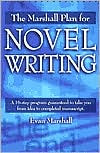
I was thrilled when Evan Marshall sent me a free copy of his new software to review. I have always been a fan of his book, THE MARSHALL PLAN FOR NOVEL WRITING, and the thought of a software program designed to accompany this plan, and help you lay out your novel, was exciting.
When I first ran the program, it took me only a few minutes to figure out how the software worked, and within ten minutes I was already using it to plan a novel. The software has some worthwhile strengths, but also some limitations.
First, the strengths.
The software is stable (no crashes, no apparent bugs) and easy to use. It is fairly intuitive, as any well-designed software should be. The various components of the program are clearly labeled, and you can proceed in a logical and orderly fashion from tab to tab across the top of the screen, reading summaries of key ideas from the Marshall Plan, and filling in fields to contain data about your novel, such as word count, names of key characters and descriptions of the characters.
Once you set up the basic data, the software uses it to calculate how many sections you need based on the projected word count you established, and it also assigns certain key sections to POV characters and their plot lines according to the format established in the Marshall Plan. You are now ready to start planning your novel's sections in detail.
To do this, you go to the main interface. This, too, is logical, easy to figure out and easy to use. On the left, you have a sequential list of the sections for your novel. Clicking on any of these sections calls up the data for that section in the main area (center) of the screen. This data includes who the POV character is, whether this is an action or reaction section (some of these are pre-determined, others you set yourself), the time and location, the POV character's goal, the complications, etc. On the right of the screen is another area with additional information, including a description of what the current section should accomplish according to the Marshall Plan, and a place for you to record additional notes about the section.
You can work on your sections by moving forward, backward, or in any order, clicking on a section from the list on the left and editing the description of that section as it appears in the center of the screen. In practice, this really is simple, easy and quick, as it should be. Indeed, the software provides a convenient way to keep track of your sections and notes, even allowing you to print them out in a document which you can easily convert to Word (tm) format for further editing. The printout brings together the key information you have entered about each section, providing a written reference that can guide you as you write your manuscript, and that you can use as the basis for a synopsis.
For a look at actual screen shots and more detail about the particulars of the software, click here.
Now, to the limitations....
First, I like to assign a title to my sections. The title is usually about three words long, a brief way for me to identify what takes place in each scene without having to look over the particulars. When I read "Harry meets Joe" I know right away this is the first scene where these two characters meet, and that it's from Harry's POV since I put his name first in the title. I remember from that title all the ideas I have associated with that scene. I only have to look at the details if I want a reminder, if I may have forgotten something, or if I'm checking for some fine point to see how it compares to some other plot detail elsewhere. If I'm scanning a list of all the sections in the novel in order to find a particular section, having a title is a very quick way to do that. The Marshall Plan software does not include any way for me to assign my own label or title to the sections, and that makes it tedious to find a given section. I have to click on section after section in the list on the left and then browse the information I've entered in the main form in the center of the screen in order to find a particular scene. The generic, numbered list in the left panel does display the POV character and plot line for each section, but these all the look the same when there are many of them. A way to change those generic labels to my own section titles would make the left panel far easier for me to navigate.
Second, if you wish to stray from the format outlined in the Marshall Plan, the software will not accommodate you. You have to assign key sections to key POV characters according to the plan. The first five sections are always in the POV of the protagonist according to the plan. If you want to start with a brief scene showing some minor character doing something or encountering something that will set up some aspect of the story, you can't. You can't alter the POV character for the sections that are pre-determined for you according to the Marshall Plan. Further, you can only assign sections to POV characters that are established for you through the Marshall Plan. Based on your word count, you might have two, three, four, possibly five or six POV characters. That's all you get. In epic fantasy there are often more. I like to read in other genres as well, and some of the best-selling writers I enjoy start their novels with a minor POV character who is often killed off in the first scene, identifying the problem the protagonist will end up solving over the course of the novel. Also, some novelists use many POV characters, including many minor POV characters. The Marshall Plan wisely limits writers to a handful, but it is possible to write with more POV characters, particularly in epic fantasy, if you set them up and spread them out in such a way that they add to the story, rather than cause confusion.
Third, I felt an urge to see more than one section on display at a time. I often use spreadsheets. I widen the columns a bit so I can view several columns side-by-side, seeing not only what is described for the current scene, but the previous scene and following scene. It reminds me of the larger context or flow. Also, with a spreadsheet I can color-code the columns, so I can tell at a glance whose POV it is, and I can change any section to any POV and easily rearrange, add and delete sections. I enjoy that freedom as it helps me try out new approaches and develop and improve upon plot ideas. The Marshall Plan software ultimately felt constraining to use, even though it is very functional and easy to use.
In summary...
The Marshall Plan software is a solid, stable piece of software that follows the Marshall Plan and can be used to help you plan out sections for your novel. It is very easy to use, but it does not allow customization or a way to venture off the template set forth in the Marshall Plan.
I can certainly recommend the software to anyone who aspires to use the Marshall Plan and who has experienced any difficulties in understanding the plan as laid out in the book. The software clarifies the system immediately, showing you exactly how many sections you need, from which POV character, and how they are properly sequenced. Also, if you need a guide or framework to guide you in your writing process, the software provides that; it can help you nurture your story from idea to developed plan. You do need the book so you will understand the Marshall Plan in detail. I would not recommend using the software on its own unless you have read the book.
However, for those who would require customization or who would not follow the Marshall Plan exactly, the software would be of less value. This could easily be remedied by including options for customization in future releases of the software.
All in all, the software represents a worthwhile effort. The Marshall Plan itself is a truly outstanding achievement, providing a clear-cut process for aspiring writers to develop their story ideas. The software that accompanies it follows that plan faithfully, which may work perfectly well for some writers, while others may need more customization.
RATING (out of 5 stars):
Basic Concept: *****
Stability: *****
Interface: *** (due to lack of customization)
Ease of Use: *** (due to lack of customization)
Customization: *
Price: * (at nearly $150, too expensive for most aspiring writers)
Overall Rating: 3 / 5
Adrian
Saturday, May 16, 2009
The Marshall Plan 4: Keeping Organized
In summary, here's how to keep yourself organized while using The Marshall Plan. At least, it works for me.
First, brainstorm on your own. Write lists, write descriptions, make notes, outlines, tables, flow charts, draw sketches, do whatever you need to in order to come up with ideas for your story. Organize your notes in your own way to develop a sense of the flow of events. When you have your story clearly in mind, the major events, the major characters, the progression of major scenes from beginning to middle to end, then take what you have learned about your story and...
Second, develop your action/reaction sections using The Marshall Plan. This will involve rethinking your story and nailing things down in considerable detail. Exactly what happens when, in what order. For each section, you'll have the choice of which character should serve as the POV character, and you'll be able to specify exactly what his/her goal is, who the opposing character is, the complication(s) that arise, and how this ends (failure for the protagonist, success for the antagonist). If it's a reaction section, you'll be able to identify exactly what emotions the POV character is experiencing, and the key ideas that he/she considers when making a decision of what to do next.
After I brainstorm, and write, rewrite and rewrite again my various notes, condensing things, keeping what's good, tossing the rest, I print them out and put them in a three-ring binder. They're right up front, where I can easily find them and refer to them while writing. Sometimes while writing I need to look up a character name in my list of characters, or remember some detail in the magic system, or refer to a map or time line, etc.
After the notes, I print out the section sheets on colored paper so they stand out, and put them in the binder. My section sheets are done in two columns. The right column contains a page-long table that lists the POV character, goal, opposition character, etc. The left column contains notes that describe the scene and list any additional ideas that I want to be sure to include when I write the scene.
Finally, as I write the manuscript, I print out the sections (typically 4-6 typed pages) and put them in the binder after their corresponding section sheets.
This helps me in a couple of important ways. First, by planning before writing, the burden of thinking up a story is removed from the writing process. I create, then I write. When I write, I can focus on the story and how best to dramatize it. I can refer to the section sheet for the current section and remember what I had dreamed up previously while planning. I can focus on just that section and reflect on how to write it, then write it. I stay focused, knowing clearly what I'm trying to accomplish, and how it fits in with the rest of the story. Second, I can easily find things by laying them out in a binder. The colored paper marks the start of each section. The notes are on top. Since I've mapped the entire story out, it's easy to make changes. If I change an important detail in one scene, I know immediately which other scenes will be affected, and I can go to them directly and make the necessary adjustments.
Being hyper-organized isn't for everybody, but I appreciate how it makes the job a lot easier, and how it keeps me on track. Scenes are so much easier to write when you've already imagined them, already thought your way through them, already planned for them. When you know what came before, and what comes next.
Next: The Marshall Plan Novel-Writing Software
But First: Here's my first 3-D film, which I made on the www.Xtranormal.com web site. You must be 18+ to view it!
Cheers,
Adrian
Saturday, May 02, 2009
The Marshall Plan 3: Sections
"Sections" as described in The Marshall Plan are like scenes, and some reviewers equate the two. However, they are not necessarily the same thing. Let me explain by using a stage play as an example.
Imagine a play begins with two characters walking out on stage, talking, then walking off. The audience would think, "Gee, that was the first scene". They'd probably be correct about that. Then, a third character comes out on stage and delivers a monologue, letting the audience hear his thoughts, and he walks off. Most people would regard that as Scene Two, and they'd probably be right. (It would depend on where the playwright chose to make the scene breaks).
But, what if two characters came out on stage, talked to each other, then stayed on stage. A moment later, the doorbell sounded, and that third character entered and talked to the other two? Was that one scene, or two?
Of course, it would depend on where the playwright chose to create scene breaks. He/she might have kept it all as one scene, but he/she might also have put a scene break just before the doorbell sounds. In that case, Scene One would involve two characters, and Scene Two would involve the same two characters plus a third character.
Playwrights typically break larger scenes into smaller scenes because it helps the people who will perform their plays. The director can say, "Let's rehearse Scene One," and everyone will know that only two actors are needed on stage. The third actor can hang out in his dressing room with the rest of the cast and brag about the reviews of his last performance. But, if the director calls for a rehearsal of Scene Two, then everybody knows that three actors are needed, two on stage and one hiding behind the door, ready to walk out on stage.
Are sections scenes? It's sort of like the example above. A section could be a scene, or a part of a scene, but a section clearly stands on its own as a distinct unit. Scenes are made up of sections, always at least one, possibly more. Sections are the basic building blocks.
So, what is a section?
A section is just that -- a section of continuous text, made up of paragraphs, maybe some dialog, lasting something like 1250 words. That's just long enough that the reader can get pulled into the story and experience something significant and meaningful, and just short enough that the reader can do this within a matter of minutes, rather than needing an hour or two. By breaking your novel down into shorter sections, you allow your readers to focus, read, get something out of it, then look up and deal with whatever distraction is pulling them away from their reading, before focusing again and tackling the next section. You can make one section into a stand-alone scene, or you can join two sections together into one larger scene, but each section will still stand on its own, a "mini-scene" that is satisfying and complete in its own right.
In the Marshall Plan, there are two kinds of sections: action and reaction. Most sections are action sections in which one point-of-view character acts to meet one specific goal. Standing in the way is one opposition character who generates one or more obstacles, and the matter is resolved in some appropriate way by the end of the section. For the protagonist, this will be in some kind of failure. For the antagonist, the section will end in success. The antagonist's success translates as failure for the protagonist, and vice versa. Each action section ends with the setting of a new goal, although that goal is usually not expressed (the POV character will think it, but the reader will not read about it until the next section). The only time a new goal is not set is when the setback was so great that the POV character needs more time to deal with the emotions that arose from the failure. In this instance, the action section is followed by a reaction section.
In the reaction section, the POV character deals first with the emotions that resulted from the prior setback, then thinks the situation over and determines his/her next course of action (new goal). Hence, a reaction section has two key phases: "emotional" and "rational".
When you divide a novel into sections, you break it down into smaller, more manageable chunks. When you map out the sections, using the template given in The Marshall Plan (and fully automated for you if you use the new software), then you produce a series of short steps that you can follow with the sort of clarity and focus that those who don't plan can only dream of. The first time I fully plotted a novel using The Marshall Plan software, I was able to write 21,000 words of new material in one day. My previous record was about 9,000 words. I had always used much longer scenes, typically 2500 - 3,000 words, sometimes 5,000 - 10,000 words long. Far too long. When I worked with smaller sections, averaging about 1250 words, it felt like an enormous weight had been lifted off my shoulders. I could focus like never before, knowing that I had to be very concise, very focused, to deliver the drama I had planned for in such a short space. I sought the best way to dramatize the key struggle (goal-conflict-resolution). I didn't have to wonder what the goal was, what the basic struggle was, or how the section was supposed to end. It was all laid out for me, thanks to careful planning. What a difference!
As followers of my blog know, I plan extensively as a matter of habit. But the Marshall Plan's constant emphasis on shorter, more manageable sections, on goal, complication, failure and new goal kept me on track like never before. The abstract became concrete. The Marshall Plan helped me to achieve a remarkable degree of clarity for each and every section, each and every scene, of the entire novel! The novel practically wrote itself since the planning had included the key pieces that drove each step of the story forward.
Adrian
The Marshall Plan 2: Genre and Story
In The Marshall Plan for novel writing, Evan Marshall encourages aspiring writers to choose a genre and stick to it. Face it, when you open a Stephen King novel, you expect a novel by Stephen King, not a novel by Nora Roberts (and vice versa). It would be difficult for Stephen King to come out with romantic fiction -- his readers would keep expecting something terrible, something other-worldly to happen. And if Nora Roberts wrote a horror novel, the horror element would likely turn off a large portion of her readers who are expecting romance, not zombies, aliens or supernatural forces. Writers are packaged and marketed just as their books are. Pick one thing that you love, that you do best, and stick with it. Follow the advice or not, but it's good advice.
Now, to story. If you choose to specialize in one genre, you will want to learn all about that genre. You will learn what is typical of the genre: length of published novels, types of characters, settings, goals and complications. You will know whether the story you envision would seem to fit into that genre, whether it is like other published novels, yet also unique. It's not good to be too unique. Your story should blend in at the same time it stands out.
The first step in developing a new story is to brainstorm. Come up with all the ideas you can. Develop a sense of who the characters are, what their goals are, the difficulties they will encounter, how the characters play off one another, how the villain's success equals the hero's failure, how things go from bad to worse, how twists and turns make the story more exciting. Make sure there is a convincing need for the protagonist to pursue his/her main story goal, a clear sense of why it matters and what the consequences of failure would be. Make sure the protagonist and antagonist are matched evenly for a good fight. If the villain is too powerful, it's not realistic that your weakling hero will win the fight. If your hero is too strong and the villain is too weak, then it's not a big deal when the hero wins. Oh, and make sure the hero wins -- readers want a happy ending. Don't disappoint them. Write notes, make lists, draft summaries, draw pictures. Do whatever you need to that helps you develop your basic story and its major plot lines. Then, use this material to help you plan out your novel in sections.
Next: What are sections?
Adrian
Tuesday, April 21, 2009
The Marshall Plan 1: It's Better to Have a Plan
I read literally every single review on Amazon of The Marshall Plan for Novel Writing, by Evan Marshall. I wanted to understand how others see the book and the plan that it offers. Most reviews were very positive. A smaller number of them were critical. The primary issue in the critical reviews was the belief that you shouldn't plan a novel using a template. Novels are unique, and each must be written according to its own dictates. By using a standard template to map out sections and sequence various scenes based on point-of-view characters, you would either end up with garbage or a manuscript that was so superficial that readers would never buy into it. The idea that the "art" that is novel-writing could be reduced to a formula was patently offensive to some reviewers.
I'm not one of them. I think the plan is great.
Many aspiring writers complain they can't work from a plan because it constrains them. They need to let the story flow, and follow it wherever it takes them. When they try to map things out and then follow their notes, or outlines, they feel hemmed in. I used to feel that way, too, until I realized that the plan, the outline I was attempting to follow, was not imposed on me from without. It was my plan. I had created it. The notes, outlines, etc., were just a written reminder of the ideas I had come up with, the very same ideas I had decided I wanted to write about.
When I realized this, and kept writing, I found my resistance to following a plan slipping away. In its place came a satisfying sense of calm. I was able to write with a sense of assurance that I knew what I was writing and where it was taking me. I could still change things along the way, but at least I knew the story and was less apt to get lost. Any changes were either minor details, the scenery along the way, or if they were truly significant story changes, then I could stop, revisit the plan, and understand what other things needed changing in order to accommodate the new inspiration.
Planning saves time in the long run. A month spent thinking about your story, brainstorming, writing notes, developing a basic plot outline, and then fleshing out individual scenes (or sections, as we shall see), is time well spent. Once you know your story, you can focus on telling it, rather than bearing the burden of creating your story at the same time you're trying to write it.
There will always be those who prefer not to plan, but I no longer feel sorry for them when I hear how they struggle, going in circles, writing chapters only to toss them once they realize they don't fit into the ever-evolving story. I no longer pity writers who complain they don't know where their story is headed, or what to write next. I deal with those same questions, of course, but I hit them head-on up front and answer them before I begin writing. I know where I'm headed, where the story is headed, where each character is headed. And, having a detailed plan means each scene is focused. It means you can focus on telling it in the most effective manner, rather than trying to figure out who the point-of-view character is, or what his/her goal really is, etc., while writing.
So, my first point in my in-depth review of The Marshall Plan, and the new software based on it, is that having a plan is a good thing. A template that can help you shape your ideas into a workable plan is a valuable tool. It will save you from poking around in the dark trying to find your own way. It will save you time, allowing you to focus on getting your story written. It will reduce the frustration and increase the tangible progress.
Furthermore, Evan Marshall, a professional editor, surveyed best-selling novels and well-written, successful fiction when he developed the plan. If you conduct your own survey, you will find that the advice he gives is followed by best-selling authors. They may or may not have read his book, but they are adhering to the same key ideas about plot and style.
And the cookie-cutter criticism? I don't share it. The template is a starting point. It provides a solid, basic, generic plan that works. If you haven't yet produced a commercially-viable novel, then you should take a good look at a plan that works. You can try it out, learn from it, improve your skills, and once you have the template down, you can change it as needed to reflect the particular needs of a given story. But before breaking the rules, it's good to learn the rules, the same rules that successful novelists follow. This plan can help you do that.
Adrian
Thursday, April 09, 2009
INTERESTING NEWS!
Recently, I received an email from one of my heroes, Evan Marshall. You probably recognize his name (you should!). He wrote THE MARSHALL PLAN FOR NOVEL WRITING, which you can find on Amazon and elsewhere. It is the one book of advice for writers that, in my humble opinion, stands above all others, because it offers truly practical advice, the sort of nuts and bolts stuff that you really need to know. I mean, the stuff you REALLY NEED TO KNOW. For more details on the book, check it out on Amazon. If you'd like to read an interview with Evan Marshall, there is one at Absolute Write.
If you're wondering why the "guru of novel writing" (see interview at Absolute Write) would send moi an email, here's the reason: for the past three years. Evan, along with coauthor Martha Jewett, was working on a software program to accompany his book. The software is a novel-writing program which follows the Marshall Plan. It is designed to help you plan your novel by breaking your story down into sections, and pointing the way as you juggle multiple plot lines. You don't need the software to use the Marshall Plan -- the plan is outlined in the book, and there is also a Workbook available to help you further (as well as a book on Getting Your Novel Published). Nonetheless, the software is very helpful in laying out the templates for you--it fully automates this process. The templates are the forms you fill in to describe what happens in each section (or scene) in your story. If you have read the book without quite grasping what the plotting system was all about, the software will lay it out for you and make it absolutely clear exactly how the Marshall Plan works.
You can find a detailed description of the software on Evan Marshall's site.
Evan offered to send me a free copy of the software so I could review it. That was certainly very generous of him. I emailed him back that I would be happy to review it, and might even test out the software and blog about it here, so my readers can learn more about it and its potential usefulness.
When I first received the software, it took me seconds to install it, about ten minutes to get the basic sense of it, and within twenty minutes I had already started plotting a novel with it. Note that I accomplished this without reading any instructions! The software is intuitive, if you are familiar with the Marshall Plan.
The past few weeks I've been working with the software, and I reread the book to make sure I'm up on the concepts and excellent advice of the Marshall Plan. I'll start sharing that experience now, using the next several blog postings to tell you about the software and the Marshall Plan and how they have helped me -- and they have!
So, look forward to some enthusiasm (I've got lots after the experiences of the past few weeks), some helpful advice (the Marshall Plan is full of it), and some rather impressive results (I've been amazed at what I've accomplished).
Until soon,
Adrian
Monday, March 30, 2009
Truly Fascinating Posting!
Okay, so I'm still not ready to share the really interesting news, but I will soon, I promise!
In the meantime, check out this TRULY FASCINATING posting by K. Hurley. I have to say, honestly, it's one of the most fascinating postings I've ever read on any blog. It really challenged me creatively. That, or I'm just a really challenged individual creatively. You decide. Check it out here.
Adrian
Subscribe to:
Posts (Atom)