Saturday, May 30, 2009
Interlude: Cool Meme Worth Checking Out
Before posting my Marshall Plan software review, I wanted to take a time-out to recommend a meme that Gabriele shared on her blog recently (link below). I'm not usually one for memes, but this one is actually a writing-related activity that is well worth the time. I haven't done it yet, but I will soon. It would clearly provide you with a stimulating, refreshing look at the characters in one of your novels.
Basically, you pick ten characters from one of your novels and assign them numbers at random (1-10). You then answer a bunch of questions which draw on your characters, but referring to them by number, so the way the characters fit into the questions is random (eg, "3 has to marry either 8, 4, or 9. Whom do they choose?"). It gets you thinking!
Gabriele's blog post is entitled "Another Meme, Because I'm Lazy" and it's dated "29.5.09". Check it out here. It's well worth your time.
Best wishes to all the characters out there (you know who you are),
Adrian

Saturday, May 16, 2009
The Marshall Plan 4: Keeping Organized
In summary, here's how to keep yourself organized while using The Marshall Plan. At least, it works for me.
First, brainstorm on your own. Write lists, write descriptions, make notes, outlines, tables, flow charts, draw sketches, do whatever you need to in order to come up with ideas for your story. Organize your notes in your own way to develop a sense of the flow of events. When you have your story clearly in mind, the major events, the major characters, the progression of major scenes from beginning to middle to end, then take what you have learned about your story and...
Second, develop your action/reaction sections using The Marshall Plan. This will involve rethinking your story and nailing things down in considerable detail. Exactly what happens when, in what order. For each section, you'll have the choice of which character should serve as the POV character, and you'll be able to specify exactly what his/her goal is, who the opposing character is, the complication(s) that arise, and how this ends (failure for the protagonist, success for the antagonist). If it's a reaction section, you'll be able to identify exactly what emotions the POV character is experiencing, and the key ideas that he/she considers when making a decision of what to do next.
After I brainstorm, and write, rewrite and rewrite again my various notes, condensing things, keeping what's good, tossing the rest, I print them out and put them in a three-ring binder. They're right up front, where I can easily find them and refer to them while writing. Sometimes while writing I need to look up a character name in my list of characters, or remember some detail in the magic system, or refer to a map or time line, etc.
After the notes, I print out the section sheets on colored paper so they stand out, and put them in the binder. My section sheets are done in two columns. The right column contains a page-long table that lists the POV character, goal, opposition character, etc. The left column contains notes that describe the scene and list any additional ideas that I want to be sure to include when I write the scene.
Finally, as I write the manuscript, I print out the sections (typically 4-6 typed pages) and put them in the binder after their corresponding section sheets.
This helps me in a couple of important ways. First, by planning before writing, the burden of thinking up a story is removed from the writing process. I create, then I write. When I write, I can focus on the story and how best to dramatize it. I can refer to the section sheet for the current section and remember what I had dreamed up previously while planning. I can focus on just that section and reflect on how to write it, then write it. I stay focused, knowing clearly what I'm trying to accomplish, and how it fits in with the rest of the story. Second, I can easily find things by laying them out in a binder. The colored paper marks the start of each section. The notes are on top. Since I've mapped the entire story out, it's easy to make changes. If I change an important detail in one scene, I know immediately which other scenes will be affected, and I can go to them directly and make the necessary adjustments.
Being hyper-organized isn't for everybody, but I appreciate how it makes the job a lot easier, and how it keeps me on track. Scenes are so much easier to write when you've already imagined them, already thought your way through them, already planned for them. When you know what came before, and what comes next.
Next: The Marshall Plan Novel-Writing Software
But First: Here's my first 3-D film, which I made on the www.Xtranormal.com web site. You must be 18+ to view it!
Cheers,
Adrian
Saturday, May 02, 2009
The Marshall Plan 3: Sections
"Sections" as described in The Marshall Plan are like scenes, and some reviewers equate the two. However, they are not necessarily the same thing. Let me explain by using a stage play as an example.
Imagine a play begins with two characters walking out on stage, talking, then walking off. The audience would think, "Gee, that was the first scene". They'd probably be correct about that. Then, a third character comes out on stage and delivers a monologue, letting the audience hear his thoughts, and he walks off. Most people would regard that as Scene Two, and they'd probably be right. (It would depend on where the playwright chose to make the scene breaks).
But, what if two characters came out on stage, talked to each other, then stayed on stage. A moment later, the doorbell sounded, and that third character entered and talked to the other two? Was that one scene, or two?
Of course, it would depend on where the playwright chose to create scene breaks. He/she might have kept it all as one scene, but he/she might also have put a scene break just before the doorbell sounds. In that case, Scene One would involve two characters, and Scene Two would involve the same two characters plus a third character.
Playwrights typically break larger scenes into smaller scenes because it helps the people who will perform their plays. The director can say, "Let's rehearse Scene One," and everyone will know that only two actors are needed on stage. The third actor can hang out in his dressing room with the rest of the cast and brag about the reviews of his last performance. But, if the director calls for a rehearsal of Scene Two, then everybody knows that three actors are needed, two on stage and one hiding behind the door, ready to walk out on stage.
Are sections scenes? It's sort of like the example above. A section could be a scene, or a part of a scene, but a section clearly stands on its own as a distinct unit. Scenes are made up of sections, always at least one, possibly more. Sections are the basic building blocks.
So, what is a section?
A section is just that -- a section of continuous text, made up of paragraphs, maybe some dialog, lasting something like 1250 words. That's just long enough that the reader can get pulled into the story and experience something significant and meaningful, and just short enough that the reader can do this within a matter of minutes, rather than needing an hour or two. By breaking your novel down into shorter sections, you allow your readers to focus, read, get something out of it, then look up and deal with whatever distraction is pulling them away from their reading, before focusing again and tackling the next section. You can make one section into a stand-alone scene, or you can join two sections together into one larger scene, but each section will still stand on its own, a "mini-scene" that is satisfying and complete in its own right.
In the Marshall Plan, there are two kinds of sections: action and reaction. Most sections are action sections in which one point-of-view character acts to meet one specific goal. Standing in the way is one opposition character who generates one or more obstacles, and the matter is resolved in some appropriate way by the end of the section. For the protagonist, this will be in some kind of failure. For the antagonist, the section will end in success. The antagonist's success translates as failure for the protagonist, and vice versa. Each action section ends with the setting of a new goal, although that goal is usually not expressed (the POV character will think it, but the reader will not read about it until the next section). The only time a new goal is not set is when the setback was so great that the POV character needs more time to deal with the emotions that arose from the failure. In this instance, the action section is followed by a reaction section.
In the reaction section, the POV character deals first with the emotions that resulted from the prior setback, then thinks the situation over and determines his/her next course of action (new goal). Hence, a reaction section has two key phases: "emotional" and "rational".
When you divide a novel into sections, you break it down into smaller, more manageable chunks. When you map out the sections, using the template given in The Marshall Plan (and fully automated for you if you use the new software), then you produce a series of short steps that you can follow with the sort of clarity and focus that those who don't plan can only dream of. The first time I fully plotted a novel using The Marshall Plan software, I was able to write 21,000 words of new material in one day. My previous record was about 9,000 words. I had always used much longer scenes, typically 2500 - 3,000 words, sometimes 5,000 - 10,000 words long. Far too long. When I worked with smaller sections, averaging about 1250 words, it felt like an enormous weight had been lifted off my shoulders. I could focus like never before, knowing that I had to be very concise, very focused, to deliver the drama I had planned for in such a short space. I sought the best way to dramatize the key struggle (goal-conflict-resolution). I didn't have to wonder what the goal was, what the basic struggle was, or how the section was supposed to end. It was all laid out for me, thanks to careful planning. What a difference!
As followers of my blog know, I plan extensively as a matter of habit. But the Marshall Plan's constant emphasis on shorter, more manageable sections, on goal, complication, failure and new goal kept me on track like never before. The abstract became concrete. The Marshall Plan helped me to achieve a remarkable degree of clarity for each and every section, each and every scene, of the entire novel! The novel practically wrote itself since the planning had included the key pieces that drove each step of the story forward.
Adrian
The Marshall Plan 2: Genre and Story
In The Marshall Plan for novel writing, Evan Marshall encourages aspiring writers to choose a genre and stick to it. Face it, when you open a Stephen King novel, you expect a novel by Stephen King, not a novel by Nora Roberts (and vice versa). It would be difficult for Stephen King to come out with romantic fiction -- his readers would keep expecting something terrible, something other-worldly to happen. And if Nora Roberts wrote a horror novel, the horror element would likely turn off a large portion of her readers who are expecting romance, not zombies, aliens or supernatural forces. Writers are packaged and marketed just as their books are. Pick one thing that you love, that you do best, and stick with it. Follow the advice or not, but it's good advice.
Now, to story. If you choose to specialize in one genre, you will want to learn all about that genre. You will learn what is typical of the genre: length of published novels, types of characters, settings, goals and complications. You will know whether the story you envision would seem to fit into that genre, whether it is like other published novels, yet also unique. It's not good to be too unique. Your story should blend in at the same time it stands out.
The first step in developing a new story is to brainstorm. Come up with all the ideas you can. Develop a sense of who the characters are, what their goals are, the difficulties they will encounter, how the characters play off one another, how the villain's success equals the hero's failure, how things go from bad to worse, how twists and turns make the story more exciting. Make sure there is a convincing need for the protagonist to pursue his/her main story goal, a clear sense of why it matters and what the consequences of failure would be. Make sure the protagonist and antagonist are matched evenly for a good fight. If the villain is too powerful, it's not realistic that your weakling hero will win the fight. If your hero is too strong and the villain is too weak, then it's not a big deal when the hero wins. Oh, and make sure the hero wins -- readers want a happy ending. Don't disappoint them. Write notes, make lists, draft summaries, draw pictures. Do whatever you need to that helps you develop your basic story and its major plot lines. Then, use this material to help you plan out your novel in sections.
Next: What are sections?
Adrian
Tuesday, April 21, 2009
The Marshall Plan 1: It's Better to Have a Plan
I read literally every single review on Amazon of The Marshall Plan for Novel Writing, by Evan Marshall. I wanted to understand how others see the book and the plan that it offers. Most reviews were very positive. A smaller number of them were critical. The primary issue in the critical reviews was the belief that you shouldn't plan a novel using a template. Novels are unique, and each must be written according to its own dictates. By using a standard template to map out sections and sequence various scenes based on point-of-view characters, you would either end up with garbage or a manuscript that was so superficial that readers would never buy into it. The idea that the "art" that is novel-writing could be reduced to a formula was patently offensive to some reviewers.
I'm not one of them. I think the plan is great.
Many aspiring writers complain they can't work from a plan because it constrains them. They need to let the story flow, and follow it wherever it takes them. When they try to map things out and then follow their notes, or outlines, they feel hemmed in. I used to feel that way, too, until I realized that the plan, the outline I was attempting to follow, was not imposed on me from without. It was my plan. I had created it. The notes, outlines, etc., were just a written reminder of the ideas I had come up with, the very same ideas I had decided I wanted to write about.
When I realized this, and kept writing, I found my resistance to following a plan slipping away. In its place came a satisfying sense of calm. I was able to write with a sense of assurance that I knew what I was writing and where it was taking me. I could still change things along the way, but at least I knew the story and was less apt to get lost. Any changes were either minor details, the scenery along the way, or if they were truly significant story changes, then I could stop, revisit the plan, and understand what other things needed changing in order to accommodate the new inspiration.
Planning saves time in the long run. A month spent thinking about your story, brainstorming, writing notes, developing a basic plot outline, and then fleshing out individual scenes (or sections, as we shall see), is time well spent. Once you know your story, you can focus on telling it, rather than bearing the burden of creating your story at the same time you're trying to write it.
There will always be those who prefer not to plan, but I no longer feel sorry for them when I hear how they struggle, going in circles, writing chapters only to toss them once they realize they don't fit into the ever-evolving story. I no longer pity writers who complain they don't know where their story is headed, or what to write next. I deal with those same questions, of course, but I hit them head-on up front and answer them before I begin writing. I know where I'm headed, where the story is headed, where each character is headed. And, having a detailed plan means each scene is focused. It means you can focus on telling it in the most effective manner, rather than trying to figure out who the point-of-view character is, or what his/her goal really is, etc., while writing.
So, my first point in my in-depth review of The Marshall Plan, and the new software based on it, is that having a plan is a good thing. A template that can help you shape your ideas into a workable plan is a valuable tool. It will save you from poking around in the dark trying to find your own way. It will save you time, allowing you to focus on getting your story written. It will reduce the frustration and increase the tangible progress.
Furthermore, Evan Marshall, a professional editor, surveyed best-selling novels and well-written, successful fiction when he developed the plan. If you conduct your own survey, you will find that the advice he gives is followed by best-selling authors. They may or may not have read his book, but they are adhering to the same key ideas about plot and style.
And the cookie-cutter criticism? I don't share it. The template is a starting point. It provides a solid, basic, generic plan that works. If you haven't yet produced a commercially-viable novel, then you should take a good look at a plan that works. You can try it out, learn from it, improve your skills, and once you have the template down, you can change it as needed to reflect the particular needs of a given story. But before breaking the rules, it's good to learn the rules, the same rules that successful novelists follow. This plan can help you do that.
Adrian
Thursday, April 09, 2009
INTERESTING NEWS!
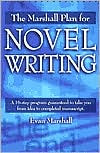
Recently, I received an email from one of my heroes, Evan Marshall. You probably recognize his name (you should!). He wrote THE MARSHALL PLAN FOR NOVEL WRITING, which you can find on Amazon and elsewhere. It is the one book of advice for writers that, in my humble opinion, stands above all others, because it offers truly practical advice, the sort of nuts and bolts stuff that you really need to know. I mean, the stuff you REALLY NEED TO KNOW. For more details on the book, check it out on Amazon. If you'd like to read an interview with Evan Marshall, there is one at Absolute Write.
If you're wondering why the "guru of novel writing" (see interview at Absolute Write) would send moi an email, here's the reason: for the past three years. Evan, along with coauthor Martha Jewett, was working on a software program to accompany his book. The software is a novel-writing program which follows the Marshall Plan. It is designed to help you plan your novel by breaking your story down into sections, and pointing the way as you juggle multiple plot lines. You don't need the software to use the Marshall Plan -- the plan is outlined in the book, and there is also a Workbook available to help you further (as well as a book on Getting Your Novel Published). Nonetheless, the software is very helpful in laying out the templates for you--it fully automates this process. The templates are the forms you fill in to describe what happens in each section (or scene) in your story. If you have read the book without quite grasping what the plotting system was all about, the software will lay it out for you and make it absolutely clear exactly how the Marshall Plan works.
You can find a detailed description of the software on Evan Marshall's site.
Evan offered to send me a free copy of the software so I could review it. That was certainly very generous of him. I emailed him back that I would be happy to review it, and might even test out the software and blog about it here, so my readers can learn more about it and its potential usefulness.
When I first received the software, it took me seconds to install it, about ten minutes to get the basic sense of it, and within twenty minutes I had already started plotting a novel with it. Note that I accomplished this without reading any instructions! The software is intuitive, if you are familiar with the Marshall Plan.
The past few weeks I've been working with the software, and I reread the book to make sure I'm up on the concepts and excellent advice of the Marshall Plan. I'll start sharing that experience now, using the next several blog postings to tell you about the software and the Marshall Plan and how they have helped me -- and they have!
So, look forward to some enthusiasm (I've got lots after the experiences of the past few weeks), some helpful advice (the Marshall Plan is full of it), and some rather impressive results (I've been amazed at what I've accomplished).
Until soon,
Adrian
Monday, March 30, 2009
Truly Fascinating Posting!
Okay, so I'm still not ready to share the really interesting news, but I will soon, I promise!
In the meantime, check out this TRULY FASCINATING posting by K. Hurley. I have to say, honestly, it's one of the most fascinating postings I've ever read on any blog. It really challenged me creatively. That, or I'm just a really challenged individual creatively. You decide. Check it out here.
Adrian
Monday, March 23, 2009
Biggest Single Day of Writing Ever!
Let me start this posting by saying that the interesting news I mentioned in the last posting is not contained in this posting! Nonetheless, this posting still has some interesting news of is own.
First, this weekend I had my biggest single day of writing ever! My previous record, as far as I remember, was 9,000 words in one day. I might have reached higher than that, but I don't recall (it's somewhere in my previous postings). This time, I produced over 21,000 words in one long day of writing! It took about 12 hours, with a number of breaks and two meals along the way, so the actual writing time was less. I didn't keep track of that because I wasn't setting out to break a record. I'll estimate around 9 hours of actual writing time, but that's a guess. Of course, the prose is rough-draft quality, but some portions of it were very succinct and powerful.
Second, with these additional words, I just completed the first draft of my new novel, which I'm calling INTERIM here. It's the unexpected novel that popped up, meant to bridge the gap between the editing of the JASPER novel and beginning my more ambitious CHASM novel.
So, as I've mentioned, yes, I have been busy, just not with blogging!
Now, I need to get busy and prepare the posting about that interesting news I promised! It's coming soon....
Best wishes for breaking your own one-day word-count records,
Adrian
Wednesday, March 11, 2009
Interesting News Coming Soon
I'm still busy working and making steady progress. I just don't have much time to blog these days! But I have an interesting posting coming soon.
Really.
So be sure to check back.
Adrian
Friday, February 20, 2009
INTERIM Progress
The new novel that just sort of happened, which I'm calling INTERIM here (the working title isn't much better, but the story's terrific), is moving along. It's now 20% done and the prose is either in final draft form or close to it. I'm editing a bit as I go. This is another one that's just falling into place. I'm really impressed with how strongly it started. I'd have to say it's my best writing yet, in terms of those qualities I'm trying to imbue my writing with from a writerly point of view. The story concept is also intriguing. The characters have definite personalities and there are real sparks flying (ie, conflict).
The distractions have persisted but hopefully things will begin to improve now and I'll have more time and focus to get more writing/editing done.
BTW, I missed the Amazon contest this year, but now that it's on my radar I'll definitely have it in mind when it rolls around next year. I will try hard to participate then, and also to finally send something out prior to then. I've certainly grown by leaps and bounds the past few years and the quality of my writing has gotten to a point where I feel it is commercial grade, at least the stuff I'm writing most recently. Certainly the story ideas always have been, but the challenge was to improve my writing in ways that I can deliver the necessary standard of prose on a consistent basis (ie, not writing a great read followed by a total flop, but writing good prose time and time again).
Anyhoo, best wishes to all other aspiring writers in elevating their prose to the desired levels, for which I recommend Evan Marshall's THE MARSHALL PLAN as a starting point.
Adrian
Sunday, February 01, 2009
Working, Just Not Posting Much
Sorry to post so little these days, but I'm terribly busy and somewhat distracted, so the time I have available I am spending on my writing and editing rather than blogging.
I can mention by way of updates the following:
- I printed out the JASPER novel in its entirety for the first time and am editing it from hard copy, promising myself not to make changes to the electronic document until after I have finished this hard copy step, which includes not only making changes to the printout but also rewriting (by hand) some pages, sections, or chapters as needed;
- I have begun another story, which I'll call INTERIM for now, since it's appearing as an interlude between the editing of JASPER and resuming the writing of CHASM (the new story is another fantasy novel for younger readers, a way for me to work on the process through a shorter and simpler novel format before getting back to longer and more complicated stories);
- I am holding off on CHASM temporarily but am keeping it in mind -- I want to make more headway first with JASPER because I know once I return to the writing of CHASM it will be a very involved and sustained effort.
Wishing everyone else progress with their projects,
Adrian
Tuesday, January 20, 2009
FANTASTIC!!!
Happy Inauguration Day to all of us! I usually keep my comments on this blog solely to writing topics, but I can't help it: after waiting eight years for the darkness to end, I have to say FANTASTIC! Almost thought this day wouldn't come.
Congratulations to President Obama, Vice-President Biden and their families, and thanks to all who supported them.
There is hope again . . . .
Cheers,
Adrian
Sunday, January 11, 2009
Back to Work!
Uh . . . is it January already? Gee, I've been so busy lately the time has just been flying by! It's time to get back to work!
So, yes, that's it: back to work.
C'est tout!
Adrian
Sunday, December 14, 2008
Editing JASPER
Another quick posting . . . gee, this could become habit-forming! Who cares about in-depth posts when there are quick-and-easy posts? They're so much quicker, and easier!
Ahem . . . .
I'm up through Chapter 6 of JASPER with the new editing work based on the recent planning work. The editing is coming along very well. I remember back to how frustrating it was when I was writing the last chapters of JASPER and I'm enjoying every moment of how it feels right now, which is to say, it feels like everything is making sense. Gone is that terrible, frustrating sense of urgency, that somehow I have to stop what I'm doing because it's not really the right thing, and if only I could see it, I'd know it, and then I could write it, and it would be the right thing. I now feel that what I'm doing is the right thing, and I'm fixing things in such a way that they will all tie in together and the plot will be consistent and will build to the right climax, not just any climax (some days, not just any climax will do).
I am debating on whether to go back and rewrite Chapter 5, just to make it more briefer, since extraneous overflowings of unnecessary wordage are superfluous, not to mention excessive. However, I think I'll hold off on that since it's not too extreme a problem, and the nature of that work lies more in balance and general tweakage. My main focus now is on bringing the story in line with itself (ie, general consistency according to the New Revised Plot Plan). After I tackle the large stuff, then I'll go back through for another round, when I can focus on finer details. I may want to rewrite some scenes then if I can think of alternate versions that accomplish the same thing story-wise but which do so in a more dramatic or engaging manner.
In order to keep this posting brief, as promised, I'll stop now.
Adrian
Sunday, December 07, 2008
Planning Has Been Productive!
Just a quick update....
The recent planning work has been productive. I have a substantial amount of new insight into the new project, and it has inspired me to go back and solve the last remaining sticking point with the previous project. In fact, I spent all of last week working again on the JASPER novel. Even though I had previously written out answers to my major questions after finishing the first draft, and had "all the answers", I knew that one of these answers remained a sticking point even still: the issue of strengths and weaknesses, and how they affect the final climactic scene. I read an article recently that helped me get a better perspective on this issue which has proven so difficult for me, and it really helped. I went back through the JASPER story and revised my plan for it, and now am ready to go back to it and edit! Something I just wasn't comfortable to do a few weeks ago. That feels really good. There is much more planning work to do yet on the new project, though, which I am still unceremoniously calling the "CHASM" novel (still need a better working title!). However, I have done an awful lot of work on it, revising the story plan, fleshing it out in greater and greater detail.
So, what's next?
I think I'm ready to dive back into JASPER for some editing and rewriting of later chapters. I'll continue the CHASM planning, which has gotten very in-depth. I really shouldn't rush that. Even though I was so eager to start writing, I feel it's best to do all the pre-thinking I need so that I can really let loose once I start to write. I don't want to run off course, or end up with the same strengths-and-weaknesses issue that I encountered in the last few novels. It's a recurring problem for me, and one I very much want to solve. I think I'm on the right track with that after my recent new insights. I have little time, so I won't go into that further in this posting, but I am very happy to have gotten a better handle on that very critical aspect of storytelling, as least as I experience it.
My respects this December 7th to those who serve and have served in the military,
And wishing everyone a low-stress, high-fun holiday season,
Adrian
Saturday, November 15, 2008
Character vs. Plot
A recent posting on a blog that I read regularly prompted me to examine how I create characters, and how I relate to them after I've created them and am actually working with them, i.e., writing them and watching them come to life. I thought I should post on this since it's worth thinking about and I don't recall posting anything on this topic per se, although I've blogged about strengths and weaknesses, which are critically important aspects to consider in character development.
Without further ado, this is more or less how I create characters, and how I relate to them....
First, I don't always think of my characters as "people", fictional or otherwise. I do try to see them that way as I'm writing them, but before I write them I try to understand them in story terms. To put it another way, I develop my characters first, then I write them. I ask myself what function does this character serve, what is this character's relationship to the main character and the main storyline, etc., what strengths and weaknesses should this character exhibit. I develop at least a vague, general sense of the character's background, a way for me to intuit where the character is coming from, how the character will interact with others, a sense of the character's personal style, image, way of projecting him-/herself, etc. I let the larger need of the story drive the development of the character, at least in the major ideas I associate with the character. Then, as I work on the details, and especially when writing the character, I try to flesh this out a little more, or a lot more, depending on how vital the character is to the story and how much "screen time" he/she gets. I take the purely functional role and transform it into a "real" person (ie, a fictional person who seems real). In summary, my character-creation process has two basic steps: develop the character abstractly in story terms, then flesh out the character as a "real" (i.e., real-seeming but fictional) person.
Second, I consciously avoid creating any characters that remind me of any real persons, including myself. I don't spend much time thinking about this. As soon as I realize a character is reminding me of anyone who actually exists, I ask myself in what way specifically the fictional character is like someone I know, and then I immediately change the fictional character. I reassess the need for the character, the way I see the character in relation to the story (see above paragraph).
Third, I do occasionally draw inspiration from real people, but not in terms of representing them in my story, even in altered form. I take only a specific attribute, not the whole person, and work that attribute into the story. If I need to depict a character who lies well, I try to think of someone I know who lies frequently. I try to understand how I know when this person is lying, what the difference is between a convincing lie and one that is easy to spot, etc. I glean some insight about lying from someone I know and use that insight to help me shape the way a fictional character might lie in a given scene. I never depict the actual real person, or anything unique to that individual. I look for insights, generalities, and apply that understanding to the shaping of an original, fictional character.
Fourth, I intentionally do not write autobiographical or semi-autobiographical stories. Sometimes there are parallels between events in my stories and events in my life, but I separate these quite clearly in my mind. I am not writing about what I have experienced. I am not depicting those specific events. Rather, as with real people, I glean insights and general ideas about my real-life experiences, using those experiences as a source for information about the nature of such experiences.
Ultimately, characters are defined not by what they think or feel, but by what they do. Character is action. Actions are events.
I create events the same way I create characters. I see the fictional events that I write about as based on dramatic need. I shape the events around the main character's main goal and main weakness, and also any additional goals or weaknesses. If I have a character who likes to swim and who wants to become certified as a lifeguard, then I'll put obstacles in the way of that goal. Those obstacles could include having someone close to the character almost drown while attempting to save someone else, and having an unrelated stranger drown while the main character is present, although not primarily responsible for saving him/her. These events would show the danger of trying to save lives, and the cost of not saving them. They would make the importance of this work and its risks very clear to the main character, who must grapple with how he/she relates to the risks and the sense of purpose that drives him/her forward to achieving the goal of becoming a lifeguard. Other obstacles and the characters who introduce them into the main character's life could focus around logistical matters such as having the time to train, having the money to pay for certification, receiving an injury while helping a friend who goofs off, creating an unnecessary emergency for which the main character pays with an injury that threatens completion of training or ability to pass the certification requirements, etc. As you see, the kind of thinking involved here has nothing to do with me; it has everything to do with developing a story that will create a meaningful set of challenges to a main character who has a certain main goal.
It makes no difference whether any of these events occurred or did not occur in my own life -- I'm not writing about my own life. If I have known someone who drowned, or who almost drowned, then I could draw from that experience, but only in broad terms. Any insights I might glean would likely apply in general to anyone in similar circumstances
Characters and events serve a purpose in my stories, and that purpose is defined by the main goal of the main character, which can be expressed in one sentence: "Joe wishes to become a lifeguard like his big brother." I can draw from real life to inform and advise me in how I depict fictional persons and events, but I never cross the line and base my characters on real persons or events. Ever.
Plot is character, and character is plot. They are so intertwined they cannot be separated. A character is defined by what he/she wants to do. What happens is defined by what a character seeks to do. Character drives plot, plot is the expression of character. Too much focus on the quirkiness of an individual character results in a character-driven story that may lack a meaningful plot; too much emphasis on plot may results in an action-thriller which is too shallow and underdeveloped, because the characters don't seem real or organically connected to the line of action.
There is a lot of information in a novel, in the sense of details the writer has to manage while writing the story. They can become confusing, contradictory, confusing, and did I mention confusing? The way to keep it all together and ensure that things fit properly is to identify priorities. Make decisions and stick with them. Decide your basic concept (that one-sentence description I mentioned above). Decide your basic intent for the story (style, genre, tone, theme). Decide the important attributes of your main character: strengths and weaknesses, what he/she has to learn, his/her motivation, the consequences of success or failure. Establish meaningful major complications, decide which few of them absolutely must appear in the story. Brainstorm ideas, other events, other characters, but keep it loose until you have enough information to work with. Start sifting through and pin things down. Prioritize the decisions. Once something is set, keep it set firmly in your mind. Let later decisions hinge on previous decisions. There is a hierarchy to the information, a sense of perspective about it. By keeping things structured in this way, you can build and maintain a clear sense of who your characters are, why they are, how, what, and where they are, etc. Make characters and events count.
Finally, even though I am not my characters and my characters are not me, my characters are ultimately an expression of me. Not in simplistic terms, but in a roundabout way. I am a gay American male. When I create characters, I do so based on my way of looking at the world. They are my characters, engaged in my events, meaning the events which I have created, in stories that I create. My characters and events, and therefore my stories, serve a greater purpose, which is that they collectively communicate something that I wish to express in writing to potential readers. Writers build a body of work over time. That work is unique to each writer. That work is the writer, but not in simplistic terms. Without the writer, the work is nothing. I don't own my characters, any more than parents own their children. We bring them into the world, we give them life, we raise them up, and we send them on their way, hoping the world will be kind to them. If they deserve it. Those that don't should get what's coming to them. Sadly, there are no protagonists without antagonists. Such is the nature of fiction: conflict, through and through.
Of all things, stories are about people. Our characters must ultimately become people to the people who read about them.
Happy character-creating,
Adrian
Planning Still, & Congratulations!
First, the congratulations -- to Sherry Thomas, whose blog, Plotters & Manipulators United, is one I read from time to time. Sherry spends her time writing historical romance and doesn't blog that often, but some months ago she had some very interesting posts that I enjoyed. The congratulations are due because one of her novels, Private Arrangements, was named one of the best books of the year by Publisher's Weekly! It was one of five mass-market paperbacks to make the list. That's worth some celebrating! Congratulations on such a wonderful achievement!
[By the way, I read about writers and writing techniques from various genres, even though my focus is on fantasy, because I believe we each have a piece of a larger puzzle, and I can learn from a romance writer, a mystery writer, a horror writer, etc., and not only fantasy writers. A fantasy is that much more interesting if it has an element of romance, of mystery, etc. Historical fiction is of particular interest to me because it parallels in less fantastic terms the sort of stuff that my fantasy stories are made of.]
Now, to the Planning . . . .
Yes, a week after my last post, I'm still planning my new novel! I started writing it the last week of October. I worked on it slowly but steadily for that first week, then stopped writing in the 2rd week (early November) to do some more planning, after having written about 7k words. I was then supposed to restart the writing this past week (week 3) and carry on, which I did, starting again with a new first scene and a fresh start, but once again I wrote only so much (this time, about 9k words) then ran into issues that just begged me to stop and plan some more. It's like deja-vu, except this time I know I've been here before! Tally: three weeks, two false starts, and a lot of extra notes from planning!
What's good:
- I enjoy planning -- I really do!
- The results I'm getting are fantabulous!
- I've now got a usable MAP for the first time!
- I've even got a "character map" (more below)!
- The story just keeps getting better!
- I'm so excited about all this!
- I'm still planning!
- Gee, shouldn't I be writing?
- I'm not writing!
- My engines are revved but I haven't released the clutch!
- "Fantabulous" is not a real word!
Now, what's a "character map"? Well, I don't know what that means to you, but here's what it means to me: I used a generic drawing program (this could also be done with a text editor) and I mapped out character names on a sheet of paper. Characters who are in the same group are listed line by line without skipping any lines, usually just a few names at a time. If there is another, related group, I skip a line and then list them (for example, two opposing sides or differences in rank or other associations). I then placed these groupings of names around the page (text fields dropped onto a blank page in a drawing program). I situated the names geographically in a way that corresponds to my map of this fictional world. So, the kingdom that is in the southeast is represented by a short list of names of key characters from that kingdom, located in the bottom right area of the paper.
What good is a character map? It looks like a page with names written all over it, in bunches, and they don't even line up with proper margins!
Yes, it looks odd, but it's useful to me. I can look at my map, which I printed out in a larger size than it would appear in the book, and I can look at my character map, which shows the same geographical relations but lists the actual characters, and I can mentally work my way through the story, or sequences of the story, specific scenes, etc., and see visually who people are, where people are, who comes and goes to and from where, etc. These tools, together, help me visualize when I'm doing all this extra planning work.
I already have over 50 names on the character map. These are characters who will be named in the story. Many of them are minor characters who will appear in only a scene or two, but they interact, so these are "speaking roles" and not just "voiceless extras". There are at least a dozen "major" characters, meaning they play a significant role in a chapter or sequence of chapters, and their input into the story has an important impact on the main character and the small group of truly major characters he associates with. For me, 50+ is a lot of named characters, more than I usually work with. What's really cool: I can look at the paper and name off instantly who these characters are, and what role they play throughout the story from start to finish! All of them! So yes, I do know the story well, as well I should.
Now, as to the exact nature of the planning . . . what is it that I'm coming up with these days, and do I really need it? Is it truly so important that it justifies stalling, restarting, then stalling again the writing of this story?
As mentioned before, I already have all the major events in each of the three acts, and the major plot pillars, and many minor events along the way, and all the characters I can foresee needing, certainly all the major players. However, I still get a little fuzzy about the back-story, the history, the mythology, and the ending, as well as making sure I have the right motivations that are reasonable and true to character. In other words, I have "everything", yet everything is suspect, and I know there are some holes here or there in spite of having filled every hole I can find. As I beat my head against the wall, I find incredible new ideas dislodging from the recesses of my mind and adding themselves to the mix. The added insights and improved decisions (where I have choices) are definitely worth the extra effort. Definitely.
What I have pinned down, without giving the story away:
- What happened years ago between a man and a woman that explains why they hate each other still to this day, enough to try to destroy each other.
- The exact sequence of events that start the present circumstances -- they were always there, I just finally drew them all out in a cause-and-effect series that makes very good sense.
- Who that strange race of beings is that lives far to the north -- I always knew the simple answer, but how they are tied to the history and mythology, and the epic proportions of the story was hard to pin down among several choices (not anymore!).
- What's located inside that large body of water and why it matters, and matters, and matters.
- What's permanent, what's changeable, and why the difference.
- How the two major threads come back together -- still working on the exact details, but at least I now have a clear sense of the way this needs to unfold -- my previous version did not rise to the dramatic potential I had created, this new version certainly does.
- What's up, what's down, and why it matters.
- Details of the second and third acts that are too fine to have been explored fully yet. I want to explore as much as I can before writing, though I know I will discover more when I actually write.
- As always, the critically-important issue of the main character's strengths and weaknesses, lessons to be learned, and how this ties in to the final confrontation and resolution.
So, I'm still planning. At least I'm enjoying it!
Best wishes to everyone else with their ongoing efforts, whatever they may be,
Adrian
Thursday, November 06, 2008
New Novel Up & Running!
My new novel, CHASM (still want to find a better working title!), is up and running. I mentioned having written the first 2 chapters last week, about 7k words. Well, over the weekend, while editing those 2 chapters and reflecting more on how the story was going, I felt I had a new set of questions that needed answering. In spite of all the planning over the summer -- I filled an entire composition notebook with notes -- I realized there were still a number of angles that I hadn't addressed. So, I spent the weekend and early into this week going back over my notes and reflecting in greater depth on certain key issues. The result is the story has advanced very nicely, with a much richer plot and set of relationships and interrelationships between characters, events and places. It's the same story, just more evolved. I also added some entirely new elements, which are useful in drawing out the ideas I already had established, but in a way that helps me dramatize things better. I did nothing that changes the original intent or basic story line. Those were already well-planned. I'm really happy with the new material, and it has that feel to it that tells me it's "right on" -- you know something is working when the pieces fit seamlessly together and everything just feels right.
However, with the new ideas, I felt I needed to go back to the beginning and make a fresh start again. I wanted to allow the new ideas to percolate and affect how I was beginning the story, and the exact way I was going to introduce the characters and circumstances. I'm glad I did. One important new change is, for the first time since I started working (again) in earnest a few years ago, I'm going to use multiple points of view. I have kept my last four novels strictly focused on one main character who is the protagonist and hero. Every scene of every chapter featured the MC, and was from that one character's POV. In earlier years I did write with multiple POV's, but when I started writing again in 2005 I decided to restrict myself to just one POV (the MC's) and keep it to that until I had mastered a number of other aspects of the novel-writing process. I wouldn't say I've mastered anything, of course, but I'm certainly doing much, much better on a number of fronts and have clearly learned a lot in these past few years. I feel comfortable branching out now, with a sense that I have enough of the key elements of good storytelling under control now that it is time to grow again. It's very exciting to work with multiple POV's after my self-imposed exile from them.
So far this week I've written only two scenes, going slowly and carefully, making sure I get it right. I believe the beginning of a story is very important as it establishes the foundation that you write from as you proceed through the rest of the story. However, I'll try to avoid the meticulous editing I normally do to the first three or four chapters. The first two scenes run a little over 3k, and I'll add another scene before closing Chapter 1. This fresh-start manuscript is up and running, and as I get past the first couple of chapters I expect the pace to pick up and the editing to fall by the way side. I don't want to rush too quickly through it, as time allows reflection, which in turn creates better scenes, but I want to set a good pace and keep it moving. I have no idea the length of this novel, but will set it at 80k to 100k.
Once I get a few chapters in, and have edited the first chapter enough times that it seems pretty well set, then I'll share the first chapter on my secure blog, ADRIAN'S ARCHIVE. By the way, thanks to Scotty for his feedback already in the comments on that blog, and, Debra, I've sent the password email but I'm not posting your comment requesting it so that I don't divulge your email address publicly.
One really cool thing about the new CHASM novel is that I feel like I'm writing a real fantasy novel for the first time. It's actually my fifth fantasy novel, but with all the growth over the past four I feel I'm finally able to write the kind of prose I was hoping to write with the first one, THE REFLECTING STONE. That was a fine story in terms of plotting and characters and the struggle the MC faces, but my prose was not then what it is now. It's nice to see progress.
I'll keep working on CHASM, enjoying the ride, not in a hurry, but feeling excitement about this story and anticipation. I can't wait to see what the finished story looks like.
Best wishes to others with their WIP's,
Adrian
Saturday, November 01, 2008
Feedback Anyone?
Breaking News:
I've been wanting to share excerpts of my fiction so other writers can see what I'm working on and provide feedback. I have a publicly-available blog for that already, ADRIAN'S FIX, but I can only share brief excerpts there. To help me share more substantial excerpts, I've created a new secure blog. It's called ADRIAN'S ARCHIVE. I've already put sample chapters on there from three of my WIP's:
- THE REFLECTING STONE
- JACK & JILL: THE UNTOLD STORY
- The First Novel in the JASPER Series
I'll post more content there on a regular basis (I have it readily available).
Why a secure blog?
If you put anything more than a brief excerpt on the internet for everybody to see, it immediately loses any potential commercial value for publication. A publicly-available blog like ADRIAN'S FIX is fine for sharing bits and pieces, or for sharing stuff that I do not plan to market one day, but it is not suitable for longer excerpts or whole works. I need a password-protected blog to share more substantial excerpts, and I'll only share this content with a handful of writers for feedback.
How do I visit a secure blog?
In case you're not familiar with secure blogs at Blogger, I'll explain briefly....
You visit the secure blog the same way you visit this one -- by going to the URL (internet address) for the blog. However, since it is a secure blog, you will first get a screen that asks you to enter a password. This way, only those who have been invited, and given the password, can enter the blog to view its contents.
Once you've entered the password, you can have your browser save the password (via a cookie), and then when you come back to the site, you can view it instantly without having to re-enter the password each time. Or, you can decline the cookie, but then you have to re-enter the password each time you visit.
How do I get the password?
In order to send you a password, I need your email address. I have to enter it into a form in my Dashboard (control panel at Blogger that I use to manage my blogs). Once I enter your email address in the form, authorizing you to view the site, Blogger will send you an automatically-generated invitation email that invites you to view the blog. The invitation email gives you the URL, and a password.
Therefore, if you would like to visit my new secure blog, please send me an email. Identify yourself and let me know you want a password, and I'll have Blogger send you an invitation!
Send requests to:
a m e r i c a n a u t h o r [ a t ] y a h o o [ d o t ] c o m
(minus the extra spaces, of course -- it all just runs together).
In conclusion....
I hope my fellow aspiring writers will request the password and visit the new blog to see what my stories look like, and to offer feedback. You can share general reactions, as well as more detailed feedback, by posting comments on the secure blog.
Additionally, if you would like to receive a longer excerpt or entire work, when available, let me know and I can send you a Mobipocket eBook version, which is also secure. You can download the Mobipocket eBook Reader and Creator programs for FREE from the Mobipocket site. It's a great tool, allowing you to read your own stories in eBook format, share them with others (with or without password encryption), and add comments directly to the text. Their site also offers 10,000 free eBooks for immediate download, and of course you can purchase eBooks as well. Check it out, if you haven't already.
Thanks for your support, and feel free to ask me to critique your own work as well. I'm more than happy to reciprocate.
Adrian
Friday, October 31, 2008
Moving Ahead
I've decided to move ahead with my next novel, CHASM. I've already started it this past week, and have written two chapters, about 7k words total. It's off to a very solid start, and I'm very excited about the rich story, rich characters, and wealth of possibilities which this story affords.
I'll continue to work on JASPER, and JACK & JILL, as time permits, editing and rewriting. However, I don't want to hold up my forward progress with a lengthy editing phase at this point. I want to keep moving forward, developing my skills. I see such a huge jump from one story to the next that I feel compelled to move forward, rather than waiting for the editing of these last stories to be complete.
I won't be doing Nano this year. I've already started my next project, prior to November 1st. I couldn't wait.
Best wishes for your Autumn writing,
Adrian
Subscribe to:
Posts (Atom)

 Posts
Posts