Wednesday, July 26, 2006
The "I Have Other Things To Do" Rule
The last posting deals with the frustration of finding too many possibilities while editing and needing to keep focused around THE PLAN (outline, whatever) for the story. In addition to the KISS Rule I mentioned in the last posting, there is another rule I should mention: the "I Have Other Things To Do" Rule.
During the planning and writing phases, this rule was one of the most helpful when I felt bogged down with the enormity of the task that at earlier points in the process still lay ahead. Now, as I'm in the editing phase, with the bulk of the effort behind me (although there is still a substantial chunk of work to do here with editing), it should come as no surprise that this rule would continue to be of value. In fact, I think this rule is of value at all times, whether in the midst of working on a novel, taking a break between novels, or at any other time. It's so tremendously helpful.
The gist of it is this: the task at hand may seem daunting for whatever reason (and there are plenty of good reasons to make the work daunting at any particular point in the process), but it's important to bear in mind that whatever you are working on at the moment is ultimately just one task in a very long series of tasks. If you're having a problem figuring out some detail in one scene, remember that there are other scenes still to work on in the present chapter. If the present chapter is a hassle, remember it is just one of many chapters. If the current novel seems to be overwhelmingly difficult, remember that it is only one novel of many that you intend to write.
In other words, "zoom out" and take in the larger picture and remember that any given struggle is just one small piece of a much larger puzzle. While this realization could cause you to throw your hands up in the air and run screaming from the room, swearing never to write again since it will always be endless confusion and difficulty, a better way to look at this is to see the present challenge as just a small thing and you have many other things to do, so simplify the task at hand, find a solution, and move on -- you have so many other things to do!
Therefore, don't make the current task any larger than it needs to be. See it as a smaller challenge, demystify it. Consider using the Q&A approach to find a solution -- write out your questions (makes them more concrete), then figure out your answers. If several possibilities exist, consider the main ones briefly, then review your findings, and choose the best solution. Yes, Keep It Simple (KISS Rule) and also keep things in perspective! You have so much to do, any given challenge can only be so big. Find ways to make it smaller, less challenging, to gain victory over it. Time and time again. Don't spend "forever" on this one task ... you really do have other things to do!
Obviously, I'm having this problem as I have hit yet another "pivotal moment" in Chapter 4 and am seeing far too many possibilities in the editing....
Adrian

KISS Rule vs. Excessive Creativity
As I'm diving deeper into the editing of THE REFLECTING STONE, I am finding an endless series (the entire novel!) of "pivotal moments" -- moments where I have written the existing draft such that one thing happens, but in the editing I think of some other thing that could have happened, that might have been more interesting. That is part of my task, to take an interesting scene and make it even more interesting. However, this quickly creates a "veritable plethora" of possibilities and can lead in no time to absolute confusion. Which direction? Which choice? What if this -- or that? Suddenly a tightly-wound story becomes an unending series of potentials, of "what-if's", and I'm thoroughly lost in how to proceed. I've dived into the abyss of creativity and I cannot find my way back to the simplicity of a coherent story line.
Except I can -- it's called the "KISS Rule", which, as you probably already know, stands for "Keep It Simple, Stupid!". No, I'm not really calling myself or anyone else stupid, but the point is where we make things complicated, we sometimes just need to stop and simplify and then keep things simplified. Get back to the basics.
The reason I was able to get through the entire manuscript in the writing phase was because I had a plan. Now, as I do the editing, I must remember to stick to a plan. The plan I had was a good one. A lot of what I've been reading from the existing draft fits very well together and I'm thoroughly pleased with it. So, when those moments come along and I suddenly see too many possibilities, and then try to figure out how each would affect the remainder of the story ... I need to keep it simple, and remember that a plan is better than wallowing in the abyss of neverending potentials, and just refer back to my original plan and limit whatever I might contemplate so that it will fit in with the original plan (and therefore automatically set aside any possibilities that call for major rewriting of every scene to follow thereafter until the conclusion of the book). The goal is not to find a whole new way of doing something, or changing the story, at this point, but simply to take what I do have and look for a better, more dramatic or expressive way of showing it in the manuscript.
To do this, I need to know for each scene what it's original purpose was, including goal/complication/resolution. I already know all of my scenes are justifiable, having gone through a review of scenes in the pre-planning and while writing and before starting to edit. However, I can still consolidate, add a scene, etc., if I find better alternatives or the need to draw out more detail of the story. But, keeping a firm grasp on the original plan, I can limit my brainstorming of potential editing routes to just those routes that are in keeping with the intent of the original plan. I really don't want to rethink the entire story at this point, and see no indication whatsoever that the story needs such drastic rewriting.
It's tough, because I tend to see a lot of possibilities, but applying the KISS Rule and keeping myself grounded in the original plan will hopefully help me to keep the editing moving forward rather than digressing into too many potential variations and wallowing in a sea of excessive creativity. There is such a thing as too much of a good thing.
Adrian
Saturday, July 22, 2006
Working on Scene Structure
I had a goal when I started work on my recently set-aside novel, HARRY VS. THE TRUCK, to work on goal/complication/resolution patterns, making sure each scene had a very clear goal for the point-of-view character. I feel this mindset has stuck well enough by now: I've internalized it, and am fairly consistent now as I strive to apply it at all times. As I approach the editing of Chapter 4 of THE REFLECTING STONE, I am focusing on other details of scene structure to continue and refine that focus. In particular, I am trying to get a handle on the concept of action/reaction sequences.
While it is important for the writer to know clearly the POV character's reactions to each setback or complication along the way, it is not necessary, as I understand it, to actually express that in a distinct scene in every case. If the stakes were high in the action scene, the defeat or twist particularly difficult for the POV character, then it is important to show the character's struggle with the undesired outcome and the process of moving from emotional reaction to rational thought to decision making as a new course of action is chosen. However, if the reaction is obvious, and can be shown "along the way", the essential elements of the reaction (emotion, reflection, decision) can be expressed without drawing significant attention to them, even in a very short space such as a sentence or even just a phrase, and can even be ommitted and fully implied, because they are in fact obvious.
Disclaimer as I apply this focus on action/reaction sequences: As I mentioned in the last posting, I am focusing on the characters having their own agendas, their own goals, and allowing them room to pursue their lives in whatever way they feel is best for them. I keep my goals as the writer separate from the characters' goals, and try to work them in without interfering with the clear development and expression of the characters' own desires, needs, wants, etc. The characters are experiencing the story, living it directly. I am watching from a distance, giving them a nudge here or there.
Some specifics....
I found one scene in Chapter 4 where there is a transition from one location to another. The main character is being held prisoner and must escape. That's my goal, but more importantly it is his goal. His life depends on it. As previously written in the current draft, he did a minor amount of reflection while in captivity about the events of the preceding chapter, which resulted in his present predicament. He escaped, then made his way to a new location to distance himself from his captors.
In the editing, I recognized the need here for more significant reflection. In essence, his old life is now being left behind, and he is taking steps toward his future, unlocking the course of his destiny, bit by bit, though he does not know what it will be. The events of the previous chapter were enormous in their emotional impact on him. This is one of the few really key points in the story where a longer reaction scene is in fact fully justified. My focus on action/reaction sequences and scene structure helped me to see that and correct it.
Another issue that came up in the editing is the transition between locations. The character escaped and set out for a new destination, but I took that as a matter of course in the previous draft and did not show more reflection than enough to establish his basic plan to get away, and in which direction, with what general goal for his safety. I realized there was in fact a choice to be made here, one that touches back on foreshadowing from earlier chapters. I allowed for a continuation of the reaction during his escape, so that he pauses literally where there is a fork in the road and considers which route to take. This brings the focus back squarely to major story questions, which must be done periodically.
I think the expansion of the reflection in two places in this chapter were needed, and the story is much stronger now. This also provides the reader with a chance to get into the character's head, to better understand what he is dealing with, and his personality as revealed in how he solves problems, deals with his emotions, plans for future actions. Hopefully, the reader will be able to identify more the with character in some sense, and will feel closer to him.
The only drawback has been a pattern I noticed in the writing phase over the past several months: the more I work with the same section of text, the more I lose my objectivity about it, until I can no longer tell if it's any good or not. I'm seeing the need in the editing to avoid going back over the same text too many times, and not to go back and reread earlier chapters. I just need to keep moving forward, and read only as many times as I need to until I get the elements in the text that need to be there, and the section seems to read well enough. I should then let the newer version sit, move on and edit new segments, and later come back to reread and polish. I'm really just trying to catch the bigger stuff on this first run-through, and will certainly go back through it all again a few more times before I'm through.
I put in several hours of work editing Chapter 4 and am still only about 25% of the way into this chapter. I remember back in January, February and March that when I slowed down to edit the first three chapters, it likewise was slow going at times. I think I do have to read over problem areas several times and play with the text, changing this, changing that, trying this version, then another, each time the changes giving me something new to think about. It takes time sometimes to explore a scene in-depth and really find all the material that is there to work with. It's not necessary to explore every possibility in the final text, but I think it's important to explore all the possibilities you can find so that you can discover important things that you might have missed. Sometimes we overlook the obvious, and it takes a while to see what was sitting in front of us all along. In any event, quality first! I'll take whatever time I need to do this right, while trying to work as quickly as I can.
Adrian
Friday, July 21, 2006
First 25% Solid!
I've worked through the first three chapters of THE REFLECTING STONE, reading them, writing a few brief notes of things to think about, minor fixes, but basically the first three chapters are very solid as-is and require only minor touch-ups, no significant editing. That's about 30,000 words worth! The first quarter of my editing work is a breeze! That's because I took the time back in January, February and March to go over these chapters several times and do a lot of editing, to make sure I had a very solid footing to build the rest of the novel on. That work sure paid off. In fact, I found the endings of the chapters to be very hard-hitting, or impactful. They generated a significant response on an emotional level as I reread them for the first time in two months. I was really pleased with the overall quality of the story. Act I is in good shape.
I'm now working on Chapter 4. Sections of it are similarly very polished already. I change a word or two here or there, drop a part of a sentence, recombine a few words into a new phrase, but only minor touch-ups. However, I am seeing the first of the sections now that do require a little more work, some rewriting within paragraphs. It's the first substantial editing work, still very minor. I know there will be much more to come. The later chapters will require a lot more work, some entire scenes will have to be rewritten from scratch, some of them several thousand words long.
With such a solid start, though I feel really confident about bringing the rest of the novel up to the same level and keeping it consistent. I am taking the approach of solving questions as I come to them in the text, in the order they are raised. Any issues I didn't fully grasp or resolve at the time, such as how two characters feel about each other or an issue they face, which will guide how they act toward each other in later scenes, I am resolving now as I come across them. I had a lot of depth and breadth to my vision or understanding of the story as I wrote it, but still I see a few examples where I didn't fully figure some things out. Still, these loose ends are relatively minor and there is so much context around them by now that I can fairly easily resolve them.
I am remembering to separate "writer's need" from "character's need" -- what I want the scene to accomplish is not the same thing as what the character might want or need at a given moment. I have to let the characters follow their own agendas, allow them to act according to their own motivations. That is the primary source for solving questions, but I take that and also compare what my goal is and whether I can still work that in while keeping the characters true to their own motivations.
I'm sure as the editing progresses that I'll find some larger and more complex tasks waiting for me. For now, at least, the editing is a breeze, and one thing I can definitely say is that I find this story to be very interesting. If I hadn't written it, I would certainly enjoy reading it. The basic premise, established in Chapter 1, is intriguing, and the story is full of possibilities, making me wonder what will happen as a reader.
Will keep editing this weekend and update again soon.
Adrian
Monday, July 17, 2006
Back to Work!
After a two-month hiatus to let the manuscript "cool", I'm officially back to work on THE REFLECTING STONE and I'm happy about that. I went over my editing notes, special notes I had set aside in a folder in my computer just for the editing process of this novel, about eleven files, I think. Good to refresh. I'm now beginning Phase Two of my editing process, "Planning What Will Be" (for details, see the TIPS & TRICKS blog for a description of "Step Three: Editing the Novel").
I read over the notes and also worked some more on the Mythology. I worked out an alternate shorter and simpler version of the Mythology (the last task I had to do as part of Phase One of my editing process, "Documenting What Is"), but I'm going to wait and see as I go over the story in detail whether I can still use the added complexity. Part of the humor of that is that no two people have the same version of history in the novel. Everyone has a different view of how things happened long ago. If I simplify the actual history too much, it might take away from this running gag, and it's actually pretty useful as it is. However, I do want to make sure at some appropriate point in the story I am either saying "it's so complicated no one really knows what's what and so it doesn't really matter, we all have our opinions", or "this is the correct version -- and it's simple and easy to undertand".
I've been updating the TIPS & TRICKS blog. As mentioned, I posted the plan there that I intend to follow for editing, but I'm already off it slightly. I think the point is do whatever works, don't just follow a script. The value of advice is that it gives us a focus, helps us consider out options, but we have to pick and choose what to do in a dynamic way according to the reality of our particular situation at any given moment. Instead of spending a lot of time planning what to change and then rereading the manuscript, I simply refreshed on the notes I had previously made while still writing, and am now diving in to read the manuscript. I'm so curious to see what I wrote after TWO MONTHS have passed!
I read Chapter 1 for the first time in at least two months. I didn't know whether I'd like it or hate it. Turns out I loved it! I was really impressed with it. I had previously put a lot of effort into editing it to get it as close as possible to a finished draft, and I see no need to do any significant editing to it. I'll tweak a few sentences here or there, just final polish stuff, but the chapter is essentially done. I know the first three chapters were heavily edited, so it will probably be similar for Chapters 2 and 3.
Reading Chapter 1 gave me a very strong feeling that this novel is really interesting, the plan for it was really good, it unfolds in a way that captures a reader's attention and pulls him along, it deals with significant conflicts that readers can identify with along the way, and -- I can write! It's ultimately up to others to say whether that's true or not, but to my own satisfaction I feel what I wrote is good stuff and I'm quite pleased with it. If I can get the rest of the novel to match the level of quality of this first chapter, this should be a very publishable novel. I know the story is there, but I will need to do more editing the farther and farther I progress into the story. The story becomes more complex and I need to make sure it is consistent throughout in how things develop plot-wise. Stories tend to evolve under our feet, if that makes sense, and that certainly happened over the course of writing the complete draft.
Anyway, I'll continue the re-read this week, and make notes along the way if anything stands out, but I want to try to capture a sense of the novel as a whole, the larger picture, first. Then I'll get into the details. Rereading will help me react to it after it has sat and those reactions will guide me in planning what to change.
I'm also getting good ideas for the SCI-FI novel, which is a really fun story. I am so looking forward to writing that one! Now that I have a template in my mind, a process to use over and over in planning, writing and editing novels, I'm seeing how my ideas begin to attach themselves to specific anchor posts more easily. I hope that makes sense. It's hard to describe mental processes. I get ideas and before they were just a flurry of ideas. Now they can be sorted and categorized immediately as to where they belong in the story (I have the basic 12-step outline worked out for the SCI-FI novel already), and where I will deal with them in the process, as the work unfolds. The ideas tend to be naturally more connected, to fit together better from the get-go. It seems every idea is a good detail that belongs in the story, rather than "just another idea" that I have to sort through, most of which I would not end up using. I guess this means I have more focus and a better understanding of the process!
Growth comes to those that strive for it.
Adrian
Saturday, July 15, 2006
Shelving HARRY!
Thanks for your wise comments, Debra! You described it to a "T". I'm going to shelve Harry for now, and get back to in at some future time after I've found a way to make my peace with the heavy issues involved in that novel. It's a worthwhile story but too much for me to handle right now. I have other priorities!
So, I'm "officially" back to work on THE REFLECTING STONE now after the post-writing break, ready to gear up and dig in on that editing. I am looking forward to doing enough editing that I will have a copy ready for readers to give me feedback in the coming weeks and months. I don't know how long it will take to complete the editing. I will take as much time as I need, trying of course to finish as quickly as possible while putting quality first.
I'm going to continue work on the SCI-FI NOVEL as well, using that to provide me with a break from the editing work whenever I need it. Juggling the two things might help push me along, stimulate my creativity, but the editing work will be Job #1 until it is completed.
I'm happy about this decision. It's certainly the right one, without any question. My goal is to write and get stuff done, not make myself suffer needlessly in the name of art. I need to focus primarily on getting things done, until I've completed a few novels and shopped them around (and hopefully gotten published somewhere in the process!). After I have more experience at completing things, I can turn my attention to more challenging novels in terms of story lines that really move me on a deeper level. For now, I'm already putting a lot of work in and my focus must be on navigating the writing process and achieving skill in the enormous juggling act that it is. There is so much to take into account in planning, writing and editing and I want to work on stories that don't offer unnecessary additional pressures, issues or challenges due to subject matter. I think THE REFLECTING STONE is already an epic novel with major issues, but they are not ones that upset me emotionally to think about or write about. I like the story, and enjoyed seeing it develop during the writing phase. Now I look forward to seeing it transform itself before my very eyes into a finished manuscript of the best quality I can possibly make it be!
I just updated my TIPS & TRICKS blog with the plan I will use to guide my editing work. Phase One of that work is essentially already completed, except for some tweaking on the Mythology notes, which I'm working on now. I'll get my attention focused back on THE REFLECTING STONE and start Phase Two this weekend!
I'm also working in bits and pieces every day or two on the SCI-FI NOVEL. This week I completed culture notes for the alien race and also started creating their language. Language and culture go together, of course, hand in hand. The way they speak reflects their culture, who they are, their world view, their social patterns. This story is going to be a lot of fun to write, I can tell. I am very enthusiastic about the possibilities as the Earthlings encounter the aliens and interact with them. I'll continue the planning phase for that novel while I'm in Phase Two of the editing of THE REFLECTING STONE. I feel like a heavy weight has been lifted and my creativity can start flowing more easily again.
Adrian
Wednesday, July 12, 2006
Sincerest Thanks for the Comments!
Yes, it's "struggle time", when in spite of the best intentions it becomes difficult to make much or even any progress. I really appreciate the recent comments. Just knowing others out there understand helps somehow. I always appreciate any words of encouragement. They really do make a difference and help me manage to push on when that's about the last thing I seem to be able to do.
To help get my creative juices flowing, yesterday I spent a couple of hours doing some initial planning work for another novel, which I'll refer to as the SCI-FI NOVEL. I'm excited about that story, always have been since I first thought of it a few years ago. I was able to work out a twelve-step outline with ease and with depth and breadth of vision. It's a first-rate outline and I had such great clarity of vision while creating it, able to see details as needed to understand all the main anchor points and the flow of each of the acts, how each builds to its own climax and how they build on top of each other to the final climax. It's a rich story idea full of possibilities. Working on that showed me yet again how I am learning so much and growing so quickly. Each time I sit down to to that type of work I have a strength I bring to it that surpasses anything I've ever been capable of before. By applying the same process over and over, I'm getting good at it and the pieces just fall into place. Doing this work helped me revive a sense that I can accomplish something.
I've found it very difficult the past couple of weeks to make progress with my current novel, HARRY VS. THE TRUCK. The work is essentially stalled about 20% into the first draft. Struggling enough with this, I finally got to the point in the past few days where I was ready to sit down and problem-solve and try to find some solutions. I applied my own advice for handling writer's block (see my posting on Phase Two: Writing the Novel, in my TIPS & TRICKS blog). Writer's block is something I only occasionally suffer from, and usually not to any great extent. The basic solution that applies here is simply to make a list of questions that are unanswered. What do I need to know in order to continue? Usually it's about story issues. The idea is to bring your unanswered questions into focus and find answers for them, clearing the way to build on that information and continue the story. In this particular instance, I really have only one question and it does not relate directly to plot details. I came up with two answers:
THE QUESTION: "Why am I finding it so hard to write this story at this time?"
1. A part of me wants to finish editing my last novel, THE REFLECTING STONE, so I can start shopping it around to publishers and agents, before I will be willing to invest too much emotionally in another novel.
2. This new story deals with some heavy subject matter that I find too depressing to write about at a time when I'd rather be enjoying the beautiful summer.
My plan had been to quickly write a complete first draft of the new novel, then get back right away to THE REFLECTING STONE to edit it. I had hoped to be at least half-way through the new novel by now. If there is still a chance of getting on a roll with it and finishing it within July, I would be willing to continue to try to do so.
The second issue is not one that I foresaw. I knew the story of HARRY VS. THE TRUCK, but I did not realize going into it that it would have such an effect on me. I haven't posted any details about the story, and don't want to give the story away any by commenting on it. As I have posted, it's ultimately one with a positive message and the characters manage okay, but there are some dark and difficult things for the main character to wade through, particularly in the early chapters. I think although it is not my story (I don't write autobiographical fiction), it is a story that resonates too much with my own life, and with the realities that many of us face, and as such it's one that evokes a strong emotional response in me as I work on it, moreso than THE REFLECTING STONE or the SCI-FI NOVEL that I just did some planning work on. Every story I think of connects with reality, no matter how fantastic the story line. Some just hit home a little more than others.
At this point, I have to decide whether to set HARRY aside and get back to work on THE REFLECTING STONE, completing the editing of it before resuming work on HARRY, or to continue to try to finish the first draft of HARRY within the next few weeks. I think I'll give it one last try, and if it "ain't happenin" soon, then I'll make that switch. I do want to write HARRY, and feel it's a worthwhile story, but it may be one to work on during the winter or something. Perhaps letting it sit will allow me to make my peace with it, and when I return to it I'll fare better. It's tough enough to manage the ups and downs which are inherent to the writing process without also having to navigate such difficult emotional terrain of a story that is itself troubling. This is why I chose THE REFLECTING STONE: I knew I did not have strong emotions tied to it, and that I would be able to look at the story and the process of writing it more objectively because of that fact. The SCI-FI NOVEL is another one like THE REFLECTING STONE as far as I know. A fun and interesting story with lots of potential. Although there are meaningful issues that underpin it, they aren't ones that stir such deep emotions in me. Perhaps if I edit the STONE then I can write the SCI-FI NOVEL and get back to HARRY after some months have gone by.
But, before making that decision final, I'll give HARRY one final try.
Thanks again for the words of encouragement. They really do help.
Adrian
Monday, July 03, 2006
Making a Little Progress
I will hold off on making a more detailed report on my progress until there is more progress, but at least I can say I have written during the past week and am on the way to reaching the goal.
I definitely feel I'm writing a first draft. It's rough -- on me. The work itself is not all that bad. That's usually how it goes.
Anyway, I'll keep at it! I'll report back when there's more to report on.
By the way, I'm updating my two other blogs these days. Glad to see them growing. This is a time when I should read my own advice and take it (see "Step Two" posting on the TIPS & TRICKS blog!).
Adrian
Tuesday, June 27, 2006
Missed the Mark!
Well, this past week I did not make ANY progress on my new novel! I will save the weekly update for next week! I think that's the first time in the months since I started setting specific weekly goals that I didn't get anything accomplished. I'll allow it. I had some significant other things going on in the past week that really demanded my full attention front and center, mentally and emotionally, and there was a significant temporary change to my schedule that also screwed with my body clock, so I wasn't quite feeling the way I usually do.
I'll just overlook this one "hiccup" in the progress and bravely resume the effort during this week.
I did manage to update the TIPS & TRICKS blog and also to edit and restore earlier postings on the WELCOME TO MY WORLD blog. At least I did accomplish something, even if those items are not as important as continuing to make progress on my writing. I can see where other writers comment that it's important to write, to write something, anything, just to keep writing. It keeps the wheels in motion. Not writing anything at all would make it much harder to start writing again after a break from it.
So, I'll renew last week's goals of adding two additional chapters and continuing to look for ways to make the difficult aspects of this new novel easier to deal with. I'll spend some time reflecting on the overall story and my purpose for it, and trying to put the challenging story events and heavy undercurrents into a fresh perspective in light of the overall intention for the work. I think I can make some headway there with a renewed effort.
I know I haven't posted anything at all concerning what this new story is actually ABOUT. I was going to post a back-cover blurb, as I did for THE REFLECTING STONE, but have decided to hold off on that for the time being. I am not sure whether the story will mutate on me in some way, and I'm still waiting to see where exactly I'll come down on it in terms of perspective. I have it fully in mind, planned out, but there is much that can happen in the writing to change the focus, if I allow it. It's quite a fascinating story and for all the planning I very much feel this is one where I have to get out of the way and let my subconscious do its work.
I am reminded of the following quote, which another writer used in his or her signature line in online forums:
"Your intuition knows what it wants to write, so get out of the way."
-- Ray Bradbury
Adrian
Sunday, June 18, 2006
PROGRESS UPDATE (6/18/06)
CURRENT GOAL: Complete Chapters 4 & 5
STATUS: Mission Accomplished!
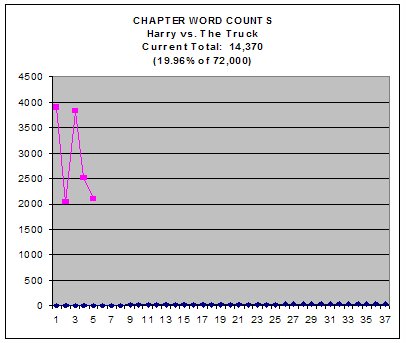
Current Word Count: 14,370.
COMMENTS:
Blogger was having technical difficulties last week which made it impossible to post the usual tables. However, it appears this feature is working again now, so hopefully the tables for this week will appear following these comments.
I edited all previous material on the current novel (HARRY VS. THE TRUCK) and met the goal of adding two additional chapters. I am updating my Master Scene List as I go, and am also keeping notes for additional ideas I am having already for the editing phase for this novel, scenes to add that I didn't think of until after I had passed where they would go. So, I'm organized, keeping organizational overhead to a minimum, keeping the focus on following the basic outline yet also discovering the story as I go, and seeing lots and lots of possibilities for this novel to turn out to be something very meaningful.
However, it remains difficult to write, in that it deals with some heavy issues, and I'm not happy about that. A lot of my story ideas over the past decade plus have dealt with heavy issues, and in part the weight of these issues has bogged down the writing. I am making progress with this novel, and with my new process, which I tried out for the first time with my last novel, THE REFLECTING STONE, I am confident I can actually finish this novel. However, getting there is trying and I don't enjoy the heavy issues. I still have to keep my sights on the larger picture, and the ending, and know that going through this is worthwhile because it will end in a good way, but it doesn't really alleviate the discomfort of dealing with the heavy issues along the way. It just helps me remember there is a point to doing it. There have been some times in writing when I gain a fairly positive outlook on the work and feel good while writing, and the tone of the prose has been developing nicely toward a more lighthearted approach, which I intended from the outset. So, there are signs that I am making progress and maybe eventually I will have it down well enough that I can write without too much discomfort.
Regarding THE REFLECTING STONE, I finished the Master Scene List for that novel and now have only one task left before I can declare Phase One of the editing of it complete: I have to revisit the Mythology and figure out how to simplify it somewhat. I want to consolidate the various Ages of that world (it's a fantasy novel). Somehow I want it to be easier to follow, even though it's not all that complicated, but still it should be very simple for purposes of the story.
I have also been at work on a couple of postings for my new TIPS & TRICKS blog, which is still getting off the ground. I hope to post them sometime this coming week.
In conclusion, and returning to HARRY VS. THE TRUCK, my new goals will be to write two more chapters. It is definitely harder these days to keep the progress going because it's summer and there are other things to do these days. The tables below summarize how far the work has come already.
Adrian

Sunday, June 11, 2006
PROGRESS UPDATE (6/11/06)
THIS WEEK'S GOAL:
Complete Chapters 2 & 3 of New Novel.
PROGRESS:
Mission Accomplished!
CURRENT WORD COUNT:
8,492 Words.
CURRENT PERCENTAGE:
11.79% if max word count is 72,000.
COMMENTS:
It was hard to find time to write this week. The change in weather will be an obstacle. It's summer now, if not yet officially. There are more things to do and a different rhythm to things. Still, I didn't blow it off but got down to work when I could and did meet my minimum goal of two chapters.
This new novel is beginning to take shape after three chapters and over 8,000 words. I found a few surprises already, including significant new characters that cropped up to provide the main character with more opportunities to interact. They were intended to be minor characters whose parts were confined within the chapters where they occur, but they turned out to be very interesting and colorful and added a lot to the story. I wouldn't be surprised if two of these characters don't show up again later in the story. I sense intuition at work here, an awareness there are some things that could be dramatized and drawn out through their participation.
Also, for the first time I found myself weaving in some discussion of issues that I care about but which are not directly in the line of the plot. They are relevant, very much so, but not anchored to the main plot. I have always wanted to weave in such things, social issues, comments on life or whatever, and finally I'm finding that flow is there. The more I write, the more I find I can actually express. Sometimes it feels there is a lot inside I just can't get down on the page no matter how hard I try. I'm finding more of that is getting down on the page now and that feels great. These things are not the direct plot line issues, which I have no problem dealing with head-on. They are ancillary comments that draw out the larger themes embraced by the story and add depth and perspective. They make the overall story richer.
I reported in the last posting that I consolidated two chapters in writing Chapter 2 (it contains what would have been Chapters 2 & 3 according to my original outline). The same thing happened again with Chapter 3: it covers what would have been Chapters 4 & 5. Consolidation is a type of shortening, but the chapter lengths are a bit longer than I intended, so I'm not so far off from where I thought I would be in terms of word count. It's basically an organization issue, wanting to keep a flow and make better use of the goal / complication / resolution paradigm. As written there is more pull and more punch and that's what I want. I have no fear of running short. There is plenty of story to tell. This just saves more room for later when I get to the really good stuff. Also, this consolidation means I will enter ACT TWO at a slightly different point in the story than I had thought I would. That's fine. It's a better breaking point with this new focus. So, I have a plan and I'm also flexible, keeping the larger picture and major events in mind.
There is one concern, which is that some of what this novel deals with is pretty heavy stuff. I find it hard to write about things that are emotionally charged and negative, but sometimes that must be. I am an optimist and want to keep it positive. I don't want to write negative things that would discourage people, but positive things that give people hope and suggest ways to overcome challenges. To do that, though, I sometimes have to wade through the "dark side". I brace myself for it and keep a perspective on the larger novel, remembering how things will turn out in the end. That helps me to keep working through the difficult material. By the way, this is not a tragic or depressing story, even if a couple of issues it inevitably raises are quite heavy. It is a story that can be expressed in a lighter vein, and that is what I am attempting, while also recognizing the seriousness of some of what it touches on.
I also have gained more courage to face the challenge of the first draft. I am more willing to accept it with all its imperfections, knowing that it is only a step along the way, and that I have to get something down in order to see what all I have to work with, and then I can change things as necessary to amplify the best stuff and remove what doesn't work. I have felt some disdain, "here I go again", remembering the long haul to get through the last draft for my other novel completed a few weeks ago. It's almost painful to think of all that work ahead again for this new novel, but it's going quickly. I'm already about 12% done and I've only sat down to write on three occasions, since time has been limited. I'm producing about half the output I want to. I hope that will increase soon.
NEXT WEEK'S CHAPTER GOAL:
Complete Chapters 4 & 5.
NEXT WEEK'S WORD COUNT GOAL:
None -- although each chapter should be around 2,000 words.
Adrian
Tuesday, June 06, 2006
HARRY: Chapter 2 Done
Finished chapter 2 of HARRY VS. THE TRUCK. Total word count now 5,712 words. I moved a chunk from the end of chapter 1 and used it to start chapter 2, creating a better breaking point between the two chapters. While composing new material, it turns out I consolidated chapters 2 and 3 and covered both goals within the one chapter. It's clear I won't be following my outline exactly, although I am following the storyline it contains. That's okay. I'm blending planning with discovery to achieve a healthy balance. Even though I'm now short a chapter, the total word count is still on track because the first chapter was longer and the second chapter was not short either.
The sense of goals and what the main character learns is certainly helping. I have a very clear sense of goal/complication/resolution at this point.
The work goes on.
Adrian
Sunday, June 04, 2006
HAVE STARTED WRITING HARRY VS. THE TRUCK
It's official -- I've begun the writing phase of HARRY VS. THE TRUCK!
This past week I reviewed my notes and answered the last remaining plot questions that came to light when I created the detailed chapter descriptions. There were a few critical issues that needed addressing, and I knew I couldn't write very much until I solved them. I found answers that I'm very happy with and feel are solid and will work well.
I also created a few new tables to help with drawing out the internal and external motivations, goals and conflicts and what the main character learns over the course of the story. As noted in my last posting, this was the area I wanted to target as I seek to improve my skills, and I definitely feel I have learned and put into use important concepts that will make a noticeable difference as I write this novel.
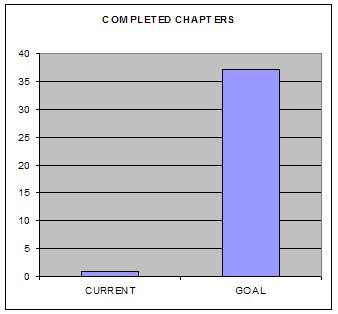
At this point, I have completed the first chapter out of a projected 37 chapters (see chart below). The word count for chapter one is 3,881 words.
I also wrote the ending of the final chapter, another 394 words. This was fun to do and I did it easily, since the ending is very specific and I have a clear sense of it. I feel good going into the writing knowing exactly how I want the story to end although I will, of course, change the ending as needed when I get there if a better idea comes along.
Regarding weekly goals and progress reports:
I will resume making weekly progress reports, usually on Sundays, sharing how much work I was able to complete since the last progress report. As for weekly writing goals, I have decided not to use word counts as a goal, but to focus on how many chapters I can complete in a week, regardless of their individual word counts. My focus on word counts when writing my last novel was helpful to me, but I no longer doubt I can churn out words on a weekly basis. The real issue is how many chapters, since they are the units I am working with. There will be 37 in all, acording to my initial plan. I want the novel to come in around 60,000 to 72,000 words total. That means I want shorter chapters, ranging from 1,600 to 3,000 words, typically around 2,000 words. In comparison, in my last novel the chapters ran around 10,000 words. I want chapters to focus primarily on one master scene each, although a short scene at the beginning or end may be appropriate in some cases. I have two scenes in the first chapter, the line break showing the passage of a few uneventful hours in what is otherwise a continuous scene.
As for how many chapters I will try to write each week, I will set a minimum goal of two to start with. I anticipate raising that in a week or two as the writing gets underway. Ideally, I'd like to write a chapter a day, since they are shorter this time around. Maybe 5 a week. At 2,000 words each that would match my earlier word count goal of 10,000 words a week. However, I will have to see how much time I have available and how consistent I am able to be. It's more fun to exceed a goal than to feel you can never reach one, so setting a reasonable target is wise. Two chapters a week should not be difficult to manage and leaves me room to exceed it when time permits.
Regarding the editing on THE REFLECTING STONE, I will continue to work on that as I write HARRY VS. THE TRUCK. I have enjoyed the past couple of weeks in which my writing-related workload was lighter. I needed a break after the long haul since October, but now I'm ready to dive in with a new draft. I'm eager to get another completed draft under my belt, strengthening my confidence that I can get things done. The editing of the THE REFLECTING STONE is still a priority, but I am placing it second to the new draft for now. This break will allow me to be more objective when I do start work on it in earnest in the coming weeks. If nothing else, I feel I can finish the draft of HARRY VS. THE TRUCK in 4-6 weeks, and will then devote my attention full-time to finishing up THE REFLECTING STONE. Also, during the coming month I will begin researching publishers and agents that might have an interest in THE REFLECTING STONE so that I will be ready to write query letters as I do the final polish on that manuscript.
Check back for my weekly progress reports, usually posted on Sundays, and other updates during the week as time permits!
Off and running and happy to be back in writing mode!
Adrian
NEXT WEEK'S CHAPTER GOAL: COMPLETE CHAPTERS 2 & 3
NEXT WEEK'S WORD COUNT GOAL: NONE!*
*But each chapter should run 1600-3000 words.
Sunday, May 28, 2006
Taking Another Week to Plan
I've been re-reading a number of articles available online (see links in the sidebar) and also a couple of books on writing, revisiting concepts again and again, each time gaining a better understanding of the various pieces of the process and how things fit together. My focus is on goals, both internal and external. This relates to motivation, obviously, and the emotional arc of the main character, how to tie things together not just on the surface level of an action plot, but on a deeper level related to the inner life of the main character...what the character needs to learn, how he needs to grow over time, how he must change internally in order to finally solve the external problems and prevail during the final climactic scene.
In fact, I've been making so much progress with expanding and deepening my knowledge of these concepts, that I want to take another week to continue working on this. One of the ways I know this is helping is that I have compared some tables and notes I made back in October when I was first planning THE REFLECTING STONE with more recent tables I made this past week for both THE REFLECTING STONE and HARRY VS. THE TRUCK, and I've seen an enormous amount of growth in my understanding of how things are tied together. I don't want to short-change this growth by rushing too quickly into another draft.
Working with the two novels at the same time is actually helpful to me. Editing one and planning another allows me to have a fresh look at new material while revisiting material I know in detail from the recently finished draft. Working on the same concepts for both novels helps me to see the same concepts from different perspectives, to try out ideas and see how they play out in different contexts. I can see what is the same, what is different, what is constant or universal.
I will need to do some significant tweaking to the draft for THE REFLECTING STONE in order to heighten the sense of goal-directedness. I tend to slip too easily into a writing mode where things just happen. Although I knew this going in and made a substantial effort to counteract this tendency by establishing clear goals, there is still this quality that things sort of just happen and the main character is swept along. Those things that seem to just happen are great events for the novel, perfectly suited, but I need to edit the way I introduce these things to strengthen the sense that the main character makes decisions and wants to go in certain directions. Also, some things I handed to him on a silver platter that I now see he needs to fight for, seek out, win for himself.
I haven't finished the Goals/Complications/Resolutions Table for THE REFLECTING STONE as I had planned, but I have written several pages of notes that help establish a very solid foundation for the main character's goals. I feel I have finally answered clearly in my own mind some key plot questions, particularly pertaining to the ending of the story, that I had never fully settled on. So, I did accomplish a good bit of work, just not the exact items I had planned to do. Again, I need more time to do a thorough job at this point.
As for HARRY VS. THE STONE, I created as similar set of notes for that novel that have helped establish a much more solid foundation for the goals. As I mentioned in previous postings, I have already completed chapter descriptions for 37 chapters, the entire projected story, but still I must edit that material. In order to do a good job with that, to really get the quality of the work to where I want it, I realized I needed to satisfy some questions I had about motivation, emotional arc, what the character needs to learn, etc. So, now that I have this solid foundation, and it's definitely very solid compared to what I was working with just a week ago, I'll have the opportunity in this coming week to go back through these 37 chapters and do a much better job of editing than I would have done had I simply rushed through it this weekend to start writing immdediately. Again, another week will be very helpful. The effort spent on planning up front makes for a better draft, and saves a lot of effort in going back and fixing things later in the editing. I want to launch each novel in the best way possible to save time on the other end.
What has been happening these past days in terms of making progress in my understanding and skills is similar to what happened earlier in the process when I was developing THE REFLECTING STONE. At that time I saw the connection between theme and plot and used theme as a way to help select plot events. That certainly helped me to create much better outlines. What I am working on now is adding the dimension of character, of the character's inner life, internal goals, need to learn something, to grow and change. This is much more powerful stuff, although theme is obviously still an important concept. I'm really happy that I'm finally "getting it". Even though I've read all these articles and thought about all this stuff before, it is connecting for me on a deeper level now. Even though I worked with this in planning THE REFLECTING STONE, I see it much more clearly now. Real growth!
Wishing everyone else working on a novel, or contemplating how to write one, the very best!
Adrian
Saturday, May 27, 2006
Coming Soon: TIPS & TRICKS
Sometime soon, as soon as I have the time for it, I'll be launching my new blog, TIPS & TRICKS, a place to share details of the process I use to write a novel.
In this blog, CHRONICLING THE NOVEL, I am reporting on my actual progress, sharing the ups and downs, the weekly goals, and what I'm learning or dealing with along the way. This blog is the "experience of doing it" blog. The TIPS & TRICKS blog will be more like a reference of generic information for writers, to-do lists, checklists, step-by-step explanations, examples of my tables, etc.
I'll eventually put links in postings in this blog to information I give in detail in the TIPS & TRICKS blog for those who want to read more about the how-to of it all. If I can figure out a way to provide files for download online through Blogger, then I'll also put sample files of tables, spreadhseets, etc., that I use there for download for free in case they are of use to other writers.
Adrian
Understanding Better the Connections Between Internal and External Goals
As I take an extra week to plan my next novel, HARRY VS. THE TRUCK, focusing on internal and external goals, complications and resolutions (which, coincidentally, I'm also documenting for my last novel, THE REFLECTING STONE), I am seeing progress in increasing my understanding of the importance of both types of goals, and how they are related to each other.
I was very excited earlier this week when I was watching the season finale of "LOST" on TV, not just because it was an interesting episode, but because I saw a direct correlation between the internal and external goals of one of the characters in one of the scenes. The connection just jumped out at me, even though I wasn't thinking critically about the plot structure of the episode -- I was just watching it to enjoy it. This happens to you when you focus on the art and craft of story-telling. You end up seeing the structure in someone else's story, even if you weren't looking for it. I won't go into detail about the "LOST" scene, but it was an exciting moment for me, when I suddenly realized a deeper sense of the connectivity between external and internal goals. It's great when you can bring the two together very closely, as they did in that scene. It's interesting that there really was no new information for me in that realization -- I didn't actually learn anything I didn't already know -- I just saw what I knew about goals being played out and connected with it more deeply. My understanding of what I already know was deepening. That happens. I was able to think of my own stories, and see some examples there as well.
I am very happy that I decided to take this extra week to reflect further on external and internal goals. As I am documenting this information in THE REFLECTING STONE I am seeing the importance of planning for it up front. I am happy that I will start HARRY VS. THE STONE with a well-defined set of goals for each chapter, both external and internal, to help me keep the chapters on track. This planning work will save time later in the editing. I had a great deal of this in place in the planning of THE REFLECTING STONE, but there were a few holes, which I'm discovering now (see posting immediately prior to this one).
Adrian
Progress on THE REFLECTING STONE Goals, Complications, Resolutions Table
I have finished the first half of the table I'm filling in for THE REFLECTING STONE in which I describe briefly the goals, complications and resolutions for each scene.
Most of the scenes are easy to do, since I had clear goals for the main character at each step along the way. Note that the main character appears as the POV character in all scenes; I am not juggling multiple viewpoint characters at this time.
A few scenes are of the type where things are just happening, the logical next step in someone's day, and there isn't a clear plot-related or main-conflict-related goal in those scenes. However, each of those scenes does advance the story in some way, such as giving us more information about something we need to know about, or introducing a new character to us that is important to the overall story and reappears later, or allowing the main character to talk to someone and share thoughts or feelings (a "reaction scene").
Right now I am wrestling with this issue. I had intended that every scene should have a clear goal for the POV character, but I recognize that there is a need for other types of information along the way. Observing the character's reactions is important. He needs to process the information he learns, to respond emotionally to things that have already happened, or ponder what he is about to face. Not every scene realistically needs to be "man vs. man-eating tiger" -- the story also benefits from "man is terrified he will soon face man-eating tiger" moments.
I think the challenge then is to try to make the scenes do double or triple duty, a concept I was aware of when I wrote but perhaps didn't always fully realize on the page. Can I introduce a new character who is of continuing importance, show a reaction, and still have a forward-moving, plot-related goal? I'll be reflecting on these scenes and looking for ways to consolidate, omit, shorten, expand, etc., to accomplish this. Some scenes may well end up merging togther, unnecessary fragments falling to the cutting room floor; others may well find a new action emerging.
In spite of needing to tackle this issue, I am encouraged that the number of scenes about which I have serious questions is really very small -- a handful compared to the total number of scenes. I did manage to keep clear goals in mind most of the time and to keep the story clearly moving forward. Even when it slows down there is still a purpose. I suppose these other purposes are in fact "plot-related", they just do not contain the typical "action-directed" type of plot goal.
As I've commented on in previous postings, the work I'm doing right now in creating and filling in tables for THE REFLECTING STONE is part of Phase One of my editing process, wherein I document "what is". I did a lot of planning when I started work on this novel, then did a lot of writing, and now that I have a completed draft (113,000+ words), I need to document what I actually wrote. I usually wrote what I meant to write according to the tables I created in planning the novel, but sometimes not. Extra scenes were created along the way, and some chapters took new twists and turns not accounted for in the original planning. I did try to update my notes along the way, but not all the new information made it into them. Therefore, I have started fresh in the documentation process with a look back at what I actually did write.
To help in keeping track of odd things I'm discovering as I do this documentation work, I have created another table called the Incongruities Table (love that name). Here I can make brief notes for any scenes where I notice something out of place, such as NO CLEAR GOAL (my "concern-du-jour"). Eventually I'll use the Incongruities Table, the Master Scene List (see previous postings), and the Goals, Complications, Resolutions Table to reflect on the scenes and ways of fixing problems (that work is Phase Two, planning the changes for the actual editing). I hope that whatever changes I later think of will be "localized changes" for the most part, things I can fix or change in a scene or two here or there, rather than "global changes" where I alter something so fundamental to the story that I have to hunt down many other places in the manuscript to make changes to accommodate the new information. In fact, I will specifically try to avoid making those kinds of changes! I don't think the story needs any, anyway, since I did so much planning before I wrote it and so much of it does fit together so well.
I hope to have the Goals Table for THE REFLECTING STONE completed later today (Saturday). This will allow me time today and tomorrow to revisit the planning work for HARRY VS. THE TRUCK. When I finish that, I can begin the writing phase for that novel, which I plan to do on Sunday or Monday. I'll advance to Phase Two of the editing for THE REFLECTING STONE once I've started writing HARRY VS. THE TRUCK. By waiting a little before jumping into the editing of THE REFLECTING STONE, I'm giving myself distance, so that I can bring a fresh perspective to the editing. I still intend to finish THE REFLECTING STONE this summer so I can start shopping it around. I'm eager for the moment when I print out the final copy of the manuscript and start composing letters to publishers and agents!
Adrian
Thursday, May 25, 2006
1st Version of New Chapter Descriptions Done
I was able to finish all 37 chapter descriptions yesterday for my new novel, HARRY VS. THE TRUCK. My new table definitely helped me to do that. No, it's not an oak table, nor a mahogany table, nor a stainless steel table. It's a word processing table, the kind that is of value and relevance to a writer. Read the previous posting for a sense of the kinds of information it prompts me to think about as I plan chapters.
The only concern I have with the plan for the new novel is that it becomes somewhat predictable. I certainly don't want that to happen! I'm focusing my thoughts on how to continue a plot at a certain point where the reader thinks he/she knows what is about to happen, but then what really happens next is a surprise, but it makes sense nonetheless in light of what has happened before in the plot. Coming up with such stuff requires unfettered creativity on the one hand, and creativity that is cognizant of what has gone before on the other hand.
I'll let the chapter descriptions sit for a day or two then I'll go back over them to see how it all ties together and whether I can use my imagination and its flights of fancy to create some surprising twists along the way. Don't know if I will succeed in that, but I'll do what I can. I think also the plot has a certain "dramatic need" -- the main character is on a certain path resolving internal and external conflicts, and certain scenes or events need to be there for that to fit together and make sense. Nonetheless, I don't want it to be entirely predictable!
As I let this sit, I will see whether I can get back to work on my previous novel, THE REFELCTING STONE. I need to compose the list of goals/complications/resolutions for each chapter of the complete draft that I finished recently. I don't mention that I finished it recently in order to brag that I actually finished a draft recently, something I already announced with fanfare and fireworks when it occurred (see archive for May for previous posting), but I mention it for the sake of visitors to this blog site who might not have been following along at that point.
As the planning for HARRY VS. THE TRUCK is now almost complete, I'm getting very excited all over again as I contemplate embarking on yet another draft!
Adrian
Wednesday, May 24, 2006
Making Progress with Planning New Novel
Here's an update mid-week as I'm planning HARRY VS. THE TRUCK.
I revised, revised again, then completely reworked the table I use to plan steps in my outline, combining some features from a character development worksheet I had made previously, and wound up with a really nice table to use in planning chapters. I've been using it and enjoying it thoroughly. It prompts me to provide additional information (in very brief form) that helps me get into the mindset of the POV character, and see the plot more intensely from the 'inside' of a character living through it. This really helps sharpen my focus and come up with ideas.
I still base the chapter work on the 12-step outline, but now I have expanded to break down each step into multiple chapters, and am thinking in terms of goals, complications and resolutions for each chapter -- both external and internal -- as well as what the POV character learns and how he/she grows, as well as other details.
I'm really pleased with this new table and have made excellent progress in planning 12 chapters already. I'm succeeding in making this transition from "step-thinking" to "chapter-thinking". Instead of longer chapters with multiple scenes, I am breaking it down so that each chapter will consist of one master scene and not be too long. I like the idea of chapters around 2,000 words each, no shorter typically than about 1,500 words, no longer than 3,000 words, and each chapter containing one continuous scene (although there could occasionally be very short pieces on either end as transitions).
This progression into finer detail (step to chapter) is part of a larger process I am using of working from smaller to larger, from overview to detail. I start with a statement, "This is a story about a [main character] who wants/needs...." and figure out the theme, the overall major external and internal goals, and then figure out the focus of each act, then flesh that out to the 12-step outline with external and internal goals, then finally am at this point of taking the 12 steps from the outline and breaking them down into scenes that are the basis of chapters. It's a system that is working very well for me.
I am not doing anything with THE REFLECTING STONE at this time since I am wrapped up in planning the chapters for HARRY VS. THE TRUCK, and realitically this might be all I get done this week, but with the level of insight I'm getting, and the detail, and the fact that I am finally succeeding on this level in the planning stage (for all the effort on THE REFLECTING STONE, I never quite got to this level of detail in the planning for it in spite of huge amounts of work and notes), I think it's worthwhile to stick with this until it's done, which it should be within a few days. I'll want to go over it when it's done and revise, but then that's it -- I'm ready to start writing!
Sunday will conclude the planning and launch the writing of HARRY VS. THE TRUCK. If I end up dragging my feet on the editing of THE REFLECTING STONE, fitting it in where I can in smaller bits, that's fine. Once I complete the draft of HARRY, I'll simply swtich my attention full-time to THE REFLECTING STONE, as I will have had a break from it by then and will be able to bring a fresh perspective to it. So, whatever works! I'm just keeping busy and know that all my efforts are solid and making progress at this time -- I'm not wasting any time or spinning my wheels, that's for sure.
Adrian
Sunday, May 21, 2006
Will Take Another Week to Plan Next Novel
After more reflection I've decided to take one more week to plan HARRY VS. THE TRUCK. Although I feel I could start the novel today, I do not want to rush it. Since I'll be taking another week, I will hold off on posting the back-cover blurb until next week, in case it is revised further.
What drives me to take more time, when I'm so eager to get into the writing, is an idea I have that I should target one or two parts of the process with each successive novel and do my best to improve in those areas.
I know one area I want to target with my next novel is the planning of scenes, making sure I have a clear sense of a goal, complication and resolution for each one before I start writing it. With my last novel, I usually did, but sometimes I was figuring things out as I wrote, and that is frustrating to me since I like to know what I'm doing as much as possible. In particular, I want more direct practice in thinking of complications -- the character wants to do something, but what can happen to make that difficult? To thwart the effort altogether? I want to sharpen my ability to quickly grasp relevant obstacles.
A second area is to try to come up with a more complete Master Scene List for my next novel as part of the planning phase, rather than looking back during the editing phase. Again, I did create this for my last novel, but there were a number of scenes I eneded up writing that I did not envision initially. It's fine to go with inpspiration -- I just want to sharpen my ability to anticipate things that need to be there. To accomplish this, I want to take the twelve steps in my outline and break them down into scenes (two or three each). These scenes could be considered chapters when the novel is finished.
Therefore, I'll take the coming week to flesh out the 12-step outline into a Master Scene List and have clear goals / complications / resolutions for the scenes. I should finish this by the weekend, no later than next Sunday. What I produce could serve as a list of actual chapters.
I'll post during the week on any breakthroughs, obstacles, or insights I gain along the way as I take my planning to the next level!
Adrian
Subscribe to:
Posts (Atom)


 Posts
Posts