Sunday, December 17, 2006
First Chapter of THE ISLE
The revised outline is one that excites me. The story is one that excites me. I came up with several twists and turns that were unexpected to me, and decided to throw them in and let the story grow some more. What I ended up with includes the main conflicts/issues I started out with, but now has even more surprises in store for the Reader. (Notice I capitalize "Reader" to show my respect for anyone who would think to read my fiction.)
Anyway, I felt I had a solid enough footing, clear anchor points, enough details and events and a strong sense of the main characters' personalities, so I went ahead and took the plunge. I'm most of the way done with Chapter 1 now. It currently runs around 3,600 words. I am only intending on a minimum of 2,000 words per chapter, and don't want them to run very long (like the 10,000-word length that is common in THE REFLECTING STONE). My style is clear and crisp and reads quickly.
The first chapter surprised me in that I got a few new characters who presented themselves, and another twist came up on two of the main characters -- nothing that alters who they are supposed to be for dramatic purposes, but a new slant on how to represent that. I know, it's all very cryptic, but this is a mysterious story (heck, with a title like THE ISLE it should have some mystery in it!). Anyway, the new ideas that come up as I write help keep me excited about the story, and I keep them (so far) in line with the outline.
I took time out for other things this past weekend, wanting to finish up some of that holiday-preparedness that is so important this time of year, so I didn't spend as much time writing as I might have, but I'll catch up tonight (Sunday) and will now keep my nose to the grindstone so I can finish this first draft within December.
It feels great to be connecting with a story, setting aside my meta-level thoughts about the process and just enjoying the sense of adventure and discovery. It helps that it's such an interesting story for me to work with.
Wishing everyone else well as they enjoy their stories this holiday season,
Adrian

Thursday, December 14, 2006
Update on Outline
The past several days I've reworked the outline a few times, using a larger group, a middle-sized group (as a compromise), and emphasizing different aspects of the initial storyline to see how things would play out depending on what I focus on. Each time through I felt frustrated that I was re-doing the same work over and over and over, wishing I'd just get it right and say "go with it", but also I knew each time I was coming up with exciting new ideas for the pool and in the end I was able to go with the best set of ideas from that expanded pool and prodeuce a final version that I like a whole lot. So, it was fun in a way, certainly frustrating as I wanted to finish up and start writing, and ultimately rewarding: the new revised outline is one I'm very excited about. Also, I found a way to keep a fantasy element in it, as well as a mystery.... (Ooh....)
So, I'll take time for any last thoughts, tweak things a bit if needed, and then dive in and start writing. I might start the writing later tonight. I am happy it's winter again as I have more time during this time of the year to write.
My current timeline for THE ISLE is to finish the first draft within December, and the second draft within January. Depending on how it goes, I hope to have a completed manuscript by March, and to start shopping it around as soon as it is finished. Meanwhile, I'll work on THE REFLECTING STONE as I can, and prepare for the next novel.
Glad to be back at it, and the break certainly made a lot of difference.
Happy Holidays,
Adrian
Sunday, December 10, 2006
Adding Characters, Changing Outline, Pre-Writing
When I looked over the fine outline I had made for THE ISLE, which is perfectly viable, not a thing wrong with it, I allowed myself to ask one question which had been nagging me when creating the outline for the story, but which I had avoided until finally I realized I just had to ask it and ponder the possibilities....
The question was, whether to stay focused as I was on four main characters, and keep the novel centered around just these four characters' experiences on THE ISLE, or whether I should keep this basic premise but expand to a larger group of characters on THE ISLE.
When I face questions like this, my strategy for dealing with them is to open a text document (I use Word for this) and write the question, then brainstorm and type out an answer. If I don't know the answer, then I brainstorm a list of possible answers, then go into detail for each possibility considering exactly how it would play out or impact other things, etc., as the case may be. Then, I read over my comments, reflect as needed, and when I'm ready to decide, either immediately or the following day, I then write a summary paragraph at the end stating which solution I chose and exactly why.
For every option I consider, I always explore the pro's and con's and list them, because when there are several viable options, it often comes down to choosing the one option that contains a certain pro the others don't adequately address, something I need for the story, in spite of whatever con's may come with it. This is typically where one direction for the story allows the characters to explore some issue or theme, and at the same time precludes them from experiencing something else that would have happened had things been different. Sometimes I can work those missed options in in other ways, but usually it does come down to some sort of "either/or" choice, and I never really get everything I want because logically it isn't possible, but I get the most important thing that will benefit the story in some essential manner.
Well, enough of the babbling....
In considering the possibiltiies, I also considered other stories that THE ISLE is related to, other well-known novels that deal with people on islands, and considered how having more or fewer people on my island would help or hinder the story and the characters' experiences, etc. I finally decided that although I had initially chosen to focus on just four characters and keep the experience rather intimate with such a small group, which made certain things more likely and more possible, I could still work some of that stuff in with a larger group but also would gain substantial drama from having a larger group present due to large-group dynamics, the sort of stuff that might happen with a larger group but that probably would not happen with a smaller group. My story is unique (of course), not a clone of other stories, but readers will certainly draw parallels to these others stories which everyone is familiar with (I'm not saying which ones they are yet). I need to be cognizant of those connections that readers will make, and it's not objectionable to me that I would pay homage in some way in my own story to some of these other great novels, while at the same time telling my own story with my own characters.
Anyway, it all boils down to the decision to go ahead and expand the group from four to a larger number, which I haven't settled on exactly yet, but I know it'll be 12 to 20 or so. Big enough for large-group dynamics, small enough that I can still focus on the few central characters and to a lesser extent with other characters who will now be present.
Apart from all of these characters, there are also the minor characters I had originally envisioned, people not on THE ISLE. They will still be in the story, although I will likely now focus more on the events that take place on THE ISLE and not spend story time before and after these events by showing much of what happens off THE ISLE with those other minor characters. Those characters may end up on the cutting room floor, but they are there as part of the back-story if nothing else.
This adjustment dictates a fundamental change in the specifics of the outline, so I am having to redo the entire outline, drawing from what I already did -- the basic premise is the same -- but now developing it on two levels, the large-group level and the individual-character level.
The past few days I've been rethinking the story, brainstorming and writing notes of how things might play out now that there are more characters, and developing other plot lines, threads that will be woven together as the individuals try to deal with other individuals and also deal with the larger group goals. I also did more pre-writing, writing another attempt at the first chapter, but I am not sure yet that I have found the proper starting point or voice for the story. I want to do more pre-writing, maybe try another two or three versions of the start of the story, maybe dive in and write a scene from somewhere in the story, just to play with the material, get a clearer sense of the characters' voices. I had though previously of doing a summary of the story from each charater's POV -- that's a very worthwhile way to prepare to write the first draft. I had a clear sense of the four characters, but with the changes, the characters have all been morphed into new versions, so I have to go back to the drawing board so to speak and reconnect with them.
Some pluses I've noticed as I work on this, ways I've grown from my work on my previous novel....
One plus has been the prose I'm writing is tighter from the get-go. Reading THE MARSHALL PLAN earlier this year has helped since the books provides concrete examples of how to write tigher prose. I commented on the book in an earlier posting and gave a few examples.
Another plus has been that I can see a way now to both plan the story and also leave things open to inspiration along the way. Having some experience with detailed outlining under my belt from my last novel, I can much more readily envision how one part of the story is tied to other parts. I can see keeping the twelve "pillars" or main plot points in mind, yet leaving it open exactly how I get from one to the other as I write the story, "discovering" it as I go. To help me keep that in-between writing on track, I can draw on another plus, which has been my increased focus on goals and complications. I focused on that aspect in my planning earlier this year and it paid off, training me to see things in that context. It's surprisingly easy to do that now, a perspective that is more ingrained than it was before. Essentially, for each scene, I have a clear goal for the POV character, and I brainstorm ways things can go wrong for a person with such a goal in that scene. I then throw complications at the character, and allow the ending to be either that the goal is not reached, or reached but not as intended, or the goal must now be replaced with another goal since the first goal proved unworkable, impossible or unnecessary. In other words, constant DRAMA, something I avoid in real life like the plague, but which is the stuff novels are made of. Of course, in selecting these complications, I keep an eye out on the larger story, the context of things, the symbolism, etc., to choose things that make sense, not just random events that are possible. Also, the characters must stay "in character" at all times in how they deal with the complications, and, yes, the complications are designed to draw out some qualities of the individuals characters who are facing them to affect their character development.
I will continue outlining until this new version is done, any day now. In spite of feeling better able to go it free-form between plot points I don't want to attempt that yet, afraid I'll get lost. I like knowing the story up front before I begin writing it. I will continue pre-writing to sharpen the characters' voices. And, within this week, I'll finally be ready to embark on the first draft outright, which I then intend to keep at until finished, and to finish it within December.
Happy Holidays to all the other novel-writers out there,
Adrian
Tuesday, December 05, 2006
Beginning Work On "THE ISLE"
I'm still finishing up the other project, the non-writing project I've focused on for probably two months now. It'll be done soon, and I'll post details about it once it is. It's really cool.
As that work is winding down to conclusion, I've had the strong desire to get back to my writing. I've decided to stay completely away from any of the novels I had worked on previously and never managed to finish. There is just too much risk of getting caught up in old patterns that weren't successful before, in terms of getting things completed.
In that vein, I've come up with a brand new idea for a novel with the working title of THE ISLE. I am drawing inspiration from a few other novels that have been written that involve islands, but the story and characters are unique. I like the story and it's nice to have a warm, tropical island to spend time on in my writing when otherwise the cold winter weather has arrived.
In the past few days I did some brainstorming, generating some initial plot notes, then used the templates for the tables and charts that I developed last year, a way to further develop the plot and characters. I also wrote a complete and detailed outline of the entire story. At this point I am going to take one more day to look over the outline and reflect on some possible changes, enhancements, and maybe take a little time to do some pre-writing in preparation. One thing I did last year on my last novel was to write a synopsis of the story from each of the main character's POV. It helped a lot with getting me into each character's head. I feel I already understand their personalities and goals/issues in the story, and how they interact, after the outlining, which was done with the four main characters in mind at each step along the way. However, a little writing to get the engines warmed up wouldn't hurt, if I can manage the patience to do it. I'm ready to dive in and start writing, so I don't want to linger too much longer at this planning stage. It went quickly this time and everything fell into place. It helps that I've planned a few novels over the past year. Each time I work through my tables and charts and create outlines it gets easier and easier for me, and I see much more readily how things fit together. Practice makes for improvement, that's for sure. I've clearly grown a lot over the past year.
Well, I'll post again later this week after I have the first chapter done. My target length is a standard 60,000 to 72,000 words, and I really don't want it to go beyond that. I want to finish the first draft by the end of December, a realistic goal. I want to get it done and out the door, and along the way to use the engergy from this to help push me back to the editing of my last novel, which is still in limbo at the moment. I will get it done, though! And I look forward to sending each of them out to publishers/agents as soon as they are ready. I also look forward to sharing details of my other exciting project in the coming weeks.
Happy Holidays,
Adrian
Saturday, November 25, 2006
Update on November
It's been longer than usual since I updated this blog. Sorry for the delay, but there wasn't much to comment on. I've been working very steadily and very hard on another creative project, as mentioned previously, which does not involve writing although it is related to my writing interests. It's been fascinating and lots of fun, and a nice change of pace, a chance to exercise other aspects of my creativity and take a refreshing break from the stress of writing/editing on a sustained basis. Unfortunately, I have been so preoccupied with this other project that I have done very little for Nano ... I really only wrote one time, about 2200 words, a good beginning, and the story is mapped out, but I never followed through and continued it. November is almost over, and unless I plan to write 10k words every day for 5 days, I see little chance of completing the 50k word goal for Nano within November -- and, frankly, I really don't care. My interests are elsewhere at the moment, and so although I thought I should jump in on the Nano-wagon, obviously my heart wasn't in it and the other project has been so fascinating I haven't concerned myself much about it. So, I made a "false start" on the other novel in that I haven't committed in practice to the follow-through, and that's fine with me.
The other project is nearing completion, having taken much more time and energy than I had anticipated, but I love what I'm creating and look forward to sharing it soon, in the coming weeks. As I finish up this other project, I will certainly return to writing, both the editing which is "ongoing" (until finished!) and the new novel which I sort of almost started. The break has been doing me good and I look forward to being back in writer-mode within December, in earnest.
Wishing everyone a happy and low-stress (if possible) holiday season. There is so much going on in the world and the potential for so much change ahead in the near future, I sometimes feel it is important to do whatever you want to do now (as a writer) because who knows what will be relevant anymore in just a few short years....
Adrian
Tuesday, October 31, 2006
Yes, I'm Gonna Do Nano Again....
After thinking it over, I've decided to do Nanowrimo again this year. Last year was my first time, it was when I wrote my first draft of my current novel (the one I'm still editing). I have another novel already planned out, which I won't comment on at all except to say it's a gay novel (big surprise), and it's a powerful story and I hope I am able to finish it within November. I will intentionally keep the word count down for this next one, aiming for 60,000 words, no more than 72,000 words (same as last year, originally, except it turned into 120,000 words). I really WILL keep the word count down this year, regardless of the sacrifices I have to make to do that. I hope to finish the complete first draft in November. Last year I made 50,000 words after writing only 6 or 7 days out of the month, essentially once or twice a week each week. I can turn out the quantity when I'm in my productive writing mode. Even though my current novel is not finished (the editing of it), I think it's wise to take advantage of Nano as a push (the support of the online community is generally very positive). It's worthwhile to get the second novel written in first draft form, and I can then continue to focus on my current novel until that editing is complete, then turn to editing the new novel. I'm struggling a bit with this editing process, to be sure, and the positive experience of getting another draft down on paper will probably help encourage me in that work.
Thanks to Christian for encouraging me to get a writers' group started. His is for gay writers and I think that is best if you are a gay writer, since you will have others there who understand what you are writing about better than "just anybody" might. Of course, I wouldn't turn away anyone who is committed to their writing if they are open-minded, whether gay or not, if they would have something positive to contribute. We'll see on this . . . I am so busy these days I am not sure when the best time is to start yet another project, but it is one that should become a priority as soon as I think I have the time to devote to it. I'd like to start advertising for it within November, though.
The new novel is one based on an idea I've had for a very long time. I've tried to write the novel before but have not been successful because it is one that is very "near and dear to my heart". It comes from my life experience, in part, and from the experiences of others, and draws heavily on powerful emotions. That has made it harder to work on whenever I have attempted it before. I think I can do it this time. My last attempt at starting another novel did not turn out because in that case the emotions and topics associated with the novel were also rather dark or depressing, and I just didn't want to deal with all that during the summer, which should be a bright and happy time. This new novel is not necessarily so dark, just powerful, and ultimately uplifting, and I'm not worried about the negativity aspect of it. I'm excited to think that I might finally have a complete draft, written from scratch, within the next month.
Otherwise, I've been terribly busy with other projects during my "creative break", as I've commented before. I've enjoyed the past few weeks immensely, a time to be creative without focusing on writing or editing. I knew I might be doing Nano, so I think I've been recharging my creative batteries the past few weeks in anticipation of that, so I'd be ready to start writing the new novel now that November is upon us. It has certainly helped and I am ready to start. Golly, I think November begins just a few hours from now . . . I should go to the Nano site and sign up, if their servers can handle the additional traffic at this crunch-time.
One of my other creative projects is coming along, and I'll be announcing details about it in the coming weeks. It's very exciting.
Best of luck to anyone else out there about to embark on a month of furious novel-writing during National Novel Writing Month! Check out the Nanowrimo web site if you haven't already.
Adrian
Wednesday, October 18, 2006
Still On Break....
Still enjoying my break, recharging my batteries, and enjoying a lot of reading. I decided I should add a new blog to my little collection, one specifically on conlangs, since it's such an interesting and fun topic. So, look for that in the coming weeks.
I'm debating whether to participate in Nanowrimo this year. I did it last year for the first time. It was fun, but also a major drain becuase it was my sole focus in my free-time during the entire month. Still, it was fun....
I want to start a writing group, if I can find the right individuals. People in my general area, particulary those into fantasy fiction and any gay/lesbian writers. I've wanted to do this for several months, but haven't started it yet. Waiting for the weather to cool off. I think writing groups work better in the off-season. During the summer people have too many other things to do and often lose focus on their writing, from my experience in two other writing groups. It depends on the individuals involved.
Well, back to my break, and will get back to regular blogging soon.
Wishing everyone a productive Fall season!
Adrian
Wednesday, September 27, 2006
Taking In A Lot During My Break
Thanks for the comments to my last post. Glad to know I'm not the only one who feels the need for a break every now and again. I think it's important to replenish the soul, restore the energy. Don't want to drain the creative well too much, but let it refill itself and then carry on. I'm certainly committed to my efforts as a writer and am not wavering on that in any way, but I've been very tired lately, aggregate stress mostly, and working too many hours every week. The break is helping.
During this time, though, I'm not exactly kicking back. Since I downloaded the Google books, now around 1.6 gigabytes worth, I've been reading about history, philosophy, culture, and language, and exploring a whole range of new-to-me sites about conlangs on the internet. I'm creating a few conlangs. I had already created one (the secret language of the Mystics), and it appears in my current novel. One of the new ones will appear now as a second conlang in my current novel (the language of the villagers, including the hero). The other new conlangs will go in future novels. I'm developing cultures with them, and ideas for future novels. Integrating lots and lots of ideas I've accumulated over the past several years.
So, I'm officially "on break" yet still I am working. The work I'm doing now, certainly still very creative, isn't the same kind as writing/editing. With all the reading I'm doing, and the sense of creating just for the joy of it, I'm replenishing my soul, and rekindling my enthusiasm, so much so that I do wonder whether I might really want to focus on being a fantasy writer, rather than a "gay/lesbian" writer by category, who happens to write a variety of types of fiction (fantasy, real-world suspense and drama, possibly mystery). I know we're supposed to pick one thing and stick to it, but that's hard to do for some of us who have serious interests in more than one area.
Anyway, I'm still on break, and am keeping my novel in mind, too, just not trying to push myself on it right now so I don't burn out. I still have another major push ahead of me to finish the complete revision, and I sense I'm resting up now so I'll be refreshed and ready to launch into it in the coming weeks. I may end up doing a complete rewrite with a shorter word count (ca. 70,000 words, instead of the current 120,000 words). I know the story very well by now, and have learned a lot in the past year of working on it, so much so that I think a rewrite might improve it in ways that editing can't. Whichever way I proceed, I want to be gung-ho and ready when I get back to work on it, and push forward at that time with a strong momentum and a rapid pace, a dash toward the finish line.
Happy Autumn,
Adrian
Tuesday, September 19, 2006
Taking A "Creative Break"
I've been feeling a bit drained creatively the past few weeks, a gradual slide downhill. I think the many months I have been working on this novel are wearing on me. I think of Frodo trying to get that darned ring to Mount Doom. It's a long journey. I started working on it in October last year. It's almost been a year now. That's a long, sustained effort, for sure. I've only taken one real break during that time, when I finished the completed manuscript, to let it "cool" before I started editing it. Even then I pressed on, trying to start another novel. For the time being, I think my creative juices have run low and I need a "creative break", a break from trying to be so darned creative all the time, and also a chance to take something in, to replenish the well. A time to feed my creativity, nurture it along, rekindle the fire and passion, which are certainly still there, but which need a little nurturing right now.
Since I discovered Google Books I've downloaded over a gigabyte of information from them. I've been like a kid in a candy shop, as my last posting shows. It's been a real joy discovering all the stuff I can download for free that it is so very interesting to me. The books I've downloaded have even inspired me to come up with a non-fiction book I want to write. I have already created a basic outline for it, and a detailed outline of the first four (of eight) chapters. This is more creating, I know, when I feel I want a break from creating, but I couldn't resist. I can definitely see completing that book and feel it would be very marketable. Special interest, not a big seller, but a valuable book for its intended audience. I won't say any more about it, but I know it's a great idea and one I have the expertise to write. I think I'll keep working at this non-fiction book, and continue to work on it even as I return to editing and completing my Fantasy novel.
I also want to take time to read some of the books I've downloaded, and others I have on my list (current fiction titles). I need to take in ideas and information right now, feed my heart and soul, and give my novel more time to sit as I contemplate how I want the remaining chapters to go as I continue the edit. I can see turning it into two very different novels depending on which direction I want to take as I finish editing it. One would be pure fantasy, the other fantasy that is closer to historical fiction. It is certainly not historical fiction by any means, but I could create a more realistic sense of actual history, or change the names and continue with the fantasy aura. I've thought about this several times over the past months, and always decided to go with "fantasy that is based very loosely on history". I'll probably stay with it, but while I'm exploring this in greater depth right now at the very least I will be getting ideas of how to anchor future novels in a more historical context.
Anyway, I'm officially on a "creative break" for a short time, maybe 2-3 weeks, not long considering the many months involved in this novel-writing project. I look forward to blasting back into it with the fervor of a zealot once again, but only after taking time to feed my writer's soul.
Adrian
Friday, September 08, 2006
Google Books & Story Note
First, a comment that I've "discovered" Google Books -- and I have been absolutely elated, on Cloud Nine, in Seventh Heaven, I've died and gone to Valhalla, I've ascended and become a new life form, I've decided to give up smoking and I didn't even smoke to begin with, I -- I -- I -- well, you get the picture.
What an absolutely fantastic resource!
You have probably heard about it, but I'll mention it in case you haven't: through Google Books you can search and find complete online scans of an amazing variety and quantity of public domain books. The complete scans are usually available for free download as Adobe Acrobrat files.
I have downloaded over 100 megabytes already of high quality books from the late 1800's and early 1900's. I couldn't be happier. My smile is brighter, my clothes fit better, people that I don't even know greet me and wish me well, and restaurants seat me at the best tables without my even asking -- all this because I "discovered" Google Books.
And the amazing thing is . . . YOU CAN, TOO! Check it out.
And, a story note regarding my novel. I'm happy I've given myself a little time to rethink the chapters I'm editing, in light of the new scene I added to Chapter 4, and the very important scenes that I'm setting up through these two chapters. I think it's great to have this extra scene, and bring these two characters together to talk and sort some things out, but the way I wrote it, I think now I had them get a little too far ahead of themselves. In fact, a LOT too far (?). I think I need to edit it, rewriting a portion of it, to take out some of the advancements to their relationship and their understanding and acceptance of their situation. I realize that with what went before in previous chapters, the love interest character is not possibly going to react the way I wrote this. I wrote it the way I'd LIKE it to be, but this scene must wait for later. They have to get to that sometime by the end of the book, even in the last chapter. It's too much for them now. Yes, this is new wisdom, and it appears solid. I have a much clearer sense now of the mindset of the love interest character.
As I mentioned previously, while rethinking these things, I've also been "tinkering" with other scenes. I also went so far as to write 5,000 words of another novel in the third person, then go and rewrite all that as a first person narrative. I'm so eager to get the current novel done and work on other stories, I'm finding it hard to keep myself in check, but I am staying the course -- I don't want to allow myself to get too distracted with anything else until the current novel is through this first intensive edit.
I hope to finish adjustments on this one new scene this weekend. The rest of Chapter 4 will still need only minor tweaking and then I can work on that last scene of Chapter 5, which has always been so problematic. I'll be sure to schedule work time along with time to read those wonderful, priceless books I've been able to download from the wonderful Google people.
Adrian
Tuesday, September 05, 2006
You Gotta Check This Out!
My recent link updates included PLOTTERS & MANIPULATORS UNITED, Sherry Thomas' blog. I also previously mentioned a really cool posting she did on the "Great Divide", or what it was like to become a published author. Subsequent to that great posting, she has started a series of postings on rejection, which are fascinating to read. I strongly encourage visitors to my blog to check out Sherry Thomas' blog -- well worth the visit!
Adrian
Tinkering
For anyone new to my blog, you can check out earlier entries to see what it's about, and catch a sense of the progression of the work. I blog about the process of writing of my current novel, THE REFLECTING STONE, a gay epic fantasy novel which I hope will be published once it is finished. I have already completed the manuscript, and am presently going through it again to edit it. If you want to know what the novel's about, there's a link on the right in the sidebar to a previous posting that gives you a "back-cover blurb" about the story.
I've been tinkering a lot with the chapters under the microscope these days, primarily 4 and 5, but also going back over 1-3. I am still evaluating this significant new addition to chapter 4, whether to go with it, how it impacts the emotional arc, whether what I wrote is really the way these characters would progress at this point. Trying to keep it real. I like what I wrote, but it seems I am needing to take a little time to step back and re-evaluate it in the context of the larger story, and the larger story now in light of this new scene. I'm almost ready to move on and continue the hard-core editing.
While I'm letting this new scene percolate, I took time to rewrite the first scene of Chapter 1. I liked it the way it was, but I wanted to try to get more quickly into the first story question. I edited out about a page and a half worth of entertaining dialogue and managed to get the first story question in by the end of the first page, which is a short page since I skip 8 spaces down then put "CHAPTER 1" then skip another space and then start the chapter text (plus the whole thing is double-spaced). It felt terrible to take out that nice banter, which builds up a sense of the two important characters in the scene, but I do like getting to the first story question sooner. So, I think I'll go with the change.
I also tweaked a few of the lines in the remainder of the scene, which I realized were too conveniently used to give the reader a little backstory. I changed the dialogue rather ingeniously to a way of expressing it that a person would in fact actually say in real conversation. Sometimes we do say what is known, but in a certain context, where there is a point to saying it. I found that context, and brought out a clearer sense of the love interest's personality as well. Getting clever!
All this tinkering, plus reading a variety of writing-related web sites, is helping me keep a focus on writing while I work through that deeper thinking. Can't wait until I sense that inside it's finally "clicking" and I'm ready to move forward again, but I know this "dream time" is important. I'm not just reflecting on the editing of Chapters 4 and 5 right now, but on important scenes later in the novel that these chapters set up. I'm looking before I leap. Doing the thinking work up front helps save time down the road.
Adrian
Saturday, September 02, 2006
Updated Links
This evening I finally updated the links in the sidebar to the right. You will find several new blogs listed by aspiring and published novelists. Also, new sections have been added with links to editors and agents, as well as a literary review blog.
Of particular note is the Authors' Blogs index, a nice listing to check out if you haven't already. I also wanted to highlight Scott Marlowe's blog, which I came across when searching for more blogs by authors. I was impressed with his hard work and commitment to becoming a published novelist. Finally, JA Giunta's blog is very nicely presented, an attractive layout for a Fantasy writer.
Adrian
Reviews of SOMETIMES THE MAGIC WORKS and THE MARSHALL PLAN
The two books on writing that I've read most recently were both very worthwhile. Over the past few months, it seems almost any book I read on writing is worthwhile. This might be partly due to the progress I've made in my work: as I advance my skills, I get more out of such books, can understand them on a deeper level, can make associations between the ideas they contain and my own experience as well as concepts from other such books. I know not every book on writing is worthwhile, of course, but these two definitely are.
I'll try to keep my review brief (not easy for me) by giving you the most important idea I gleaned from each of these two books, or the main impression that I received.
Terry Brooks' book, SOMETIMES THE MAGIC WORKS, struck me as saying more than anything else that success as an author is due not only to one's talent, but to a significant extent also to GOOD LUCK.
He was in the right place at the right time when he connected with Lester del Ray, who chose his manuscript to use as an example in his own quest to show that Fantasy, as a genre, can sell and sell big (this was back in the 70's when the genre was still seen as something of an oddity).
I did not receive the impression that Mr. Brooks' manuscript was extraordinary by any means. He indicated it needed significant rewriting and revision and that he learned a lot in the process. It is not that he presented them with a polished, finished mansucript that they were able to print "as is" and which was of such high quality that it sold a gazillion copies on its own. The editors helped him transform his writing into a publishable manuscript and also went out of their way to promote it, to create an overnight success.
I am sure Mr. Brooks has learned a great deal about writing over the years and has become a much better writer over time than the one he started out as. I appreciated his openness in sharing these details, which I would otherwise have never known. His experience strikes me as offering hope for others, that you can be less than perfect and somehow still make it, with a little help. Every aspiring writer struggles with self-confidence, so this message is appreciated. I think it is also fair: everyone needs a little help here or there in life.
It also strikes me that so much of this is a matter of chance. An aspiring writer needs to connect with the right editor or agent at the right time. I'm sure it must be so, as this notion has been reflected in so many other books on writing that I've read over the years.
With so much left open to chance, to GOOD LUCK, a very talented writer producing a quality manuscript is not guaranteed it will find its way into print, even though editors and agents typically scream that they are always hungry for a good manuscript. It needs to be not only a good manuscript, but the right one at the right time in the hands of the right person.
I suppose the only remedy to this for an aspiring writer who believes in the quality of his work is to be patient and keep trying, so as to maximize the opportunity of presenting a quality example of his/her work to the right person at the right time. It also reinforces the idea that you have to be willing to do the hard work, to learn and grow, to become a skilled writer if you are not one already. Otherwise, you will be a one-hit wonder with a short writing career.
Mr. Brooks' book does not give a lot of deail on how to do this, compared with THE MARSHALL PLAN, but it does provide a lot of insights into the experiences of one successful author's career, and to the career aspect of writing for those who are otherwise preoccupied with the nitty-gritty details of point of view, developing complications, etc. Mr. Brooks does list 10 rules, and does give some good advice scattered throughout. His best advice deals with the importance of the challenge that the main character faces. For a more in-depth look at how to develop a story, write and edit it, a book such as the following one will be of much more use.
Evan Marshall's book, THE MARSHALL PLAN, struck me as a very solid introduction or review of the principles of good writing. Of particular value in this book were the examples later in the book about how to edit your writing. Mr. Marshall gives specific examples of original text and edited text which illutrate very clearly the types of mistakes that beginners often make, and how they can be corrected. While one can question some of this advice, in general I would say he is 100% correct. Even those points which I thought to question were usually accompanied by a disclaimer specifying when, for example, the rule might be broken.
This material is invaluable and EVERY ASPIRING WRITER SHOULD READ THIS SECTION OF THIS BOOK!!! It will help you tighten up your prose and keep your story moving along quickly without the clutter of unnecessary phrases or words. I could remember being aware of some of these issues when I was writing the complete draft of my current novel, and wondering how I should handle some things. I worked out the best approach I could find, but frankly didn't know what I was doing on some points. After reading Mr. Marshall's book, I was able to go back through my chapters and edit them, removing a lot of unnecessary clutter. It felt liberating, and I had a very solid sense that I KNEW what I was doing was right, that the advice I had picked up from THE MARSHALL PLAN was of the highest quality. The guy knows what he's talking about! (Check below in recent postings on my blog for some examples.)
Back to work, I have editing to do!
Adrian
Monday, August 28, 2006
Festina Lente
"Festina lente", for anyone not familiar with the Latin quote, means "Make Haste Slowly". It describes my current work on Chapters 4 and 5. I'm so eager to put them behind me and get on to the remaining chapters and to FINISH this editing so I can start SHOPPING the completed manuscript around! But I have to be patient and make my progress at the rate that is necessary to accomplish the work I have to do.
I'm taking time to do more "ruminating" on the story, some of the deeper thinking and dreaming that I really didn't take the time for back in the Autumn when I was dreaming up and planning this story. I took a month (October) and worked nearly full-time on planning this novel then, but still I needed more time to really explore the possibilities -- it's a rich story.
I built a very solid foundation last Fall, and have added to it in the months since, but now that I am editing I know there are some unanswered questions, some areas of potential that I really must explore in order to make this the best story it can be. I'm enjoying this in part, and seeing clearly the importance of it, but still I find myself chronically impatient, wanting to leap ahead when I really just need to walk along slowly and smell the roses along the way, and discover some new things that I hadn't noticed before while traveling the terrain of the story.
The positives have been rewarding. I have enjoyed adding a number of little bits into existing scenes in the first 5 chapters (yes, although I'm focusing on 4 and 5 right now, I still go back over 1-3 as well from time to time). Little ideas that draw out more depth, show more detail of the characters, their situations, their personalities, the choices they have to make or how things impact them. Sometimes it's just a line or two of dialogue, or an extra sentence added to an existing line of dialogue.
In Chapter 4, I've added one whole scene that has been wonderful, and which has grown considerably in what it covers. It's about 2,500 words long now, and adds much depth to the main character, his love interest, and the main plot questions. Both his internal and external plot questions come to the fore in this scene, making it a good transition from Act I to Act II.
The editing is helping me reshape the existing material, and bring it into much sharper focus. I'm really excited to see how sharply the story can be focused. This is the first time I've worked with a 120k-word manuscript, and it's a lot of material to keep in mind and keep track of, but it's not too much. Still, finding clarity when working with so much material is very gratifying. I always know and never doubt I have an excellent plan -- my 12-step outline has worked very, very well for me and has held up over the months no matter how much I rework, tweak or add to the story.
Chapter 4 is almost done now. I just need to go over the new scene a few more times to make it flow smoothly, and to add one more bit of information as part of the focusing I mentioned. That will occur in pieces in a few interactions over the remainder of the chapter, and then come into sharp focus in the very last scene. For anyone not familiar, my chapters in this novel run around 10,000 words and contain multiple scenes (3-6 scenes per chapter). There is really little left to do with 4 except minor tweaking.
Chapter 5 may end up being changed more. I've already gone through it in the editing, but now I have more ideas for what to do with it. There is a lot of potential there and I don't feel I've realized enough of it yet. The last scene was always the challenging one, and adding the poem and quotes to the story has helped me remove the excessive info dump there, but still that scene will need more work. I completely rewrote it several times back in the winter when first working on it, and it may take a few more times to get it right. I see some possible new scenes to draw out more aspects of the overall experience and conflict that this chapter presents in the plot. I look forward to seeing just which scenes I end up with, since some of them could be really fascinating. The conflicts here are related to larger conflicts later, although not directly, but it's important to set up the climax of the book in Chapters 5 and 6.
I finished "Sometimes the Magic Works" and will comment on it in my next posting. Good book!
Well, getting back to work!
Adrian
Tuesday, August 22, 2006
Interesting Blog Postings
I've found some new blog sites to visit, and will update my links to other authors' blogs in the coming days. I wanted to share links to a few specific blog postings I've read in the past week, in case they are of interest to others who visit my own blog.
The reason these postings seemed interesting to me at this time is probably that I am in the middle of editing THE REFLECTING STONE and, for a lot of writers, the middle of anything seems a hard place to be (reminds me of a joke a famous drag queen told me once, but perhaps I'll choose not to post it here).
This posting is from a recently published author who writes about "The Great Divide" that separates the published from the unpublished, and how she feels now that she has crossed it. Fascinating!
This blog currently has a couple of recent postings ("Discipline, Deadlines and Creativity" and "Going Hollywood") about the importance of discipline, of keeping at it, and how deadlines can help that (as well as collaborative vs. individual writing projects).
Finally, this posting on a literary blog mentions a renaissance in gay fiction, saying that some of the most exciting writing in America these days is being done by gay authors. Whether that's true or not, it sounds encouraging to an aspiring gay writer.
I could not find a copy of Terry Brook's book on writing, "Sometimes the Magic Works", which was recommended to me not long ago. I managed to reserve a copy through the library. The copy has come in, so I'll be picking it up and reading it over the coming week. I read reviews of it on Amazon. I remember reading "The Sword of Shannara" many years ago and putting it aside -- it was too boring! I think I was so spoiled by "The Lord of the Rings" that anything else would have disappointed me. I would be curious to check out his writing again now and see whether my response to it is different. I seem to remember that I couldn't seem to care about his characters or their goals. Probably I just wasn't "into it" at the time. It's amazing to read the reviews of different books on Amazon (or other booksellers' sites). Some people just love something to death, and others can't stand it. Tastes vary!
Keeping at the editing, feeling very happy with the recent progress. Laying a solid foundation in the current work (Chapters 4 and 5) for many scenes I know they tie into in later chapters.
Adrian
Saturday, August 19, 2006
"Aha!"
The past few days I've continued work on my alternate strategey, the one that is helping me avoid the info dump in Chapter 5. It's a simple strategy, one that is very common in the Fantasy genre, but I was trying to avoid it, probably since it is so common in the Fantasy genre.
I created a poem to appear at the beginning of the book, prior to the first chapter, an excerpt from an ancient text that tells something about the world of the story. This allows me to tackle that information head-on, set the tone for the story, and do it in only one page, rather than 5 pages of bloated dialogue and intervening gesticluations (aka "info dump"). I saw no way not to provide this information -- the reader needs to understand the history of the world, the context that the characters are living in -- and it's involved enough that it needs to be handled outright.
I've been able to avoid other info dumps by breaking the info down to what was absolutely necessary and embedding it as a phrase here, a sentence there, in various places, sometimes scattered over several chapters, so it's not really noticebable to the reader yet the reader is given the background info that is helpful and necessary to understanding the story.
This initial poem is not "too much". The reader needs only pause a moment to enjoy it. It is interesting in its own right, and it lets the reader get the key information in the most concise and interesting way possible then get right into the story. Also, it raises the primary story question very neatly and at the very outset.
While writing, rewriting and tweaking this poem, I have also hit paydirt, so to speak, one of those "AHA!" moments that makes you shudder as a writer and think "Golly, maybe this story really is worthwhile after all!". I was finally able to get substantial clarity on the dynamic that drives this world, and how the main character stands in relation to it. To the writer, stories are constructed layer upon layer, and there is a sense at times there is a murky or foggy expanse in front of you and you know what's in it, what's on the other side, but still you can't quite see it for yourself as clearly as you'd like to. I've been struggling for months and months to get this clarity on this fundamental relationship between the main character and the world he inhabits, and now I have it! Down to a tiny little point, barely a pin-prick in size! 120,000 words of information in this story (give or take), and it comes down to something as focused as that. That's clarity! It feels great to finally "get" my own story, in a sense.
Writing the poem also helped me simplify the mythology, something I had been trying to find a way to do for some time. I'm happy that issue is finally cleared up.
Writing the poem has also led me to a structural technique that not only reinforces the story idea, but also raises suspense chapter by chapter, and much more as the story progresses: I'm putting a very short quote from another ancient text before each chapter. This stuff isn't heavy, unfathomable, and hard to relate to the story. Quite the opposite. Each quote connects very directly with the emerging context of the story, and is focused very clearly on the chapter ahead. It doesn't give anything away that wouldn't be guessable already, and heightens suspense.
Seeing how well this new layer of information worked when woven into the story, I decided to take advantage of a structural break at the mid-point of the story, where I put another longer excerpt from yet another ancient text, preparing the reader for the second half. It greatly raises interest by introducing new information at that point, since the stakes have just been raised considerably, and the reader really won't know what's going to happen next, yet some background is in order. Again, not giving anything away, just "versing" the reader in the world of the story so when things do happen, they will make more sense.
I think the excerpts and quotes are not overwhelming, are balanced very nicely, and contribute a lot. I'm still not sure how exactly things will run with the quotes in the second half of the story. I haven't written them yet. I'll work that out as I go, but I have a pattern established now that carries me through the first half of the novel. I have the first six quotes, even though I haven't edited Chapter 6 yet. Nonetheless, it's clear to me what I want out of this pattern as the story progresses through the second half.
Back to the editing....
Adrian
Wednesday, August 16, 2006
2 Reasons to Be Happy
Considering the neverending struggle which is novel writing, it is important to find whatever causes for JOY you can along the way, to keep the process from being or becoming total drudgery. Toward that end, as I continue editing Chapters 4 and 5, I have recently found two reasons to be happy!
1) I finally wrote that scene from Chapter 4 that I felt needed to be there. It allows the main character to do some "reacting" and planning with another major character, rather than alone. It works very well, and is much better. I'm really happy with this improvement. It makes for a much stronger progression in the plot.
2) I finally hit on an excellent way to avoid the nasty info dump that I have at the end of Chapter 5. Oh, it's terrible! Grown men have jumped screaming from the decks of ocean-going vessels with far less cause than reading this nasty info dump. It is so large, the UN recently petitioned me study its impact on third-world countries, considering how Americans like to use the rest of the world as a dumping ground. (I wrote back and told them I was keeping it all in my own backyard at this time but would study the potential for widespread negative impact before releasing it into the environment.) Suffice it to say, using this excellent alternative method works so well that not only am I happy, but my main character is happy, too, since he no longer has to sit through it!
Yes, the work goes on!
Adrian
Saturday, August 12, 2006
Editing Chapters 4 & 5
I really appreciate the comments to my last post. It always makes my day when someone takes the time to post a comment. I get a lot of encouragement from that. I think it helps, just knowing there are others out there who are going through the same kinds of experiences in their own writing, and that I am not alone in this work.
With the summer weather, I have found it hard to devote as many hours to my writing as I did during the winter and spring. This past week, again, the work dwindled down to a nominal amount, which I really don't like to see. At least I am keeping at it as best I can under the circumstances.
I spent more time on Chapter 4, although I have not yet rewritten that reaction scene, and then several days on Chapter 5, which is very lengthy. I finally started making notes/corrections/changes on the hardcopy printout for Chapter 5. This is something I did a lot of in past years with other novels, and it felt very familiar to me. I agree that we see so much more and see it so much more clearly when we edit in hardcopy. I still like the idea of editing on the computer at first, but at some point it needs to be printed out and done the "old-fashioned" way. It does make a difference.
TIP: I put a checkmark in the upper right corner to indicate if there are any changes on a page. That way, when I'm hurrying through pages later to enter the changes into the computer, I don't miss a page if there is a minor change somewhere on the page that might not be so obvious.
I have now hit the threshhold where the existing draft begins to weaken. The first few chapters are very strong as written, but by Chapter 5 things begin to become bloated, or rambling, to some degree. Not really "rambling", with all that word implies. Perhaps "bloated" is better. A little too much attention given to some things that aren't really that important. Probably that was just my way of trying to find what was important, working through in detail, searching out the next significant moment. The editing thus far has been fairly superficial. I want to make those changes, print the chapter out again, then see what I can do to make it even tighter. Maybe I can knock out several thousand words, cut a minor scene or two.
It will only get more challenging as I continue from this point, since I know the later chapters were rough in comparison with the early chapters. Nonetheless, I do have a sense of what I want them to be, so I just have to keep that in mind as I go over things, and not be afraid to cut-cut-cut and chop-chop-chop and even rewrite a scene or two from time to time.
In the writing phase I found I would cycle between "I love this!" and "I hate this!" in regard to what I had written. In the editing phase, I think the same oscillations are occurring. It's hard to maintain objectivity. That's okay. I know how to "fly by my instruments" by now. I try to keep my focus on my vision of the finished product, which I see as being of good quality and worth reading for the reader.
Having never edited a full-length manuscript before, I'm just winging it. The book I've been referring to recently, THE MARSHALL PLAN, has been an excellent source of what not to do in prose. The author gives concrete examples of "beginner's prose" and what it should look like once edited. I have done fairly well overall, but there were a couple of patterns I used too much. They're easy to fix. One was use of the word "then" and the other involves too many "-ing" forms. Better to use "and" or just start another sentence, and to replace progressive forms with simple past tense verbs except where something really calls for "-ing".
Hypothetical Examples:
BEGINNERESE: He sat on the chair, frowning. / He sat on the chair then frowned.
IMPROVED WRITERESE: He sat on the chair and frowned.
BAD: He ate an apple, wondering what to do next, thinking of his lover, wanting to find a way out of all his troubles.
BETTER: He at an apple. He thought of Mark. [more specific example of a solution?] They could always return to Montreal.
One can argue the point, of course, but it makes a lot of sense, tightens things up. Also, getting rid of connectors and just jumping in, especially "began to" or "started to", "heard", "saw", etc.:
BAD: He looked out the window. He heard the sound of a bird chirping.
BETTER: He peered outside. A bird chirped.
BAD: He began to drink, then stopped and thought a moment about the weather.
BETTER: He drank. The weather was nice. Too nice. Maybe a storm was overdue.
Keeping at it....
Adrian
Sunday, August 06, 2006
Printed It Out for the First Time!
Today I printed out the complete manuscript of THE REFLECTING STONE in its current form, running 609 pages. The current word count is just under 116,000 words (goal being 120,000 for final draft). I used the new Courier font in 12-point with 1.25" margins all around, and double-spaced, so it would resemble the final product.
I wasn't sure there was a value in printing it out, even though I had been eager to do so at various times while writing it. It's going to change so much as I edit it, I figure why waste the paper. I am comfortable editing on my computer, and reading on it. It did occur to me that maybe I should have at least one hardcopy in case of a computer crash, although I have multiple copies on my computer and saved to a flash drive.
Now that I see it in hardcopy, I feel that excitement again that usually accompanies printing something out. I got a sense that what I have been working on all this time is actually meant to be printed on paper, something I had almost forgotten! I wanted to go paperless, and it's worked, but seeing the hardcopy is still a thrill.
I'll try editing from the hardcopy, to see whether it's better.
UPDATE ON THIS WEEKEND'S PROGRESS:
I made progress with rethinking the story using THE MARSHALL PLAN as a guide. At this point, I think the re-thinking will last until the final copy of the final draft is printed and mailed. Re-thinking is a quicksand from which there is no easy extrication.
I added some details to various scenes in each of the first 3 chapters and really like how they enrich the story. The first quarter of the book is now more or less finished (Chapters 1-3).
Chapter 4 is pivotal (entry into Act II). I like what I have overall, but there is this one significant reaction scene that I'm still going over again and again. It's been holding me up for several days now. I have edited it and re-edited it and have it down about as well as it can be for now. After all that work, I'm now thinking I will go ahead and rewrite it, changing it and introducing a new subplot (!). At this rate, I'll be done with it by the year 2011 and will finish Chapter 4 by mid-century. Or so it seems.
In conclusion, I put in several quality hours of work this weekend (wasn't counting but there were a few on Friday, Saturday and again on Sunday). In spite of tangible progress, it still feels I'm not really getting ahead . . . but I know I did move forward.
Wishing everyone else working on a novel much more rapid progress!
Adrian
Friday, August 04, 2006
Update on "Marshall Re-Think"
That's an interesting title for a posting! Whatever works. (lol)
As mentioned in my last posting, I'm re-thinking my novel, THE REFLECTING STONE, using the book THE MARSHALL PLAN as a guide to re-examine the story from conception through to completed draft. This is an in-depth look at the story to see if I want to plan for any changes as I continue with the editing.
Over the past several days, I've re-examined several major issues with the story and considered some fundamental-to-the-story alternatives that I had wondered about previously ("should it go this way or that way"). It's interesting that so far in most cases what I had already decided still stands up as the best alternative. That's reassuring, in that I see I really did put considerable thought into things over the past months when I planned then wrote the complete draft, and what I came up with is very solid. However, I know there are still a few key questions I have to work on and there may yet be some important changes in this edit.
One decision I reviewed in depth was what distinguishes the main character, Thor, from his best friend, Sven. There is one quality that I gave Thor but not Sven, but I realized that in some situations in the story it would actually be better if Sven had that quality. In some scenes, it would be substantially better as it would create more of a struggle for the main character, Thor. However, I see that in spite of that, and allowing for the loss of the potential strength of those scenes, overall it still works better for Thor to possess this quality. It was one of those plot decisions I had to make that is messy, since there are good things in either direction, but it was important to choose the option that worked best overall.
Another question was the selection of main turning points at the end of each Act. Is the progression logical, and does it develop ever-escalating conflict and danger? I have been thinking of switching a couple of the sequences, essentially changing the importance of some opposition characters, but I see that what I did was right and again it works best overall, even though there would be good reasons to switch things around. Not every decision is cut and dry. Sometimes going off in one direction with the plot comes with regrets over what is missed by not going in the other direction, but not every option can be reconciled and included together in the same story. Some choices really are "either/or".
Not every issue I've examined has resulted in a decision to leave things as they are. In reconfirming some details, I've also recognized the importance of tying together the various pieces in the conclusion. So, a couple of significant changes are under consideration. A major character that was going to be far from the final conflict scene is likely now going to be present at it. He's not directly involved in it -- at least, he wasn't -- but I see now where his participation is necessary. Also, another major character that I had killed off prior to the end of the story is now going to live to see the end of the story. So, those are two significant changes in the works, but they're not a "done deal" yet, until I finish working through the story to be sure that these changes do work and how they would impact other things. As significant as these changes are, they still fit within the overall storyline, which has held well up under scrutiny. I have not found any need yet to change anything so fundamental that the core plot line would be altered, and don't think I will. It's more a question of how to best realize that basic plot line through all the many details.
I'm continuing the review of the story and hope to wrap it up this weekend and get back to the actual editing as well before Monday.
Adrian
Tuesday, August 01, 2006
Using THE MARSHALL PLAN
Well, I finally got back into the thick of it! My "game plan" for editing (see TIPS & TRICKS posting) called for reviewing my notes and making decisions based on an overview of the story first, then diving in and doing the detailed editing work. Instead, I threw that idea out the window and just dived into the text. The reason was I had let it sit for two months to gain distance and needed to work with the text a little to "get back into it". Well, I'm back in the thick of things, again aware in detail of the underlying structural and plot issues of the entire story, and the questions I had as I finished the complete manuscript. So, I'm ready to pause and take a step back and look at the overall story and see if there are any significant decisions I want to make right now that will affect the rest of the editing work.
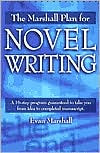
To help me in this, I'm using THE MARSHALL PLAN, an excellent book that describes how to plan, write and edit a novel. It's one of many such books I've referred to while working on THE REFLECTING STONE, and in the many years prior to this current novel. I like the way the author (Evan Marhsall) handles things in a matter-of-fact way, with a clear system, and a sense of purpose. Do this, then it prepares you to do the next thing. Anyone following my novel-writing exploits through this blog will know that is very much how I like to work. It's efficient, if nothing else. Being organized, having a plan and a process, and step-by-step tasks to complete, help me move forward with a focus on results.
I'm happy to be rethining the novel. It's not that what I wrote is seriously flawed -- it's certainly not -- but that the story will benefit from yet another run-through in the details of conception and execution. You can always take something and make it better. I know from my earlier work, now that I'm back "in the thick of it", what the key questions were, exactly what details of the plot I thought of changing, wondered if there might be a better way to sequence them, or to tie things together, etc. It's not "everything", just certain specific points that I had questions about. However, I am quickly going back through "everything" in my mind, step-by-step, as I read through THE MARSHALL PLAN. It's not to say, "Gee, I screwed this up," but to confirm "This is good, this is fine" and then "Aha! Here is something I meant to think about! Should it go this way, or that way?"
I expect to take only a short time for this reflection, which I've been working on over the past several days, and should finish up this week. The benefit is the story will be more focused (a lot of it already is, but a few scenes still need tightening) and subplots will be more fully tied together. I may then go back to the editing work directly, or take more time to review my notes in detail and plan more for the editing, depending on the complexity of the insights/changes as I rethink the story.
It feels nice to recognize myself as mentally "back in the thick of it", a place I like to be!
Adrian
Wednesday, July 26, 2006
The "I Have Other Things To Do" Rule
The last posting deals with the frustration of finding too many possibilities while editing and needing to keep focused around THE PLAN (outline, whatever) for the story. In addition to the KISS Rule I mentioned in the last posting, there is another rule I should mention: the "I Have Other Things To Do" Rule.
During the planning and writing phases, this rule was one of the most helpful when I felt bogged down with the enormity of the task that at earlier points in the process still lay ahead. Now, as I'm in the editing phase, with the bulk of the effort behind me (although there is still a substantial chunk of work to do here with editing), it should come as no surprise that this rule would continue to be of value. In fact, I think this rule is of value at all times, whether in the midst of working on a novel, taking a break between novels, or at any other time. It's so tremendously helpful.
The gist of it is this: the task at hand may seem daunting for whatever reason (and there are plenty of good reasons to make the work daunting at any particular point in the process), but it's important to bear in mind that whatever you are working on at the moment is ultimately just one task in a very long series of tasks. If you're having a problem figuring out some detail in one scene, remember that there are other scenes still to work on in the present chapter. If the present chapter is a hassle, remember it is just one of many chapters. If the current novel seems to be overwhelmingly difficult, remember that it is only one novel of many that you intend to write.
In other words, "zoom out" and take in the larger picture and remember that any given struggle is just one small piece of a much larger puzzle. While this realization could cause you to throw your hands up in the air and run screaming from the room, swearing never to write again since it will always be endless confusion and difficulty, a better way to look at this is to see the present challenge as just a small thing and you have many other things to do, so simplify the task at hand, find a solution, and move on -- you have so many other things to do!
Therefore, don't make the current task any larger than it needs to be. See it as a smaller challenge, demystify it. Consider using the Q&A approach to find a solution -- write out your questions (makes them more concrete), then figure out your answers. If several possibilities exist, consider the main ones briefly, then review your findings, and choose the best solution. Yes, Keep It Simple (KISS Rule) and also keep things in perspective! You have so much to do, any given challenge can only be so big. Find ways to make it smaller, less challenging, to gain victory over it. Time and time again. Don't spend "forever" on this one task ... you really do have other things to do!
Obviously, I'm having this problem as I have hit yet another "pivotal moment" in Chapter 4 and am seeing far too many possibilities in the editing....
Adrian
KISS Rule vs. Excessive Creativity
As I'm diving deeper into the editing of THE REFLECTING STONE, I am finding an endless series (the entire novel!) of "pivotal moments" -- moments where I have written the existing draft such that one thing happens, but in the editing I think of some other thing that could have happened, that might have been more interesting. That is part of my task, to take an interesting scene and make it even more interesting. However, this quickly creates a "veritable plethora" of possibilities and can lead in no time to absolute confusion. Which direction? Which choice? What if this -- or that? Suddenly a tightly-wound story becomes an unending series of potentials, of "what-if's", and I'm thoroughly lost in how to proceed. I've dived into the abyss of creativity and I cannot find my way back to the simplicity of a coherent story line.
Except I can -- it's called the "KISS Rule", which, as you probably already know, stands for "Keep It Simple, Stupid!". No, I'm not really calling myself or anyone else stupid, but the point is where we make things complicated, we sometimes just need to stop and simplify and then keep things simplified. Get back to the basics.
The reason I was able to get through the entire manuscript in the writing phase was because I had a plan. Now, as I do the editing, I must remember to stick to a plan. The plan I had was a good one. A lot of what I've been reading from the existing draft fits very well together and I'm thoroughly pleased with it. So, when those moments come along and I suddenly see too many possibilities, and then try to figure out how each would affect the remainder of the story ... I need to keep it simple, and remember that a plan is better than wallowing in the abyss of neverending potentials, and just refer back to my original plan and limit whatever I might contemplate so that it will fit in with the original plan (and therefore automatically set aside any possibilities that call for major rewriting of every scene to follow thereafter until the conclusion of the book). The goal is not to find a whole new way of doing something, or changing the story, at this point, but simply to take what I do have and look for a better, more dramatic or expressive way of showing it in the manuscript.
To do this, I need to know for each scene what it's original purpose was, including goal/complication/resolution. I already know all of my scenes are justifiable, having gone through a review of scenes in the pre-planning and while writing and before starting to edit. However, I can still consolidate, add a scene, etc., if I find better alternatives or the need to draw out more detail of the story. But, keeping a firm grasp on the original plan, I can limit my brainstorming of potential editing routes to just those routes that are in keeping with the intent of the original plan. I really don't want to rethink the entire story at this point, and see no indication whatsoever that the story needs such drastic rewriting.
It's tough, because I tend to see a lot of possibilities, but applying the KISS Rule and keeping myself grounded in the original plan will hopefully help me to keep the editing moving forward rather than digressing into too many potential variations and wallowing in a sea of excessive creativity. There is such a thing as too much of a good thing.
Adrian
Saturday, July 22, 2006
Working on Scene Structure
I had a goal when I started work on my recently set-aside novel, HARRY VS. THE TRUCK, to work on goal/complication/resolution patterns, making sure each scene had a very clear goal for the point-of-view character. I feel this mindset has stuck well enough by now: I've internalized it, and am fairly consistent now as I strive to apply it at all times. As I approach the editing of Chapter 4 of THE REFLECTING STONE, I am focusing on other details of scene structure to continue and refine that focus. In particular, I am trying to get a handle on the concept of action/reaction sequences.
While it is important for the writer to know clearly the POV character's reactions to each setback or complication along the way, it is not necessary, as I understand it, to actually express that in a distinct scene in every case. If the stakes were high in the action scene, the defeat or twist particularly difficult for the POV character, then it is important to show the character's struggle with the undesired outcome and the process of moving from emotional reaction to rational thought to decision making as a new course of action is chosen. However, if the reaction is obvious, and can be shown "along the way", the essential elements of the reaction (emotion, reflection, decision) can be expressed without drawing significant attention to them, even in a very short space such as a sentence or even just a phrase, and can even be ommitted and fully implied, because they are in fact obvious.
Disclaimer as I apply this focus on action/reaction sequences: As I mentioned in the last posting, I am focusing on the characters having their own agendas, their own goals, and allowing them room to pursue their lives in whatever way they feel is best for them. I keep my goals as the writer separate from the characters' goals, and try to work them in without interfering with the clear development and expression of the characters' own desires, needs, wants, etc. The characters are experiencing the story, living it directly. I am watching from a distance, giving them a nudge here or there.
Some specifics....
I found one scene in Chapter 4 where there is a transition from one location to another. The main character is being held prisoner and must escape. That's my goal, but more importantly it is his goal. His life depends on it. As previously written in the current draft, he did a minor amount of reflection while in captivity about the events of the preceding chapter, which resulted in his present predicament. He escaped, then made his way to a new location to distance himself from his captors.
In the editing, I recognized the need here for more significant reflection. In essence, his old life is now being left behind, and he is taking steps toward his future, unlocking the course of his destiny, bit by bit, though he does not know what it will be. The events of the previous chapter were enormous in their emotional impact on him. This is one of the few really key points in the story where a longer reaction scene is in fact fully justified. My focus on action/reaction sequences and scene structure helped me to see that and correct it.
Another issue that came up in the editing is the transition between locations. The character escaped and set out for a new destination, but I took that as a matter of course in the previous draft and did not show more reflection than enough to establish his basic plan to get away, and in which direction, with what general goal for his safety. I realized there was in fact a choice to be made here, one that touches back on foreshadowing from earlier chapters. I allowed for a continuation of the reaction during his escape, so that he pauses literally where there is a fork in the road and considers which route to take. This brings the focus back squarely to major story questions, which must be done periodically.
I think the expansion of the reflection in two places in this chapter were needed, and the story is much stronger now. This also provides the reader with a chance to get into the character's head, to better understand what he is dealing with, and his personality as revealed in how he solves problems, deals with his emotions, plans for future actions. Hopefully, the reader will be able to identify more the with character in some sense, and will feel closer to him.
The only drawback has been a pattern I noticed in the writing phase over the past several months: the more I work with the same section of text, the more I lose my objectivity about it, until I can no longer tell if it's any good or not. I'm seeing the need in the editing to avoid going back over the same text too many times, and not to go back and reread earlier chapters. I just need to keep moving forward, and read only as many times as I need to until I get the elements in the text that need to be there, and the section seems to read well enough. I should then let the newer version sit, move on and edit new segments, and later come back to reread and polish. I'm really just trying to catch the bigger stuff on this first run-through, and will certainly go back through it all again a few more times before I'm through.
I put in several hours of work editing Chapter 4 and am still only about 25% of the way into this chapter. I remember back in January, February and March that when I slowed down to edit the first three chapters, it likewise was slow going at times. I think I do have to read over problem areas several times and play with the text, changing this, changing that, trying this version, then another, each time the changes giving me something new to think about. It takes time sometimes to explore a scene in-depth and really find all the material that is there to work with. It's not necessary to explore every possibility in the final text, but I think it's important to explore all the possibilities you can find so that you can discover important things that you might have missed. Sometimes we overlook the obvious, and it takes a while to see what was sitting in front of us all along. In any event, quality first! I'll take whatever time I need to do this right, while trying to work as quickly as I can.
Adrian
Friday, July 21, 2006
First 25% Solid!
I've worked through the first three chapters of THE REFLECTING STONE, reading them, writing a few brief notes of things to think about, minor fixes, but basically the first three chapters are very solid as-is and require only minor touch-ups, no significant editing. That's about 30,000 words worth! The first quarter of my editing work is a breeze! That's because I took the time back in January, February and March to go over these chapters several times and do a lot of editing, to make sure I had a very solid footing to build the rest of the novel on. That work sure paid off. In fact, I found the endings of the chapters to be very hard-hitting, or impactful. They generated a significant response on an emotional level as I reread them for the first time in two months. I was really pleased with the overall quality of the story. Act I is in good shape.
I'm now working on Chapter 4. Sections of it are similarly very polished already. I change a word or two here or there, drop a part of a sentence, recombine a few words into a new phrase, but only minor touch-ups. However, I am seeing the first of the sections now that do require a little more work, some rewriting within paragraphs. It's the first substantial editing work, still very minor. I know there will be much more to come. The later chapters will require a lot more work, some entire scenes will have to be rewritten from scratch, some of them several thousand words long.
With such a solid start, though I feel really confident about bringing the rest of the novel up to the same level and keeping it consistent. I am taking the approach of solving questions as I come to them in the text, in the order they are raised. Any issues I didn't fully grasp or resolve at the time, such as how two characters feel about each other or an issue they face, which will guide how they act toward each other in later scenes, I am resolving now as I come across them. I had a lot of depth and breadth to my vision or understanding of the story as I wrote it, but still I see a few examples where I didn't fully figure some things out. Still, these loose ends are relatively minor and there is so much context around them by now that I can fairly easily resolve them.
I am remembering to separate "writer's need" from "character's need" -- what I want the scene to accomplish is not the same thing as what the character might want or need at a given moment. I have to let the characters follow their own agendas, allow them to act according to their own motivations. That is the primary source for solving questions, but I take that and also compare what my goal is and whether I can still work that in while keeping the characters true to their own motivations.
I'm sure as the editing progresses that I'll find some larger and more complex tasks waiting for me. For now, at least, the editing is a breeze, and one thing I can definitely say is that I find this story to be very interesting. If I hadn't written it, I would certainly enjoy reading it. The basic premise, established in Chapter 1, is intriguing, and the story is full of possibilities, making me wonder what will happen as a reader.
Will keep editing this weekend and update again soon.
Adrian
Monday, July 17, 2006
Back to Work!
After a two-month hiatus to let the manuscript "cool", I'm officially back to work on THE REFLECTING STONE and I'm happy about that. I went over my editing notes, special notes I had set aside in a folder in my computer just for the editing process of this novel, about eleven files, I think. Good to refresh. I'm now beginning Phase Two of my editing process, "Planning What Will Be" (for details, see the TIPS & TRICKS blog for a description of "Step Three: Editing the Novel").
I read over the notes and also worked some more on the Mythology. I worked out an alternate shorter and simpler version of the Mythology (the last task I had to do as part of Phase One of my editing process, "Documenting What Is"), but I'm going to wait and see as I go over the story in detail whether I can still use the added complexity. Part of the humor of that is that no two people have the same version of history in the novel. Everyone has a different view of how things happened long ago. If I simplify the actual history too much, it might take away from this running gag, and it's actually pretty useful as it is. However, I do want to make sure at some appropriate point in the story I am either saying "it's so complicated no one really knows what's what and so it doesn't really matter, we all have our opinions", or "this is the correct version -- and it's simple and easy to undertand".
I've been updating the TIPS & TRICKS blog. As mentioned, I posted the plan there that I intend to follow for editing, but I'm already off it slightly. I think the point is do whatever works, don't just follow a script. The value of advice is that it gives us a focus, helps us consider out options, but we have to pick and choose what to do in a dynamic way according to the reality of our particular situation at any given moment. Instead of spending a lot of time planning what to change and then rereading the manuscript, I simply refreshed on the notes I had previously made while still writing, and am now diving in to read the manuscript. I'm so curious to see what I wrote after TWO MONTHS have passed!
I read Chapter 1 for the first time in at least two months. I didn't know whether I'd like it or hate it. Turns out I loved it! I was really impressed with it. I had previously put a lot of effort into editing it to get it as close as possible to a finished draft, and I see no need to do any significant editing to it. I'll tweak a few sentences here or there, just final polish stuff, but the chapter is essentially done. I know the first three chapters were heavily edited, so it will probably be similar for Chapters 2 and 3.
Reading Chapter 1 gave me a very strong feeling that this novel is really interesting, the plan for it was really good, it unfolds in a way that captures a reader's attention and pulls him along, it deals with significant conflicts that readers can identify with along the way, and -- I can write! It's ultimately up to others to say whether that's true or not, but to my own satisfaction I feel what I wrote is good stuff and I'm quite pleased with it. If I can get the rest of the novel to match the level of quality of this first chapter, this should be a very publishable novel. I know the story is there, but I will need to do more editing the farther and farther I progress into the story. The story becomes more complex and I need to make sure it is consistent throughout in how things develop plot-wise. Stories tend to evolve under our feet, if that makes sense, and that certainly happened over the course of writing the complete draft.
Anyway, I'll continue the re-read this week, and make notes along the way if anything stands out, but I want to try to capture a sense of the novel as a whole, the larger picture, first. Then I'll get into the details. Rereading will help me react to it after it has sat and those reactions will guide me in planning what to change.
I'm also getting good ideas for the SCI-FI novel, which is a really fun story. I am so looking forward to writing that one! Now that I have a template in my mind, a process to use over and over in planning, writing and editing novels, I'm seeing how my ideas begin to attach themselves to specific anchor posts more easily. I hope that makes sense. It's hard to describe mental processes. I get ideas and before they were just a flurry of ideas. Now they can be sorted and categorized immediately as to where they belong in the story (I have the basic 12-step outline worked out for the SCI-FI novel already), and where I will deal with them in the process, as the work unfolds. The ideas tend to be naturally more connected, to fit together better from the get-go. It seems every idea is a good detail that belongs in the story, rather than "just another idea" that I have to sort through, most of which I would not end up using. I guess this means I have more focus and a better understanding of the process!
Growth comes to those that strive for it.
Adrian
Saturday, July 15, 2006
Shelving HARRY!
Thanks for your wise comments, Debra! You described it to a "T". I'm going to shelve Harry for now, and get back to in at some future time after I've found a way to make my peace with the heavy issues involved in that novel. It's a worthwhile story but too much for me to handle right now. I have other priorities!
So, I'm "officially" back to work on THE REFLECTING STONE now after the post-writing break, ready to gear up and dig in on that editing. I am looking forward to doing enough editing that I will have a copy ready for readers to give me feedback in the coming weeks and months. I don't know how long it will take to complete the editing. I will take as much time as I need, trying of course to finish as quickly as possible while putting quality first.
I'm going to continue work on the SCI-FI NOVEL as well, using that to provide me with a break from the editing work whenever I need it. Juggling the two things might help push me along, stimulate my creativity, but the editing work will be Job #1 until it is completed.
I'm happy about this decision. It's certainly the right one, without any question. My goal is to write and get stuff done, not make myself suffer needlessly in the name of art. I need to focus primarily on getting things done, until I've completed a few novels and shopped them around (and hopefully gotten published somewhere in the process!). After I have more experience at completing things, I can turn my attention to more challenging novels in terms of story lines that really move me on a deeper level. For now, I'm already putting a lot of work in and my focus must be on navigating the writing process and achieving skill in the enormous juggling act that it is. There is so much to take into account in planning, writing and editing and I want to work on stories that don't offer unnecessary additional pressures, issues or challenges due to subject matter. I think THE REFLECTING STONE is already an epic novel with major issues, but they are not ones that upset me emotionally to think about or write about. I like the story, and enjoyed seeing it develop during the writing phase. Now I look forward to seeing it transform itself before my very eyes into a finished manuscript of the best quality I can possibly make it be!
I just updated my TIPS & TRICKS blog with the plan I will use to guide my editing work. Phase One of that work is essentially already completed, except for some tweaking on the Mythology notes, which I'm working on now. I'll get my attention focused back on THE REFLECTING STONE and start Phase Two this weekend!
I'm also working in bits and pieces every day or two on the SCI-FI NOVEL. This week I completed culture notes for the alien race and also started creating their language. Language and culture go together, of course, hand in hand. The way they speak reflects their culture, who they are, their world view, their social patterns. This story is going to be a lot of fun to write, I can tell. I am very enthusiastic about the possibilities as the Earthlings encounter the aliens and interact with them. I'll continue the planning phase for that novel while I'm in Phase Two of the editing of THE REFLECTING STONE. I feel like a heavy weight has been lifted and my creativity can start flowing more easily again.
Adrian
Wednesday, July 12, 2006
Sincerest Thanks for the Comments!
Yes, it's "struggle time", when in spite of the best intentions it becomes difficult to make much or even any progress. I really appreciate the recent comments. Just knowing others out there understand helps somehow. I always appreciate any words of encouragement. They really do make a difference and help me manage to push on when that's about the last thing I seem to be able to do.
To help get my creative juices flowing, yesterday I spent a couple of hours doing some initial planning work for another novel, which I'll refer to as the SCI-FI NOVEL. I'm excited about that story, always have been since I first thought of it a few years ago. I was able to work out a twelve-step outline with ease and with depth and breadth of vision. It's a first-rate outline and I had such great clarity of vision while creating it, able to see details as needed to understand all the main anchor points and the flow of each of the acts, how each builds to its own climax and how they build on top of each other to the final climax. It's a rich story idea full of possibilities. Working on that showed me yet again how I am learning so much and growing so quickly. Each time I sit down to to that type of work I have a strength I bring to it that surpasses anything I've ever been capable of before. By applying the same process over and over, I'm getting good at it and the pieces just fall into place. Doing this work helped me revive a sense that I can accomplish something.
I've found it very difficult the past couple of weeks to make progress with my current novel, HARRY VS. THE TRUCK. The work is essentially stalled about 20% into the first draft. Struggling enough with this, I finally got to the point in the past few days where I was ready to sit down and problem-solve and try to find some solutions. I applied my own advice for handling writer's block (see my posting on Phase Two: Writing the Novel, in my TIPS & TRICKS blog). Writer's block is something I only occasionally suffer from, and usually not to any great extent. The basic solution that applies here is simply to make a list of questions that are unanswered. What do I need to know in order to continue? Usually it's about story issues. The idea is to bring your unanswered questions into focus and find answers for them, clearing the way to build on that information and continue the story. In this particular instance, I really have only one question and it does not relate directly to plot details. I came up with two answers:
THE QUESTION: "Why am I finding it so hard to write this story at this time?"
1. A part of me wants to finish editing my last novel, THE REFLECTING STONE, so I can start shopping it around to publishers and agents, before I will be willing to invest too much emotionally in another novel.
2. This new story deals with some heavy subject matter that I find too depressing to write about at a time when I'd rather be enjoying the beautiful summer.
My plan had been to quickly write a complete first draft of the new novel, then get back right away to THE REFLECTING STONE to edit it. I had hoped to be at least half-way through the new novel by now. If there is still a chance of getting on a roll with it and finishing it within July, I would be willing to continue to try to do so.
The second issue is not one that I foresaw. I knew the story of HARRY VS. THE TRUCK, but I did not realize going into it that it would have such an effect on me. I haven't posted any details about the story, and don't want to give the story away any by commenting on it. As I have posted, it's ultimately one with a positive message and the characters manage okay, but there are some dark and difficult things for the main character to wade through, particularly in the early chapters. I think although it is not my story (I don't write autobiographical fiction), it is a story that resonates too much with my own life, and with the realities that many of us face, and as such it's one that evokes a strong emotional response in me as I work on it, moreso than THE REFLECTING STONE or the SCI-FI NOVEL that I just did some planning work on. Every story I think of connects with reality, no matter how fantastic the story line. Some just hit home a little more than others.
At this point, I have to decide whether to set HARRY aside and get back to work on THE REFLECTING STONE, completing the editing of it before resuming work on HARRY, or to continue to try to finish the first draft of HARRY within the next few weeks. I think I'll give it one last try, and if it "ain't happenin" soon, then I'll make that switch. I do want to write HARRY, and feel it's a worthwhile story, but it may be one to work on during the winter or something. Perhaps letting it sit will allow me to make my peace with it, and when I return to it I'll fare better. It's tough enough to manage the ups and downs which are inherent to the writing process without also having to navigate such difficult emotional terrain of a story that is itself troubling. This is why I chose THE REFLECTING STONE: I knew I did not have strong emotions tied to it, and that I would be able to look at the story and the process of writing it more objectively because of that fact. The SCI-FI NOVEL is another one like THE REFLECTING STONE as far as I know. A fun and interesting story with lots of potential. Although there are meaningful issues that underpin it, they aren't ones that stir such deep emotions in me. Perhaps if I edit the STONE then I can write the SCI-FI NOVEL and get back to HARRY after some months have gone by.
But, before making that decision final, I'll give HARRY one final try.
Thanks again for the words of encouragement. They really do help.
Adrian
Monday, July 03, 2006
Making a Little Progress
I will hold off on making a more detailed report on my progress until there is more progress, but at least I can say I have written during the past week and am on the way to reaching the goal.
I definitely feel I'm writing a first draft. It's rough -- on me. The work itself is not all that bad. That's usually how it goes.
Anyway, I'll keep at it! I'll report back when there's more to report on.
By the way, I'm updating my two other blogs these days. Glad to see them growing. This is a time when I should read my own advice and take it (see "Step Two" posting on the TIPS & TRICKS blog!).
Adrian
Subscribe to:
Posts (Atom)

 Posts