Wednesday, May 07, 2008
2/3 Through This Transition Step
The sequence of chapters that I've been working on for some time now, which build to and end with the mid-point of the story, are coming along! I'm glad.
This sequence, like so much in storytelling, can be divided into three parts: a beginning, middle and end. I'm 2/3 of the way through now, thanks to a combination of intensive editing and even rewriting.
The key changes center on drawing out the true motivations, feelings and reactions of the characters, and updating the way a pivotal new character is depicted when he is introduced here. He evolved during the first draft, and I needed to bring his earlier representation into line with how I know things will turn out later. Also, the extra emphasis on the thoughts of the central characters has helped in showing character development for the main character. He has to change his mind about something, and that needs to seem authentic.
The impact of these changes has been significant. The story rings true now, and feels tight. It grips you and holds you, moves you right along, which is fitting for a sequence that involves high stakes. The improvement is very noticeable and it's very gratifying to see. (Of course, this is just my opinion; I'll have to wait a while yet until I finish the editing for a beta reader to tell me whether there's any truth to it!)
What remains in this sequence is just to draw the story forward another step, refining the focus down to the point where there is the key decision by the main character which marks the mid-point of the story. Another night or two and I hope to have this finished.
After that, I will follow the existing flow of the story through the second half of the novel as laid out in the first draft, trying to edit where that will do the trick, but also rewriting entire chapters as need be. I don't see changing the basic plot in any significant way. All the changes I've made in the first half have only reinforced the existing plot line. Nothing is competing with it. Fortunately, I'm not being pulled in two directions at once with this story, as I so often have been with other stories.
I'm learning a lot about editing. I'm sure I still have much to learn, but I think finally I really am clued in to what editing should be, what it should accomplish, and how to go about it. I knew these ideas before, but after doing so much of it, I'm seeing these ideas in a whole new light. I feel I'm really "getting it" now.
I also believe that you have to write at least 500,000 words, if not a million, before you really understand how to write. I've heard quotes to that effect, and read them in a number of articles, blog postings, forums and books on writing. I'm really understanding so much more about storytelling, how the various components and parts of a story tie together, and also about language, how to structure it, pace it, develop it, nurture it along to various effects. Practice may never make perfect, but it certainly does generate a considerable improvement in quality over time!
And, again, it always comes down to enjoyment. For me, at least, that is the key. I must enjoy the process, and the results, and have a reasonable hope that Readers will enjoy the results as well. Without that, there really is no point, for me, in spending so many hours on something called fiction.
Best wishes to other aspiring writers,
Adrian

Wednesday, April 30, 2008
More Good Progress
I have been working steadily on the editing of JACK & JILL. I'm now thoroughly immersed in the detail of the first half of the story. I have gone through again and again with the cluster of chapters that mark the mid-point. Each time I make things better and better. I even went back a few additional chapters, just to see what else I could tweak, and sure enough I found a few things. Seeing that, I went all the way back to the beginning again and worked through yet another time, over stuff that had pretty well been edited to a final shine already. Just a few things here or there, but each additional change has helped tighten and improve.
What has emerged from all this work has been a new way to handle a key, pivotal character, who is introduced in this cluster of chapters that has proved so problematic. I cast him in a new light, borrowing from what I know comes later, seeding it in much earlier, right from the start. Gee, when we write first drafts, we don't have it all figured out from the get-go, do we? Hence this character evolved a bit in how I handled him, and so there is room to alter how he first appears, in order to bring it in line with the take on things that I ended up with after completing the first draft. It's working wonders.
The most essential thing, as I blogged about recently, has been to make sure the scenes are true to the characters. The whole story depends upon the thoughts and reactions of the characters. The story must be character-driven. That is, it must propel itself forward based not on external plot events, but the thoughts and reactions of the characters to their circumstances, and their efforts to move toward an outcome they desire. It's the horse before the cart, not the other way around. Some stories fail because plot takes precedence, and it always shows. If you follow the characters through the maze of events you have created for them, they will choose the path that makes the most sense for them, and it will ring true.
Anyway, sometimes I love what I've written and sometimes I hate it, but mostly I think it's good, and some of it is excellent in terms of clarity, conciseness, motivation, a constant forward momentum. Overall it's good, at least to my satisfaction. Certainly I will be quite pleased to send this manuscript out once finished, based on reasonable expectations I have about its quality as a polished final draft.
The intense editing that this first half has received over time has done wonders to tighten it. With my present understanding of the key characters, and knowing what lies in store for them, I feel very much more confident now in proceeding into the second half, albeit gradually and with much revision until they are clearly on their way. This transition is so important because it changes the story direction and moves it toward the ending, although the Reader won't see what lies so far down the road, just what it seems lies so far down the road. That's good, keeps the story from being too predictable.
Another thing I've noticed is how much more strongly I now handle the issues surrounding magic. When I first started writing fantasy, which was only a couple of years ago with THE REFLECTING STONE, a novel that remains in progress after two complete drafts, it was a bit awkward for me. I had read fantasy stories and seen the movies made from them, as well as the sagas and epics the genre draws from historically. The idea of a fantasy story, or a story with fantastic elements, including magic, was nothing new to me and something I was quite comfortable with as a reader (or viewer). However, to actually sit down and write one was another matter entirely. I felt so self-conscious about it at first. After two years of work, I am now so much more comfortable with the genre and magic in particular, which is an essential element in my stories. I'm getting much better at utilizing it as an essential element, and am having spontaneous ideas for new novels, new stories which are quite different from anything else I had ever imagined writing. I see that as a sign of growth, my new ability to explore and create within this genre. A good sign, to be sure.
Nonetheless, I am keeping my focus on JACK & JILL to finish it as quickly as I can, whenever that will ultimately prove to be, but hopefully within a couple of months, given the slow and tedious rate of the editing. I'm not concerned -- seeing the quality of the work that is resulting from this editing, I'm quite pleased to continue trudging along. The story is fun and meaningful, and anything I don't like -- well, I'm making it better day by day.
It feels good to see more good progress!
Best wishes to other aspiring writers,
Adrian
Monday, April 28, 2008
Back to Work
Last week I did manage some more work on JACK & JILL, and I'm happy to say this week is off to a good start. I find I'm still going back over the same few chapters, even though I've edited my way through them a number of times already. They form a unit together, a series of scenes that are directly related to each other and which serve as the crucial mid-point of the story -- they build to it and end with it.
My effort to rediscover my joy of writing has helped immensely. I am really hearing the characters again, and sensing their concerns, and finding the scenes vivid and meaningful as I work on them, and as I reflect on them at other times. The changes I made last week and already this week have helped focus the scenes around the real issues.
It's another one of those vase situations that I've blogged about before. You know, you find a beautiful vase and bring it home and put it on your table and marvel at how beautiful it is, yet something seems odd. Somehow, it just doesn't work. Then you discover some minor detail, some way in which it clashes with other things in the room, even thought at first glance, and second glance, it seems to go so well with them. It's an excellent vase, but not the right one.
I'm finding that I need to find exactly the right vase here, the right set of motivations, the right set of issues. The characters need to struggle over just the right things, and arrive at just the right decisions for just the right reasons, or else this section of the story will not ultimately ring true. I'm now closer than ever, and hot on the trail of that ultimate fit.
I'm happy to have that familiar feeling of being back to work. I'll work hard to keep myself moving forward, now that I'm getting something serious accomplished again.
And, most importantly, I'm enjoying it.
Wishing everyone else progress and pleasure in their work,
Adrian
Saturday, April 19, 2008
Joi d'Ecrire
Recently, I spent a little time reading excerpts from other writers' work which was posted online. This included both published and unpublished authors and works, ranging from nanovels to published books. It was very interesting. I found a link to a nanoer who has several excerpts of nanovels written over the past handful of years and I was quite impressed with how his work has evolved. His most recent novel reads quite well, and I found that it inspired me. I also found a small publisher of gay and lesbian fiction. Their site includes sample chapters and several of the excerpts I read there also inspired me.
I think what really moved me in all this was seeing how others are realizing their dream, and even with all the imperfections which I could find in the various texts, they had their own rhythm, their own flavor, their own excitement about them. The writers each had a vision, and they found a way to express that vision, and to get the job done. Since I've been in editing mode, it seems all I see are the imperfections. No work is ever "perfect". If getting started is half the battle, the other half is finishing what you set out to accomplish, warts and all. Readers won't notice the minor blemishes nearly as much as we do.
With all the stress in my life over the past few months, which has exceeded all the stress over the past few years put together, I have been very distracted and emotionally focused elsewhere. Reading these texts has reminded me of why I write: the JOI D'ECRIRE (joy of writing). I have never been one to believe in driving myself in die-hard fashion through thick and thin, writing seven days a week no matter what. I have always found when I sit down to write and have nothing to say, that whatever I write is ultimately garbage and ends up in the appropriate receptacle. For me, writing is a joy, and it should remain so. If I cannot find that joy, then I should not write. After all, in spite of the joy and the pleasure, writing is hard work, and why would anyone put themselves through that if they did not enjoy it? There are other, surer and easier ways to make a living.
I am seeking now to rekindle that joy, that excitement about stories, that spark. It is only through that joy that I would ever want to write. Writing has not become drudgery to me, but pushing on to complete a project without a sense of the joy of it cannot by definition lead to good writing, at least in my opinion, and, from what I have seen, in my work. Writing is not combat, fighting against the enemy (blank pages) with a winner-takes-all mentality. It is magic, an expression of love -- love of story, love of discovery, love of characters and places and times and events and the hope, which the Reader will share, that maybe somehow things will work out okay in the end.
A little humor helps.
Wishing each of us the joy in our writing which we require and our Readers deserve,
Adrian
Friday, April 11, 2008
It's Spring Already
I finished generating feedback for another writer on a short story. I'll summarize my feedback in an email and send it back soon. That's not progress on my own writing, but it was a helpful exercise, not only because it provides someone else with feedback, but also the process of doing that helps me to see how I react to a text in detail, how the other writer's style compares with my own, what sort of editing changes I would make, or not, etc. Hard to explain, but suffice it to say that it was an enlightening experience, an opportunity for reflection.
Otherwise, earlier this week I did edit another one of my own chapters, which is encouraging.
I'm enjoying the Spring. Hope everyone else is as well.
Adrian
Monday, March 31, 2008
CSS?
I have done a little work recently on Jack & Jill, in addition to reviewing a short story for another writer. I'm half-way done with my comments for the other writer, and still only half-done on my novel, but at least I've managed to get something writerly accomplished in the past week. I plan to continue, even at a snail's pace, which is usually not my modus operandi, but better that than no work at all on what is most important among my creative projects: my writing.
Apart from that morsel of progress, I am looking at the prospect of learning CSS in the near future. It seems Scott Marlowe's new site has inspired me to do some much-needed work on my own site. Not the blog -- I recently enhanced its presentation and am still happy with it -- but on my actual internet site, or homepage, or whatever you want to call it. I need to learn CSS as a better way to control the look of the pages, and to make changes, without having to go into each and every page and change a thousand little format instructions in HTML. CSS is a new (to me) way of doing that and it saves a lot of time -- if you know how to do it. With my progress with Java I'm emboldened to tackle CSS, which should hopefully be a little (or a lot) less daunting than Java itself.
Otherwise, I'm almost ready to start making my first Java applications. Spilling coffee down the front of my shirt regrettably does not count as a Java application, at least in this sense [boo-hiss, I know].
It's gratifying that my yearn to write is growing steadily. The creative side of me is saying, "Hey, if you can let that logical part of you do all that good work, then why not let the illogical part of you continue its good work, which it was already doing so well previously, and which is more important anyway?"
Can't argue with that logic.
I'm remembering some of the tenets of my belief in myself as a writer, ideas which I had conveniently forgotten about in order to shy away from writing. One of these tenets is, "Don't think about it, just write it". I only distract myself by thinking about my writing. It's better just to immerse myself in the stories and focus on writing them, rather than thinking about the fact that I'm writing them. Another tenet is, "This present task is only piece of a much larger puzzle." I let myself get bogged down in the specifics, and the issues surrounding this one story. I need to remember that the task at hand, and indeed this story itself, are just steps along a greater path. I need to finish this edit so I can get the story out for feedback and move on to my next writing project (probably finishing the Jasper story). I need to finish both of these stories so I can get back to the STONE novel, and then the ISLE novel, and then on to other novels. Can't let myself spend too much time in one place. Gotta keep on keepin' on. Get a move on.
Tally ho,
Adrian
Saturday, March 29, 2008
Scott Marlowe's Impressive New Site
I wanted to offer a plug for Scott Marlowe's impressive new site: ScottMarlowe.com. If you haven't checked it out, you should!
Scott's old site is still up, but he launched a new site not long ago and raised the bar. It's a very professional-looking site for a serious, aspiring fantasy writer.
May the arrival of Spring inspire those of us who need to get back to our writing,
Adrian
Thursday, March 20, 2008
My Brain Hurts!
I don't know if it's technically plausible or not, but my brain actually hurts these days. I've been working very hard for a couple of weeks now on one of my creative projects and it has me floored, or spinning in circles, or whatever effect it's having. If my "instances" hint in my last comment wasn't enough of a tip-off, I'll share that one of my creative projects involves learning to write computer programs in Java. This is purely as a hobby, a leisure-time pursuit, but also a means to an end -- there are some simple programs that I very much want to write.
In spite of the cold, hard, inhuman logic of it all, programming is actually a very creative activity. It's also a real challenge. Anyone who has ever struggled to make sense out of something they call object-oriented programming will know that it's a bit confusing for someone who knows absolutely nothing about it. I'm very proud of the progress I've made. I'm already close to where I need to be to begin work in earnest on my first project, so that's a lot of progress in picking up this difficult material in a very short, if grueling and painful, time.
I think whenever we devote our minds to some organized study of something, we glean from that a sense of the underlying structure or system of whatever we are studying. We force a certain logic into our thinking, and it helps us see the logic in other things, too. Anytime I study anything complex, in a serious and protracted effort, I always feel more "logical" myself afterward. The effect is only temporary, but it is very interesting to experience.
I have to ask myself whether the short-term benefit of all this hard work is worth the pain incurred. I won't know for sure until I write my first Java program. I also won't know for sure until I return to writing, and see whether I think I'm thinking more logically in some sense, able to see the complex system which is a novel, its many interrelated parts interwoven and, well, interrelated, with some greater depth of understanding due to the imposition of another system of logic. Is there a carry-thru? I think there is.
For a long time people said if you study Latin you will learn to think more clearly, or be more smarter, or speak English better, or whatever. I think that is true, even if it isn't. My other significant creative project at this time is learning Ancient Greek. I chose Attic Greek, the language of the Classical era in Athens, as opposed to Homeric Greek, which predates it, or Koine Greek, which follows it. I have a terrific book to study from and I'm enjoying immensely the exposure to this tangible piece of the reality of that long-ago world. If a study of systems is of any benefit to the mind, then learning both Ancient Greek and Java programming at the same time ought to qualify me for a discount on my next purchase of a scientific calculator, at the very least (I have never purchased a scientific calculator because I am not very scientific, but with my brain bulging with organized thoughts, I might become more scientific in the future).
All of which leads me back to the brain-related impact of this logical effort. Since I am so into logic right now, my creative side is feeling, well, rather neglected. The whole "arts and humanities" side of me is reeling from disuse. Just the other day the creative part of me threatened to sue the logical side of me for wanton neglect. It's not something I take lightly, that part of me that cares. The other part, the reckless, adventurous side, refuses to worry about it and urges me to carry on with wild abandon, learning all I can about loops and class declarations and public access, about declensions and verb stems and theme vowels, about GUI's and passing methods and operands, not to mention the dual, the aorist or the vocative.
That tiny portion of me that is left in between this struggle wishes with utmost sincerity that my brain would stop hurting, that my foray into logic would wind gracefully to an end, and my heart would be allowed to sing again as I merrily produce the sort of emotion-laden fiction that, well, makes my heart sing.
And all this because I'm getting too close to a finished product. Yes, I think I got into these projects as a way of distracting myself because I don't feel ready to actually finish a novel yet, as silly as that sounds. I have to learn to step out of the way and let the part of me that wants to be a writer pass through and become that writer.
int confidence = 10;
int apprehension = 100;
int diversion = 0;
boolean ready = false;
if (confidence < apprehension) {
diversion++;
confidence = diversion;
}
if (confidence >= apprehension) {
ready = true;
}
Wishing us a peaceful Easter in all parts of the world,
Adrian
Sunday, March 16, 2008
Working Hard ... On Other Things!
I've been working very hard since my last posting, but not on my writing! I did a little more with it, but I've been very preoccupied with two other projects that have been long in coming, and much expected. The timing seems to work for them. Perhaps because they are providing me with a thorough distraction from my writing. In any event, I am working very hard again with my creative time, just not on my story. Perhaps this is good in that at least I am back to hard work, and momentum, etc. This will carry back to the story once these other projects get to a point where I need to slow the pace. I think this hard work will stimulate me to continue the flow of hard work once my creative energies cycle around again to writing. I've been trying, and it's on-again, off-again. Perhaps I realize I'm getting closer now to an actual finished product (manuscript), and that scares me.... I must have some reason to work so hard at avoiding my story! I had other distractions, but at this point I should be hard at work on it.
I won't worry about it, though. I am happy to be working hard, and I think my theory is a good one -- this hard work will pay off by putting me firmly back in hard-work mode, and as soon as I get back to the story in earnest, I'll already have the pace and momentum of hard work to carry me along. Now, I just need the focus, when I'm ready for it. In the meantime, these other two projects are incredibly satisfying to be working on. They're not writing projects, but they are creative projects that are very engrossing and exciting to me.
I love being vague, if that's not clear enough already.
Wishing everyone else the progress on their novels that I should be making on mine, and I'll catch up before long, really,
Adrian
Wednesday, March 05, 2008
Excellence Award
Something unexpected and very pleasant came my way. Writerwoman has bestowed my blog, Chronicling the Novel, with the following auspicious award:

Thanks, Writerwoman! That really made my day. Since good news is best shared, I'm supposed to nominate others to receive this award. The actual number I'm supposed to nominate is higher, but I'll shorten it to only three, which makes it more special. Here are three blogs of excellence, focusing on other aspiring writers:
Living the Writer's Life
The Lost Fort
Pendrifter
Congratulations one and all!
Adrian
Some Significant Progress
Within the past few days I managed to substantially rewrite most of Chapters 9 and 10. The same basic events occur, but I needed to draw out questions/issues that were of concern to the main characters, Jacques and Giel. There was a lot of tension that was building over all the previous chapters, and they had stuff on their minds, and the situations they found themselves in presented them with opportunities to raise those questions/issues and seek some answers. I had touched on this stuff lightly, but needed much more focus on the main story questions, since this is now leading in to the mid-point and it all comes together with a decision that Jacques must make. The new version is much stronger and more directly connected to the rest of the story. I'm very happy with it. Now, just need to ride this out to the mid-point to complete this transition sequence, then it's on to the new, as-of-yet unedited material of the second half.
It feels good to have made some progress!
I'll also mention that some of the other research I'm doing these days involves philosophy, ancient Greece and Ancient Greek. Perhaps the blogs of certain historical fiction writers have inspired me.... ;-) Unrelated to those topics, I've also conceived of a new novel I'd love to write. It is definitely "high concept" and would make a great best-seller and film version, not that I'm seeking to write only for commercial reasons -- my writing is my art, a way to take my life and experience and seek meaning in it and all that sort of thing. But it's fun to realize I've got a really cool, potentially hot idea.
So, the inspiration is there again. Now I just need to buckle down. I think that part is harder, since I know how much work I do when I'm writing and taking a break from all that is such a naughty pleasure in itself. Perhaps Janet Jackson's new album will inspire me. [Disclaimer: The preceding was a joke, it was only a joke, and nothing other than a joke.]
Wishing everyone the discipline they need to get things done,
Adrian
Saturday, March 01, 2008
Making Progress
Thanks to those who shared their comments to my last posting. I do appreciate your kind words of support.
It has felt like the doldrums, where sailors loathe to sail, that place where you have your sails at the ready yet no wind rises to greet them. Patience is the key. Eventually the currents themselves will cause you to drift to a better place, a place where there is a breeze, and before long that breeze will lead you to better seas and stronger winds.
I have not worked on my writing nearly as much as I had intended, but I have kept it in mind, and have spent the time whenever I could manage it. I am still editing JACK & JILL and the results are positive. The first half of the novel now reads very smoothly and is nearly finished, except for any minor polishing that may yet occur to me. I feel much more confident about the story overall, and just need to press on to complete this work, which with any reasonable effort could well be done in 2-3 weeks.
I am seeing the light at the end of the tunnel where this difficult time is concerned. I'm feeling a little traction, and a sense of hope again that I'll actually get fully back into the swing of things. It just takes me time sometimes to rebuild that focus which is so essential to my work: the more utterly it's lost, the more effort it takes to recapture it. I'm making progress and the editing work continues. I'm beginning to feel the joy again, and the excitement, associated with my writing. I want to cultivate these feelings and others which will lead me back into the swifter currents. The breezes are tugging at my sails even now.
To help things along I've been reading and researching, finding much enjoyment and food for thought.
Wishing us all progress and satisfaction with our work,
Adrian
Thursday, February 14, 2008
Happy V-Day!
Wishing visitors to my blog a Happy Valentine's Day!
It's been longer than usual since my last posting. I'll update you....
Back in December some unfortunate things happened, affecting the health and well-being of three of my relatives. These were separate and unrelated events, but they happened one after the other. All three ended up in the hospital, including stays in shock-trauma and intensive care. The last of them has just now been released from the hospital. In all three cases, there was a concern that things were, or might have become, life-threatening. To say the least, this terrible string of unfortunate events really threw me for a loop. It caused such a significant interruption to the routine of things that I found myself far too distracted to maintain the creative flow and focus necessary to keep up with my work. Not to mention on top of all this there was the holiday season as well! Anyway, it took until mid-January for the dust to settle, and until now for things to finally get more or less back to normal.
This past week I have finally been working again on my writing, something I have longed to do throughout these many weeks but have simply not had the focus I need to be productive with. I dabbled at it here or there, but could never get anywhere with it. Instead, I used the creative time to read and catch up on some other projects. It turned into another of my "creative breaks" where I seek to feed the soul and replenish the well-spring. Over time, and with the improving conditions of all three family members, I have found my way back to where I was before all this happened.
So, at this point, I am happy that everyone is doing well, and I am back to work and have been for a week already. I am still editing JACK & JILL and it is going well. I like the story, and feel after rereading the entire manuscript that I do NOT have to make significant changes. I'll keep the story as it is -- it works. I just need to continue editing for clarity, to increase focus on scene goals and complications (which helps to raise suspense), and to fill in little tidbits that keep it smoothly flowing. I am reluctant to set any goals at this time as I don't want to invite another series of disasters, but with any luck I'll manage to keep the flow going and should be done with the edit in the next 2-4 weeks (end of February or by mid-March).
After that, I'll get back to the JASPER story to finish it off, and will invite Beta Reader comments on each, do any additional editing, and start sending this two stories out. And then it's back to work on THE REFLECTING STONE and/or whatever else, depending on where my interests lie at that time.
Glad to be back at work, and glad to have the stresses off my shoulders. Glad things worked out for all concerned.
Wishing everyone else focus and productive writing time,
Adrian
Saturday, January 26, 2008
Scene-Level Editing
My previous posting discussed the three levels or types of editing. In this
posting I'll share an example regarding scene-level editing using my current
editing project, the novel JACK & JILL: THE UNTOLD STORY.
Scenes work best when there is a TIGHT FOCUS on a SPECIFIC GOAL and a clear sense of the RESULT of the POV character's effort to achieve that goal in the here-and-now. The actual result may itself be clear or unclear to the POV character, but whatever the case, the result should be clear to the READER, including the fact that things may be unclear to the POV character. In other words, it's okay to keep the POV character guessing, but don't leave the Reader guessing -- let the Reader know clearly who the POV character is, what his/her goal is, what stands in the way, and how things turn out.
Here is a closer look. The following elements are essential to a tightly-
focused scene:
1. At the outset, the Reader wants to know where we are, what the basic situation is, who the POV character is, what time it is, what's happening around the character at this moment, etc. (i.e., "clue me in, please!"). The Reader also wants to know what the POV character is attempting to do, or what danger or risk he/she is facing. This poses a story question for the current scene, one that is IMPORTANT and provides a REASON TO READ the scene. Even if this scene is part of a subplot and not part of the main dramatic throughline, what is going on in this subplot needs to tie in eventually to the main plot, the way smaller streams feed into a larger river.
2. Once the basic idea of the scene is established, the Reader wants to follow along and even anticipate what the POV character is doing or will do in order to accomplish the goal, or escape from or face the danger (responding to danger provides its own obvious and immediate goals -- other goals need to be made clear since they won't be so obvious or immediate). In other words, the Reader wants to see COMPLICATIONS and how things move along. The Reader also wants to understand the RATIONALE for these efforts and these circumstances. The goal must pan out, must make sense once we see it in action. The complications need to make sense also, not seem contrived or too convenient for the story. Real characters face real obstacles with real stakes!
3. Eventually, the Reader wants to see how things turn out. They want to see the RESULTS of the POV character's efforts when confronted with the complications. They want to know if the POV character achieved the goal or not, why or why not, and where this leaves things: what's next? If the POV character did achieve his/her goal, then there must be some twist to that -- having "won", he/she finds that "winning" is not all it's cracked up to be. Having obtained something, the "something" poses a new set of problems. Having gotten the key to the vault, there is now the issue of a monster that stands in the way of using the key to get into the vault, or the key comes with a new group of thugs that want it back, etc., etc. The result answers the current story question and immediately poses a new story question: where next? I'll repeat that: WHERE NEXT? This adds something called suspense, AKA a REASON TO READ.
Now, to illustrate how I took a simple scene from JACK & JILL, my current WUM (work under the microscope), and edited it to make it more focused! This scene is short, basic and simple. I don't want to share anything that is more involved or important to the story since I don't want to give away anything more than that about the story.
You will recall that JACK & JILL is a fantasy novel which is supposed to reveal the true story behind the Jack & Jill nursery rhyme. In this "original version", the characters are Jacques and Giel, two seventeen-year-old boys who live in a small village somewhere in a fictional version of the Low Countries ("Benelux": Belgium, Netherlands, Luxembourg). You can read the Prologue and first three chapters on my fiction excerpts blog, ADRIAN'S FIX.
Now, to the SIQ (scene in question). In the ORIGINAL (first-draft) version, Jacques and Giel walk along a road, escaping from a great danger behind them. They're far enough from it at the moment that they can walk instead of run. They haven't slept in a while and decide to take a break in a quiet ravine where they will not be seen. Later, some local farmers find them there, fast asleep. The farmers realize Jacques and Giel are fleeing, and take them prisoner in order to hold them for the very "whatever" they were fleeing from. One of the farmers who finds them is named "Jori".
Challenge to the Reader: Before continuing, can you tell what's wrong with the original scene? Name at least two things.
In the REVISED (second-draft) version, Jacques and Giel are walking along the road when the farmer Jori happens by on a wagon pulled by a horse. Jori is alone, going about his own business. He figures out that Jacques and Giel are fleeing and sought after by the dangerous "whatever" of the story. Jori is supportive of them and their cause, and tells them how he will help them. He tells them to wait in the ravine until nightfall, when he will return to give them a ride to safety. Now, the boys have to decide whether or not to believe Jori. Jacques wants to trust him, Giel does not (of course). Jacques prevails, the boys go to the ravine, but they do not acknowledge knowing anything about whatever intrigue Jori is talking about. They say they just want to rest, and if Jori happens back later and can offer them a ride then, they will be happy to take it. Jacques decides to take the risk since he wants to trust the kind farmer, but also he realizes potential danger, so he is playing it safe by denying everything, including any knowledge of "whatever". Later, the farmers arrive and find the boys sleeping in the ravine. The farmers take them prisoner.
The revised version is better than the original version in the following ways:
1. The new immediate danger (the local farmers) is introduced earlier -- we know there are local farmers and at least one of them might pose a threat, before we are faced with a group of farmers arriving as a threat.
2. There is suspense over whether or not to trust Jori. The kindly old farmer makes a convincing case that he really is on the boys' side, and the Reader would have also have every reason to think he may actually be genuine, yet know he might also not be.
3. We suffer greater disappointment when the local farmers show up at the end of this sequence. Not only are we already familiar with the "whatever" that the boys are fleeing from (based on earlier scenes), but we have had time to reflect on the danger the farmers pose, and what it would mean if they were to get into the middle of things and ruin the escape. We feel disappointment that the kindly old farmer is really a nasty guy after all, betraying the boys and taking them captive to return them to the "whatever" from which they were escaping.
4. The new version involves a more significant CHOICE by the POV character (Jacques) -- Jacques decides to trust Jori, and stay in the ravine. Bad choice, of course. By making a choice, Jacques is taking an active role in shaping his own fate. This is stronger than having Jacques decide to stay and rest in a ravine that he just happens to find along the way. Compare: "We're so tired and we just happened upon this ravine and there is no one around -- should we rest here?" vs. "This dude named Jori seems to know our secret but I'm not sure, and he wants us to stay here at this ravine and rest and wait for him to come back to help us, but maybe he's going to betray us, I'm just not sure -- should we rest here?"
5. Something you couldn't have guessed because I didn't tell you enough details up front: The choice Jacques must make also creates FORESHADOWING. Soon after this, there will be another major choice when Jacques has to decide whether or not to trust someone else. Giel will be very much against it -- downright adamant -- but Jacques will have a lot of reasons why he must take the risk, reasons that have been worked in since the very beginning of the story. Jacques is indeed compelled to do something that will turn out to go very, very, very badly for him.
In summary, when writing a first draft we are seeking our story and might describe things as just "happening" to the POV character while feeling our way along. We should strive wherever possible to keep things goal-driven instead. When we edit, we must correct any events that "just happen" and turn them into events that involve a CHOICE by the POV character. At the outset, clue the reader in to the POV character, time, setting, etc., firmly establish the POV character's goal and give a clear rationale for the goal. Along the way, provide justification for the particular complications and reinforce the rationale for having this goal in the first place, in spite of the obstacles. At the end, make it clear how things turn out, even if the way things turn out is that the outcome is not clear -- let the reader know the POV character is unsure, but don't leave the reader unsure about whether or not the POV character is unsure. If the goal is reached, it turns out not to be as helpful as originally thought. There is a twist and a new set of complications that come from having reached the goal. If the goal is not reached, then it should have been and it's not having been reached creates additional problems. However things turn out, there must be a new question, stated or implied, a new direction, a next step. If scenes are goal-driven, you raise story questions, and provide twists and turns, the reader will find it much easier to maintain and build interest.
GOAL-DRIVEN WRITING GIVES READERS A REASON TO READ.
Best wishes for your own editing adventures,
Adrian
Saturday, January 19, 2008
Editing the Novel
I posted a hypothetical "how to edit" piece on my TIPS & TRICKS blog some time ago, before actually attempting to edit a full-length manuscript. I included a disclaimer that warned readers I had never attempted to follow my own advice. The purpose of writing the piece was not to tell people how to do something that I didn't know how to do, but to put myself through the paces of trying to anticipate how I might actually go about it, since I was about to embark on a major editing effort at that time. Since then, I've had the fine pleasure of writing additional complete drafts and also reworking full-length novels and editing them. I've learned a little bit more than I knew before, and want to share a glimpse into the EDITING PROCESS as I experience it. Here goes....
There are three types of editing: story-level, scene-level and text-level. I'll tackle them one at a time.
1. STORY-LEVEL EDITING.
This is the highest-level editing, the one with the view to the entire story. It involves reviewing your overall plan for the story and figuring out whether what you wrote accomplishes that. This is where you figure out whether the ending works, whether a given scene is necessary, whether you adequately set up something or just dropped it on the reader. This is where you look for opportunities to work in more foreshadowing, where you raise questions and leave them to be answered later, creating suspense. You decide whether a given sequence is a relevant sub-plot or whether it ventures too far afield of your main plot, failing to contribute to the development of the themes or major threads. You realize you now possess a deeper level of understanding about your characters, the situation they're in, and their motivations. You gained this understanding while writing a complete draft. You use this understanding to draw out a stronger sense of the characters' motivations and the cause-and-effect aspect of the chain of events for the Reader, who will also appreciate seeing these connections. You also determine whether any new developments that came up in the writing are worth keeping, even if it means changes to your original plan. You have to negotiate with yourself on this, and it can be tough.
I think of this type of editing as reworking the story, more akin to planning and writing the story than editing the story. In fact, I don't really think of it as editing at all, even though it is a form of editing. This is what I do after completing a draft. If what I wrote works overall and needs only a few relatively minor changes, then I use this type of editing (or rethinking) to help me change individual scenes or chapters. If the changes needed are substantial, then I just do a complete rewrite, which is much easier than trying to fix something that is seriously broken. I enjoy this type of editing to a point, since I enjoy plotting. However, sometimes this gets frustrating, usually because I realize I have to make a decision that I don't want to make (should the story go this way or that way...). Overall, this sort of stuff is fun. At least, it can be. I work actively to keep it that way.
2. SCENE-LEVEL EDITING. This type of editing involves making changes to scenes to help them accomplish their business. When I realize from the story level that I need to add a certain piece of story information to a given scene, this is the point where I do that. If I need an outcome of a scene to be different in order for things to work better for the overall plot, then this is where I do that. My focus here is not so much on the actual words in the scene (that's the next level of editing), but on making the scene itself work properly. I take whatever insights I have and work them into the reality of the scene, its particulars, its specifics. I make sure I can see clearly where the beginning of the scene is, its middle and its ending, and what the point of it is.
The main thing I do in scene-level editing is tighten the focus. I make sure the POV character has a clear goal at the outset and makes a decision or two so that he/she takes an active role in doing things. I make sure the scene ends with a clear sense of how things turned out and that the ending of the scene implies or states directly a new question or direction to go in -- scenes must lead from one to the next, and where possible should increase suspense. Not all scenes have to have a major cliffhanger for an ending, but they should all have an emotional impact and/or new question that Readers will notice.
3. TEXT-LEVEL EDITING.
I tend to do text-level editing at all times. Every time I reread I change a word here or there. Every time I go through the story, I find myself fixing little things. Many little fixes over time add up to an awful lot of fixes. The enhancements make a difference, make the story more readable, makes it flow smoothly. I do this so much that I have to make it a point to shut off the text-level editor within me so I can focus on scene or story issues when I need to, or when I just want to read to catch the flow of the story over a longer sequence.
Text-level editing is where I find a more suitable word or phrase, where I break a long sentence down into several short sentences, where I take two short sentences and join them together, where I get rid of "and" and other words I find myself overusing from time to time, where I change -ing forms into -ed forms, where I get rid of "had" to simplify past tenses, where I get rid of "he said" or "she said" as much as possible, etc., etc.
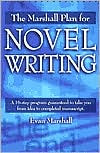
I love this type of editing and now that I've done so much of it I've gotten really good at. I see new ways to consolidate and clarify text that I never dreamed possible before, a higher-level of editing skill -- and I was always a good editor to begin with, a "natural" at it. To learn more about this, I strongly recommend Evan Marshall's book, THE MARSHALL PLAN. The book features concrete examples. Before reading it, I had already learned a lot from reading best-selling authors. I noticed how they had a common style in structural terms that kept their prose readable. THE MARSHALL PLAN helped me bring those impressions together and create a conscious awareness and clear perspective on editing for clarity as it relates to novel writing.
In the near future, I'll post two more entries on my blog about editing. They will focus on scene-level editing and text-level editing, providing examples.
Since story-level editing involves whole stories, and I don't want to give away too much about my plots, I won't post examples of story-level editing. However, basic story planning is what's behind this type of editing -- having a sense of how to outline a story. For more ideas on that, see THE GAY MAN'S GUIDE TO WRITING FANTASY FICTION.
Adrian
Friday, January 11, 2008
If You Can't Write, Edit!
I've been trying to get back into the JASPER novel to continue writing the first draft and finish it. Turns out that's not so easy. Not because I couldn't pick up any other novel right now, but that particular novel is tricky. I had a very particular mindset while writing it, drawing from a very particular sense of humor. Since I set it aside, I haven't been able to recapture that mindset yet to my satisfaction. I don't want to write on it until I know I'm back in the particular grove that this one story requires.
So, I've finally decided to push on and edit the JACK & JILL novel. I've worked my way through the first five chapters already, and was very happy to see that what I wrote, after it had sat for a while, seemed very readable, very tight overall, and actually pretty darned good, in my humble opinion. I was quite pleased with it. That's good, in that I should be happy with my work at this point, in general. If you can write and you've developed some skill at it, then what you write ought well to be readable and engaging, at least in general. It would be unusual if it weren't any good -- a sign that there are problems that need to be addressed! I think I'd address them to someone who cares, and put extra postage on them just to be sure they make it there. (haha)
Only one scene needed any rewriting, since I needed to change the tone of the interaction. Otherwise, the changes were mostly a word or two here or there, or tightening up a sentence, or joining two sentences together or breaking one sentence in two. The minor stuff that makes the text more readable, easier and faster to read.
I was impressed by the clarity of the text. The images and sense of what was happening in each scene was all very clear. There was a tight focus: each scene was about something specific, and ended with a clear sense of how it went, and where it needed to go. The chapter endings in particular were able to raise suspense, or create some impact that generated a sense of "I wonder what happens next". The shorter chapter lengths and goal-driven style really do pay off. There is a goal in each scene, a motivation, an obstacle (or two), and an outcome. Questions are raised, some answered right away, others left dangling there, raising the intrigue and suspense.
Okay, I love to gloat when I feel something I wrote worked well. It's a bad habit, potentially impolite, and certainly something that can define one as a "bore". But, there is a point here -- to become a writer, we must change our self-concept from "wannabe" to "I am a capable writer". Seeing that something you wrote works is part of that process, as much as seeing what doesn't work. I think we need to allow ourselves to see the growth, the progress, and feel good about it. It's not bragging, it's reaffirming for ourselves that what we are trying to do ... is something that we can do, and something we are in fact doing.
As for the editing, I anticipate the first half of the story will go along fairly smoothly, then the second half will turn into a real nightmare, since the later part of the story was less certain for me as I wrote it. I'll probably have to completely rewrite several chapters, maybe even the entire second half. However, that's only 35k words or so, and manageable. I was quite pleased to see that the basic outline held tight, and it's very easy for me to plug new ideas in for minor tweaking as needed, to enhance, draw out the significance of plot details, etc. I also figured out how to rewrite the ending. At this point I have no real questions left regarding this story, which is excellent. I should know it by now. I hate not knowing. Knowing is good.
Back to the bliss of editing,
Adrian
Sunday, January 06, 2008
2008: A Year of Writing Furiously
The glitter begins to settle, the throbbing in my ears dies down to a faint, rhythmic hum ... the frantic commotion of the past few weeks gives way to gentle calm. Reassuring signs that a return to normalcy might indeed be possible.
I have decided to call 2008 my Year of Writing Furiously, a year in which I'll strive to write as many stories as I can. There is a value in writing my way through complete stories. Each time I learn more about the various parts of the three-act plot template, I understand better how things are set up and then realized later, how things tie together, how one part of the story supports another. Each time through I get better at conceptualizing stories, keeping myself on track, moving with more confidence and a more finely-tuned story sense. Even if I end up with a number of first drafts and a backlog of editing to do, still I will have advanced my skills at storytelling, the foundation aspects, which I need to hone and strengthen. I also want to complete at least two stories, three if I can, so that I'll have something to start sending out this year.
I've begun to hear my many Muses again, calling out to me, their sweet melodies drifting across the primordial sea, the Urstoff out of which our universe and our reality were fashioned. Powerful voices, muted still by the techno beats I can't quite free myself from. When I achieve silence in my own mind, I'll be able to hear those voices clearly again.
For now, I seek oblivion. Being and not being. Thinking and not thinking. Feeling and not feeling. In that twilight, I can look up and see not the world as it is, but as it could be, as it once was, as I am sure it is elsewhere. I can see across the planes of existence and know there is more, and find a way to bring it into being within our own world. A way to draw the energy of pure creativity into physical form, a series of symbols on the page that spell out stories which I know must somewhere be true.
Best wishes to all aspiring writers in 2008,
Adrian
P.S. Hope you enjoy the new look for this blog. I have also done away with the ellipsis after the title ("Chronicling the Novel..." is now "Chronicling the Novel").
Monday, December 24, 2007
Happy Holidays!
Wishing all aspiring (and published!) writers a safe and happy holiday season!
Adrian
Wednesday, December 19, 2007
"Nuthin'", huh?
Go figure! Just when I ended my last post with the very optimistic comment that nothing would stop me now, what else happens but something that could stop me! Ugh. I should have known better than to jinx my writing progress!
I won't go into details because I'm such a private person, but something rather significant came up that most definitely did take all my time, energy and focus away from writing. I didn't write at all last week, and am now struggling to get back into it. C'est la vie! The distraction was certainly something important enough to cause such an upset to my routine. I'm not upset with myself for not writing -- it was entirely appropriate to set it aside under the circumstances -- but now it's time to get back to work. I can still finish JASPER within December if I get a move on.
Current status on JASPER, after cutting and editing again, and adding a little: around 28k, in Chapter 10. Goal: 60k to 65k.
Where's that RESET button?
Adrian
Wednesday, December 05, 2007
JACK & JILL: DONE @ 70k
I did finish the JACK & JILL story last night, coming in at just over 70k. I'm not sure on the ending. It was a surprise to me. There was another ending I had envisioned, and which I might want to write after all when I do the editing. This ending is intriguing, but I'm not sure about it. Can't say more, unfortunately.
Now, I'll go back to JASPER and start on that tonight, to finish it. Before I dive back into the writing, I want to rethink the story in basic outline terms, just to make sure I feel solid about going into the second half of ACT II, which is always the most difficult part to write. I know I had intended JASPER to be one I write off-the-cuff, in order to reconnect with unfettered creativity, but to put it bluntly I've found I do have access to my creativity even when working from an outline, and I feel a lot better having a sense of what I'm doing. It saves a lot of time and produces better results. I'll do what I did recently with basic outlining of the JACK & JILL story -- I actually used my own walk-thru from the GAY MAN'S GUIDE TO WRITING FANTASY FICTION and wrote my notes in a simple text editor. A couple of hours to work through it, think it through again, edit, change, improve, was well worth the time. I'll also take time to reread, since it's been a few weeks now when I took off from JASPER to do JACK & JILL for Nano.
I hope to finish JASPER in about two weeks, three at the most, definitely within December. Then I'll edit both JASPER and JACK & JILL. I'll make complete copies available to Beta Readers once I have edited them, for feedback to use in final editing and polishing. The Beta Reader versions would be available in January, 2008, both as encrypted eBooks and on my new password-protected blog.
Oh, and it's December. That's okay. I'm on a roll. Ain't nuthin' stoppin' me now!
Muahahaha.
Adrian
Subscribe to:
Posts (Atom)

 Posts
Posts